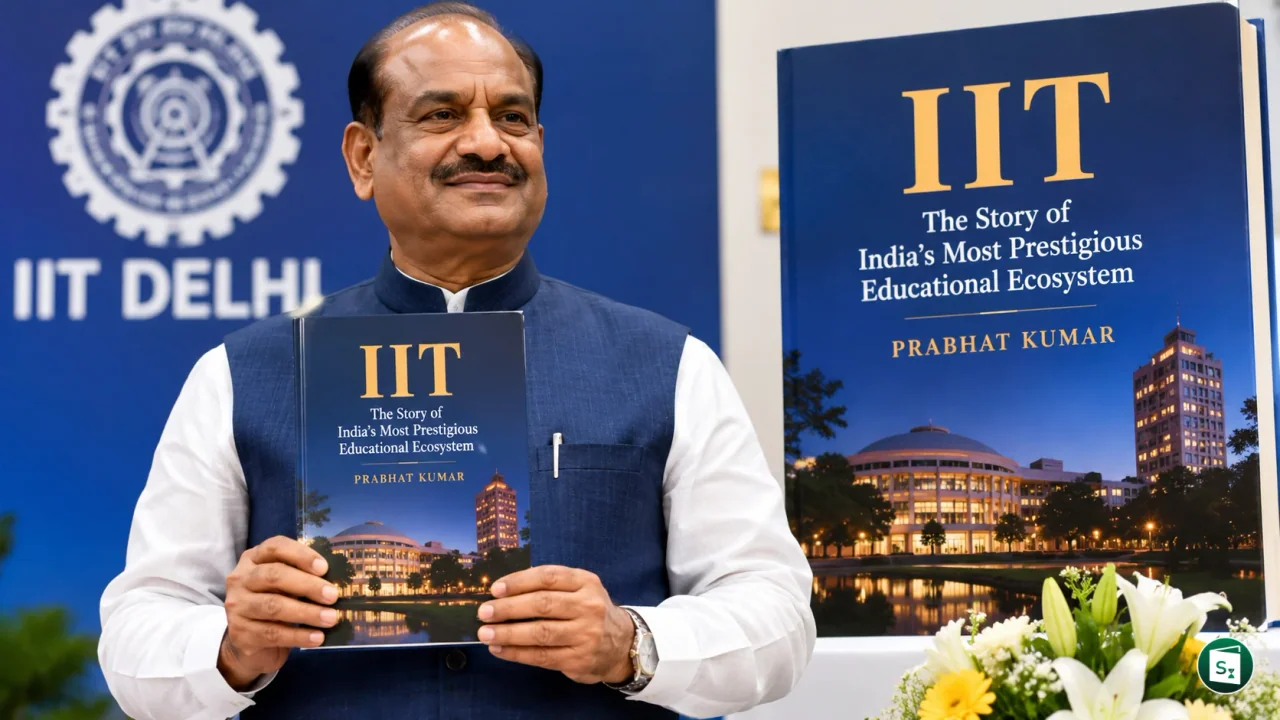
Lok Sabha Speaker Om Birla launched the book “IIT: The Story of India’s Most Prestigious Educational Ecosystem” at IIT Delhi on June 20, 2026. Authored by Prabhat Kumar, a 1994-batch Indian Revenue Service officer and Chairman of PanIIT Alumni India, the book is published by HarperCollins India. It traces the journey of the Indian Institutes of Technology from the founding of IIT Kharagpur on the site of a former British-era detention camp to their present status as a network of 23 institutions shaping India’s technological future.
About the Book and Its Author
Prabhat Kumar is a 1994-batch officer of the Indian Revenue Service (IRS) currently serving as Principal Commissioner in Mumbai. He is an alumnus of IIT Delhi (B.Tech, 1991 batch) and serves as the Chairman of PanIIT Alumni India, the umbrella alumni federation representing graduates from all 23 IIT campuses. He was elected to this position for the 2025-2027 term and has previously served as Global President of the IIT Delhi Alumni Association.
The book, published by HarperCollins India, examines the evolution of the IIT system from Jawaharlal Nehru’s vision of “temples of modern India” to their current role as centres of innovation, entrepreneurship and technological advancement. HarperCollins India is the Indian subsidiary of HarperCollins, one of the world’s largest English-language publishers, which traces its origins to a print shop founded in New York in 1817. The Indian arm began operations in 1992 and publishes about 250 new titles every year.
Drawing on historical records, institutional data and personal narratives, the book documents the transformation of the IIT system from a handful of elite institutions into a network of 23 campuses with a global alumni community of more than 500,000 members spread across technology, business, academia and public service.
The IIT Journey: From Hijli Detention Camp to 23 Campuses
The origins of the IIT system go back to 1946, when a 22-member committee headed by Nalini Ranjan Sarkar recommended the establishment of higher technical institutions in India along the lines of the Massachusetts Institute of Technology. The first IIT was founded in May 1950 at the site of the Hijli Detention Camp in Kharagpur, West Bengal. This camp was used by the British to imprison Indian freedom fighters, and the transformation of a detention camp into a temple of learning became a powerful symbol of India’s journey from colonial oppression to self-reliant nation-building. The institute was formally inaugurated on August 18, 1951 by Maulana Abul Kalam Azad, then Education Minister.
The Indian Institute of Technology (Kharagpur) Act, 1956 was passed by Parliament declaring it an Institute of National Importance. Following the Sarkar Committee’s recommendations, four more IITs were established in the following decade: IIT Bombay (1958), IIT Madras (1959), IIT Kanpur (1959) and IIT Delhi (1961). For decades, these five institutions remained the only IITs. A sixth campus, IIT Guwahati, was established in 1994 following the Assam Accord. The expansion accelerated significantly after 2008, when eight new IITs were created, followed by additional campuses in subsequent years.
Today, India has 23 IITs spread across the country, from IIT Jammu in the north to IIT Tirupati in the south, and from IIT Gandhinagar in the west to IIT Kharagpur in the east. Each IIT is recognised as an Institute of National Importance and operates as an autonomous public technical university. The IIT system admits students through the highly competitive Joint Entrance Examination (JEE) , which sees over a million candidates each year for roughly 16,000 undergraduate seats.
Key Themes of the Book
At its core, the book seeks to move beyond familiar narratives of entrance examination success, lucrative placements and global CEOs. It examines the broader social, economic and human dimensions of the IIT phenomenon, making it both a historical account and a social commentary.
The JEE System and the Coaching Industry
One of the significant areas the book explores is the evolution of the Joint Entrance Examination (JEE) , India’s most competitive engineering entrance test. The book traces the rise of the multi-billion-rupee coaching industry, with Kota in Rajasthan emerging as its epicentre. It documents the intense competition that has made IIT admission one of the most sought-after academic pursuits in the country, while also examining the pressures faced by students and their families and the mental health concerns arising from this high-stakes environment.
Several chapters focus on the lives of students and aspirants. The book argues that the story of IITs cannot be fully understood through rankings and salary packages alone. It must also account for the sacrifices made by families and the challenges faced by those striving to enter and succeed within the system.
From Brain Drain to Brain Circulation
The book revisits one of the longest-running debates around IITs: the question of brain drain. Tracing the migration of IIT graduates to the United States and other global technology hubs, it argues that the narrative has shifted significantly over time. What was once seen as a loss of talent has gradually transformed into “brain circulation” , with IIT alumni increasingly contributing to India’s growth through investments, mentorship, entrepreneurship and research collaborations.
The book examines how career choices among IIT graduates have evolved over the decades. Earlier generations played key roles in nation-building projects such as dams, steel plants and public-sector enterprises. Newer cohorts have gravitated towards technology, finance, consulting and startups, reflecting broader changes in India’s economic landscape.
IITs as Engines of Innovation
The later chapters of the book focus on the emergence of IITs as drivers of India’s innovation ecosystem. From startups and venture capital networks to developments in artificial intelligence, space technology and deep-tech research, the book highlights the growing role of IITs in shaping India’s technological future.
Looking ahead, the book envisions a larger role for IITs in supporting India’s aspiration of becoming a developed nation by 2047, the centenary of independence. It explores themes such as sovereign AI, global research collaborations, reverse brain drain and the expanding influence of IIT alumni in science, technology and public policy.
The Launch Event: Om Birla’s Address
Speaking at the launch event at IIT Delhi, Lok Sabha Speaker Om Birla described the IITs as a continuation of India’s rich knowledge heritage, carrying forward the legacy of ancient centres of learning such as Takshashila, Nalanda and Vikramshila into the age of science and technology. He said the story of the IITs reflects modern India’s self-confidence, intellectual strength and nation-building journey.
Birla highlighted the transformation of the Hijli Detention Camp into IIT Kharagpur as one of independent India’s most inspiring stories. He noted that the institution symbolises the nation’s transition from colonial oppression to self-reliance and innovation-driven development. Referring to examples from the book, he recalled the dedication of young engineers involved in landmark national projects such as the Bhakra Project, saying their commitment continues to inspire future generations.
The Speaker noted India’s shift from “brain drain” to “brain gain” , reflecting growing confidence and expanding opportunities within the country. He pointed to emerging sectors such as artificial intelligence, robotics, quantum technology, green energy and advanced manufacturing as areas where India is steadily strengthening its global presence.
Birla also used the occasion to launch the PanIIT Book Club, a new initiative by PanIIT Alumni India to promote reading and knowledge sharing among the IIT alumni community. He called upon IIT alumni to contribute more directly to public problem-solving and suggest reforms across sectors, stating that Parliament Standing Committees could benefit from their experience, especially on questions of reform, technology and public welfare.
Key Takeaways
- Lok Sabha Speaker Om Birla launched the book “IIT: The Story of India’s Most Prestigious Educational Ecosystem” at IIT Delhi on June 20, 2026.
- The book is authored by Prabhat Kumar, a 1994-batch IRS officer and Chairman of PanIIT Alumni India.
- It is published by HarperCollins India, which began its Indian operations in 1992.
- The first IIT was established in 1951 at the site of the Hijli Detention Camp in Kharagpur, West Bengal, and there are now 23 IITs across India.
- The IIT system has a global alumni community of more than 500,000 members.
- Om Birla described the transformation of the Hijli Detention Camp into IIT Kharagpur as one of independent India’s most inspiring stories and noted the shift from brain drain to brain gain.