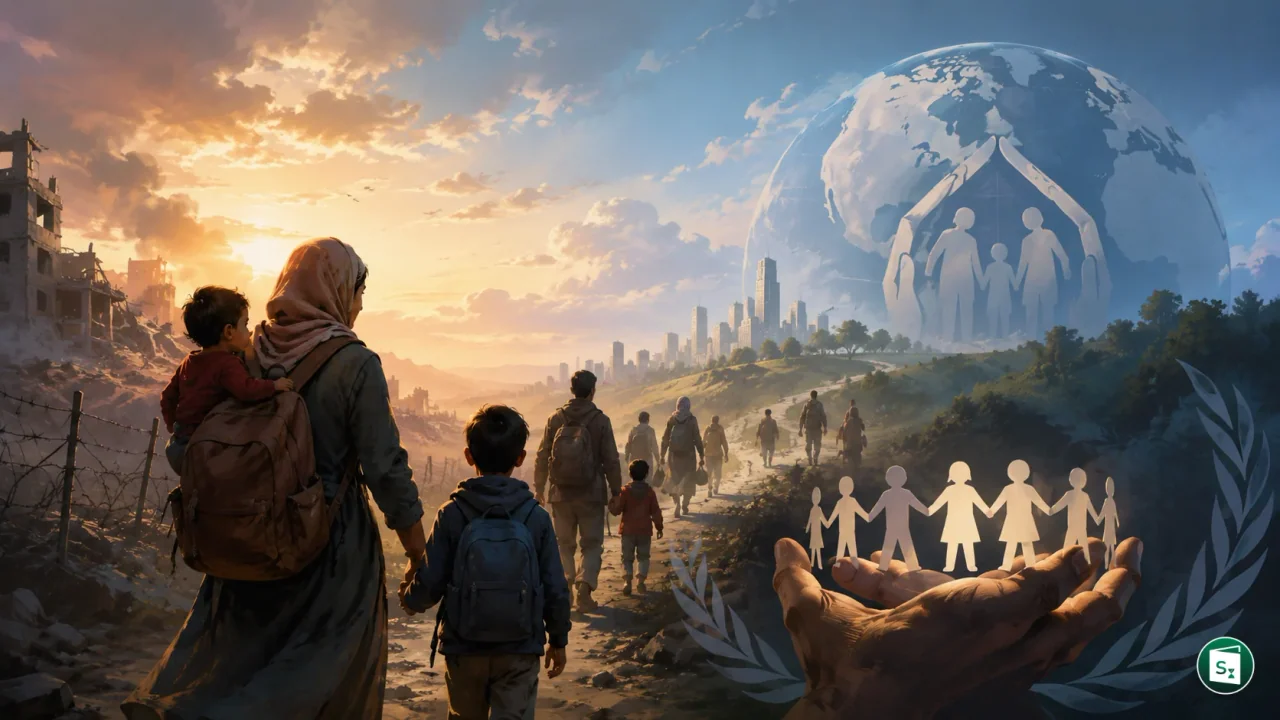
World Refugee Day was observed globally on 20 June 2026, with the United Nations High Commissioner for Refugees (UNHCR) leading commemorations under the theme “Until Everyone Is Safe”. The 2026 observance carried special significance as it marked 75 years since the adoption of the 1951 Refugee Convention, the landmark international treaty that defines who a refugee is and establishes their rights. With 117.8 million people forcibly displaced worldwide at the end of 2025 according to UNHCR’s Global Trends report, the day served as a powerful reminder that the promise of safety and protection made seven decades ago remains unfulfilled for millions.
What Is World Refugee Day?
World Refugee Day is an international observance designated by the United Nations General Assembly through Resolution 55/76 on 4 December 2000. The day was first observed globally on 20 June 2001 to commemorate the 50th anniversary of the 1951 Refugee Convention. Before this global designation, many African nations had been celebrating Africa Refugee Day on the same date, and the UN resolution built on that tradition with the agreement of the Organization of African Unity (OAU).
The day serves three broad purposes: to honour the strength, courage, and resilience of millions of people forced to flee their homes due to conflict, persecution, or violence; to draw global attention to the challenges refugees face; and to mobilise political will and resources so refugees can not only survive but also rebuild their lives with dignity. Each year, events are organised by UNHCR, governments, civil society groups, and communities in more than 100 countries around the world.
The 2026 Theme: “Until Everyone Is Safe”
The theme for 2026, “Until Everyone Is Safe”, carries a powerful message that safety is indivisible. No community is truly secure while people forced to flee are denied protection, dignity, and the chance to rebuild their lives. The theme was chosen to resonate with younger generations who are driven by a desire for social justice while also facing uncertainty and economic pressures. It frames asylum not as a distant, abstract issue but as a collective safety net that protects the most vulnerable today and could protect any of us tomorrow.
UNHCR High Commissioner Barham Salih, who assumed office on 1 January 2026 as the 12th person to hold the post, marked the day by visiting refugees in Ethiopia. In his official statement, Salih recalled his own experience as a refugee who fled repression in Iraq, saying: “Fleeing home to seek safety is one of the hardest choices anyone can make. But while a person may, for a time, be defined as a refugee, becoming a refugee should not define a person’s life.”
Observing Agencies
The day is observed by the World Health Organization (WHO) and the United Nations High Commissioner for Refugees (UNHCR) . UNHCR, formally known as the Office of the United Nations High Commissioner for Refugees, was established by the UN General Assembly on 14 December 1950 and is headquartered in Geneva, Switzerland. It operates in 122 countries with a staff of over 20,000 personnel, providing life-saving assistance including shelter, food, water, and medical care for people forced to flee conflict and persecution.
The 1951 Refugee Convention: The Foundation of Refugee Protection
The 1951 Refugee Convention, formally called the Convention Relating to the Status of Refugees, is the cornerstone of international refugee law. It was adopted by a United Nations Conference of Plenipotentiaries held in Geneva, Switzerland, from 2 to 25 July 1951 and was signed on 28 July 1951. The convention entered into force on 22 April 1954, and has since been ratified by 149 states.
Origins and Evolution
The convention was born from the devastation of the Second World War (1939 to 1945), which left millions of Europeans displaced. It built on earlier efforts that began under the League of Nations in 1921 to provide travel documents and protection for refugees. The 1951 Convention consolidated and expanded these earlier international instruments.
Initially, the convention applied only to persons displaced by “events occurring before 1 January 1951” and gave states the option to limit their obligations to “events occurring in Europe.” This meant it was essentially a Eurocentric document designed for the post-war context. However, the 1967 Protocol Relating to the Status of Refugees, adopted on 4 October 1967, removed both the geographic and temporal limitations, making the convention universal in its application.
Core Principles
The most critical principle of the 1951 Convention is non-refoulement, enshrined in Article 33. This principle asserts that a refugee should not be returned to a country where they face serious threats to their life or freedom. Non-refoulement is now considered a rule of customary international law, binding on all states regardless of whether they have ratified the convention.
The convention defines a refugee as someone who, owing to a well-founded fear of persecution based on race, religion, nationality, membership of a particular social group, or political opinion, is outside their country of nationality and is unable or unwilling to return. It outlines the basic minimum standards for the treatment of refugees, including the right to housing, work, education, access to courts, and freedom of movement. It also specifies categories of people who do not qualify for refugee status, such as those who have committed war crimes or serious non-political crimes.
UNHCR as Guardian
UNHCR serves as the guardian of the 1951 Convention and its 1967 Protocol. The agency helps governments translate these international instruments into national laws, monitors compliance, and ensures that the rights of refugees are respected and protected. The convention has also inspired important regional instruments, including the 1969 OAU Refugee Convention in Africa, the 1984 Cartagena Declaration in Latin America, and the development of a common asylum system in the European Union.
Key Concepts in Refugee Protection
Understanding the terminology used in the refugee protection framework is essential, as different legal categories carry different rights and obligations.
| Category | Definition |
|---|---|
| Refugee | A person who has fled their home country due to a well-founded fear of persecution based on race, religion, nationality, membership of a particular social group, or political opinion, as defined by the 1951 Convention |
| Asylum Seeker | A person who has applied for refugee status but whose claim has not yet been definitively evaluated |
| Internally Displaced Person (IDP) | A person who has been forced to flee their home but remains within their own country’s borders |
| Stateless Person | A person who is not considered a national by any state under the operation of its law, often denied access to basic rights such as education, healthcare, employment, and freedom of movement |
The principle of non-refoulement remains the bedrock of all refugee protection. It prohibits states from transferring or removing individuals from their jurisdiction when there are substantial grounds for believing the person would face irreparable harm upon return, including persecution, torture, or other serious human rights violations. Under international human rights law, this prohibition is absolute and applies to all persons regardless of their migration status.
Durable Solutions
UNHCR pursues three durable solutions for refugees:
Voluntary repatriation refers to the return of refugees to their country of origin when conditions allow them to do so safely and with dignity. This is considered the preferred solution. Local integration involves refugees settling permanently in their host country, gaining legal, economic, and social rights comparable to those of citizens. Resettlement involves the transfer of refugees from their host country to a third country that has agreed to admit them and grant them permanent residence.
Global Displacement Crisis: Key Statistics
The UNHCR Global Trends report for 2025, released on 11 June 2026, provides the most comprehensive picture of forced displacement worldwide. The data points to both the scale of the crisis and the disproportionate burden borne by low and middle income countries.
Key Figures at a Glance
| Indicator | Number |
|---|---|
| Total forcibly displaced people (end of 2025) | 117.8 million |
| Refugees (including UNRWA mandate) | 41.6 million |
| Refugees under UNHCR’s mandate | 28.5 million |
| People in refugee-like situations | 1.5 million |
| Other people in need of international protection | 7.2 million |
| Palestine refugees under UNRWA’s mandate | 6 million |
| Asylum seekers (pending cases) | 9 million |
| Internally Displaced Persons (IDPs) | 68.7 million |
| Stateless people | 4.5 million |
| People who fled across borders during 2025 | 5.4 million |
Key Trends
One in every 70 people on Earth, or 1.4 per cent of the world’s population, is now forcibly displaced. More than seven in ten refugees come from just six countries: Afghanistan, South Sudan, Sudan, Syria, Ukraine, and Venezuela. This concentration highlights the protracted nature of these conflicts, which leave millions with no realistic option to return home.
Low and middle income countries hosted 68 per cent of the world’s refugees, and 65 per cent of refugees lived in countries neighbouring their country of origin. Nearly 40 per cent of all refugees are children, with serious consequences for their education, well being, and future opportunities.
The global number of refugees fell by 3 per cent compared to the end of 2024, reflecting a sharp increase in returns, mostly to Afghanistan, Syria, and Sudan. However, many of these returns occurred under adverse conditions, and reintegration remains extremely challenging. Climate related disasters, particularly storms, are increasingly becoming a driver of new displacement, adding pressure to already vulnerable regions.
The Way Forward
World Refugee Day 2026 came at a time when the right to seek asylum is under growing pressure in many parts of the world. UN High Commissioner for Refugees Barham Salih used the occasion to call for a “paradigm shift” that moves beyond emergency responses and creates conditions that enable refugees to rebuild their lives in dignity and security.
The “Until Everyone Is Safe” campaign challenges stereotypes about refugees and emphasises that the right to seek safety is a lifeline that goes beyond merely escaping war or violence. It calls on governments to uphold fair and accessible asylum systems, donors to sustain life saving support, communities to welcome those forced to flee, and individuals to defend the principle that safety must never depend on nationality, wealth, race, religion, or migration status.
Key Takeaways
- World Refugee Day 2026 was observed on 20 June under the theme “Until Everyone Is Safe”, marking 75 years of the 1951 Refugee Convention.
- The 1951 Refugee Convention was adopted in Geneva on 28 July 1951 and entered into force on 22 April 1954. It is the cornerstone of international refugee law.
- UNHCR, the UN Refugee Agency, was established on 14 December 1950 with headquarters in Geneva, Switzerland. It operates in 122 countries and protects or assists 129.4 million people.
- The core principle of refugee protection is non-refoulement, which prohibits returning a refugee to a country where their life or freedom would be threatened. It is now a rule of customary international law.
- At the end of 2025, 117.8 million people were forcibly displaced worldwide, including 41.6 million refugees, 68.7 million IDPs, and 9 million asylum seekers.
- Low and middle income countries hosted 68 per cent of the world’s refugees, and nearly 40 per cent of all refugees are children.
- UNHCR’s three durable solutions are voluntary repatriation, local integration, and resettlement.
- India is not a signatory to the 1951 Refugee Convention or its 1967 Protocol, but hosts refugees under the Revised Bangkok Principles and through UNHCR’s mandate operations based in New Delhi and Chennai.