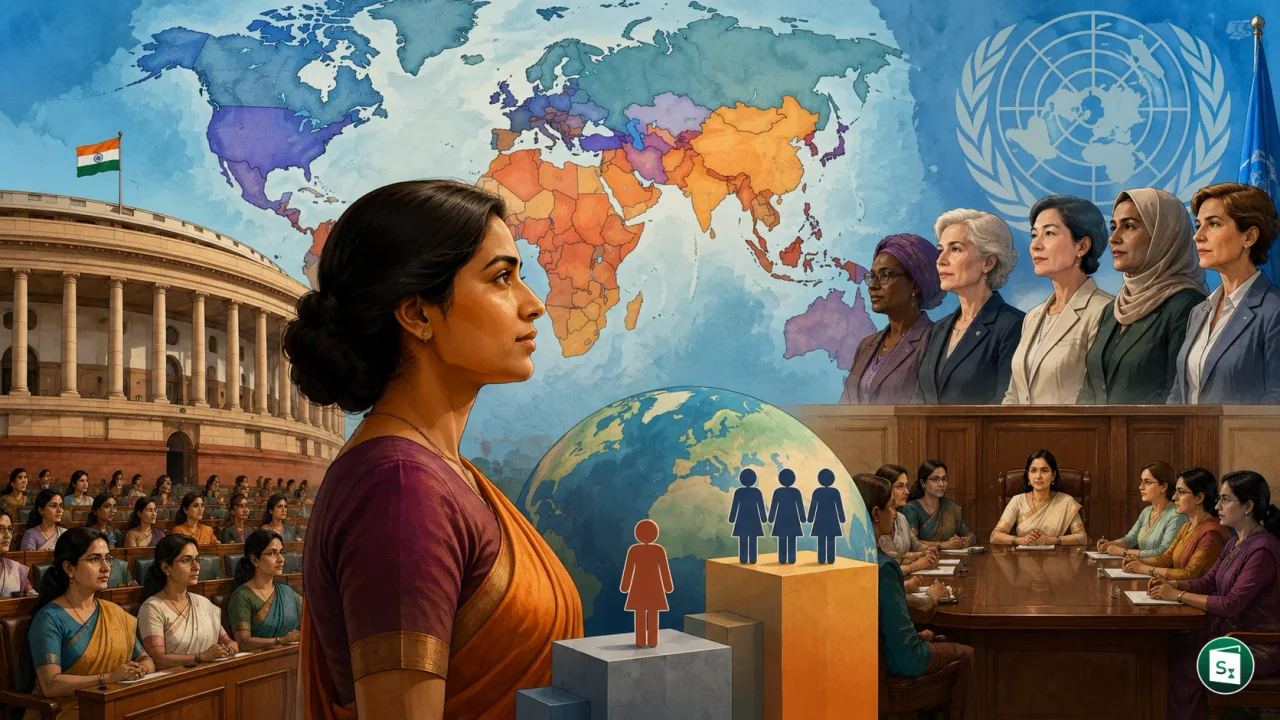
The Inter-Parliamentary Union (IPU) and UN Women released the 2026 Women in Politics map in March 2026, providing a comprehensive global ranking of women’s representation in parliaments and cabinets as of 1 January 2026. India has been placed at 151st out of nearly 190 countries in women’s parliamentary representation, with women holding just 13.8% of Lok Sabha seats. In cabinet representation, India fares even worse, ranking 173rd globally with women occupying only 5.6% of ministerial positions.
About the Women in Politics Map
The Women in Politics map is an annual publication produced jointly by the Inter-Parliamentary Union (IPU) and UN Women. It provides a snapshot of women’s representation in national parliaments and cabinets across the world as of 1 January each year. The IPU, founded in 1889 and headquartered in Geneva, Switzerland, is the oldest multilateral political organization and the global body of national parliaments with 183 member parliaments. UN Women, established in July 2010 and headquartered in New York, is the United Nations entity dedicated to gender equality and the empowerment of women.
The map ranks countries on two parameters: the percentage of women in the lower or single house of parliament, and the share of women among cabinet ministers who head ministries. It has been published regularly for over two decades and serves as a key benchmark for tracking global progress on gender parity in political leadership.
Key Global Findings from the 2026 Map
The 2026 edition reveals a mixed picture of stagnation and regression in women’s political leadership worldwide. Women hold only 27.5% of parliamentary seats globally, up marginally from 27.2% in 2025, marking the slowest growth since 2017 for the second consecutive year. At the cabinet level, women occupy just 22.4% of ministerial positions, down from 23.3% in 2024, a notable reversal after years of gradual progress.
Only 28 countries are led by a woman head of state or government, while 101 countries have never had a woman leader. The number of women speakers of parliament declined sharply to 54, representing 19.9% of all speakers, down from 23.7% a year earlier. This is the first drop in women speakers in 21 years. On a positive note, 14 countries have achieved gender parity in their cabinets, showing that equal representation is possible. However, eight countries still have no women ministers at all.
The map also reveals a gendered distribution of portfolios. Women are most often assigned ministries related to human rights, gender equality, and social protection, while men dominate defence, home affairs, finance, and foreign affairs.
India’s Performance: A Detailed Look
India’s ranking of 151st in parliamentary representation places it among the bottom quartile of nations globally. Women hold 13.8% of the seats in the Lok Sabha, the lower house of Parliament. This figure is well below the global average of 27.5% and far behind regional leaders such as Rwanda (63.8%), Cuba, and Nicaragua. Even within South Asia, India trails countries like Nepal and Bangladesh.
In cabinet representation, India’s position is even more concerning. With women occupying just 5.6% of cabinet minister positions, India ranks 173rd globally. This places the country in the category of nations with less than 10% women ministers, alongside Iran, Syria, and Nigeria. As of January 2026, India’s cabinet had only a handful of women ministers, with key portfolios such as defence, home, finance, and external affairs held by men.
India’s performance is particularly striking given that women make up nearly 48% of the country’s population. The gap between women’s demographic presence and their political representation remains one of the widest in the world. The 18th Lok Sabha, elected in 2024, has around 77 women MPs, representing about 14% of the total strength, a slight decline from 78 in the 17th Lok Sabha.
India’s Efforts to Address the Gender Gap
The Nari Shakti Vandan Adhiniyam
In September 2023, Parliament passed the Constitution (106th Amendment) Act, 2023, known as the Nari Shakti Vandan Adhiniyam or the Women’s Reservation Bill. This landmark legislation reserves one-third of all seats in the Lok Sabha and state legislative assemblies for women. The bill was passed unanimously by both Houses and signed into law by the President of India.
The reservation will come into effect after the completion of the ongoing delimitation exercise, which is based on the first census conducted after 2026. The quota will remain in force for 15 years and will be rotated after each delimitation. However, the reservation does not apply to the Rajya Sabha or state legislative councils.
The Nari Shakti Vandan Adhiniyam represents the culmination of a demand that had been pending for nearly three decades. Previous attempts to pass similar legislation were made in 1996, 1998, 1999, and 2008. The Rajya Sabha had passed a version of the bill in 2010, but it lapsed with the dissolution of the 15th Lok Sabha in 2014.
Reservation in Local Bodies
India has had more success at the grassroots level. The 73rd and 74th Constitutional Amendments of 1992 mandated reservation of one-third of seats for women in panchayats and urban local bodies. Several states have since increased this quota to 50%. As a result, India now has more than 1.4 million elected women representatives at the local level, one of the highest numbers in the world. This experience at the grassroots is expected to build a pipeline of women leaders for higher offices.
The Way Forward
The 2026 Women in Politics map shows that despite constitutional commitments and legislative efforts, India remains far from achieving gender parity in political representation. The implementation of the Nari Shakti Vandan Adhiniyam after the upcoming delimitation exercise could significantly improve India’s standing in future editions of the map. However, legal quotas alone are not sufficient.
Experts point to the need for political parties to field more women candidates in winnable seats, strengthen inner-party democracy, and address structural barriers such as lack of financial resources and safety concerns that deter women from entering electoral politics. Countries that have successfully improved women’s representation have combined quotas with proportional representation electoral systems and measures to combat violence and harassment in politics.
The gap between India’s strong grassroots representation of women in panchayats and their poor presence in Parliament and state assemblies needs to be bridged. For India to climb the global rankings, a sustained, multi-pronged approach involving legal reform, political will, and social change will be essential.
Key Takeaways
- The 2026 Women in Politics map is published jointly by the Inter-Parliamentary Union (IPU) and UN Women, providing data as of 1 January 2026.
- India ranks 151st globally in women’s parliamentary representation with 13.8% of Lok Sabha seats held by women.
- India ranks 173rd globally in women’s cabinet representation with only 5.6% of cabinet minister positions held by women.
- Globally, women hold 27.5% of parliamentary seats and 22.4% of cabinet positions, with the latter reflecting a regression from 23.3% in 2024.
- The IPU, founded in 1889, is headquartered in Geneva, Switzerland, and has 183 member parliaments.
- UN Women was established in July 2010 and is headquartered in New York, USA.
- The Nari Shakti Vandan Adhiniyam (Constitution 106th Amendment Act, 2023) reserves one-third of Lok Sabha and state assembly seats for women, but implementation awaits delimitation.
- The 73rd and 74th Amendments (1992) reserved one-third of seats for women in panchayats and urban local bodies, with over 1.4 million elected women representatives at grassroots level.