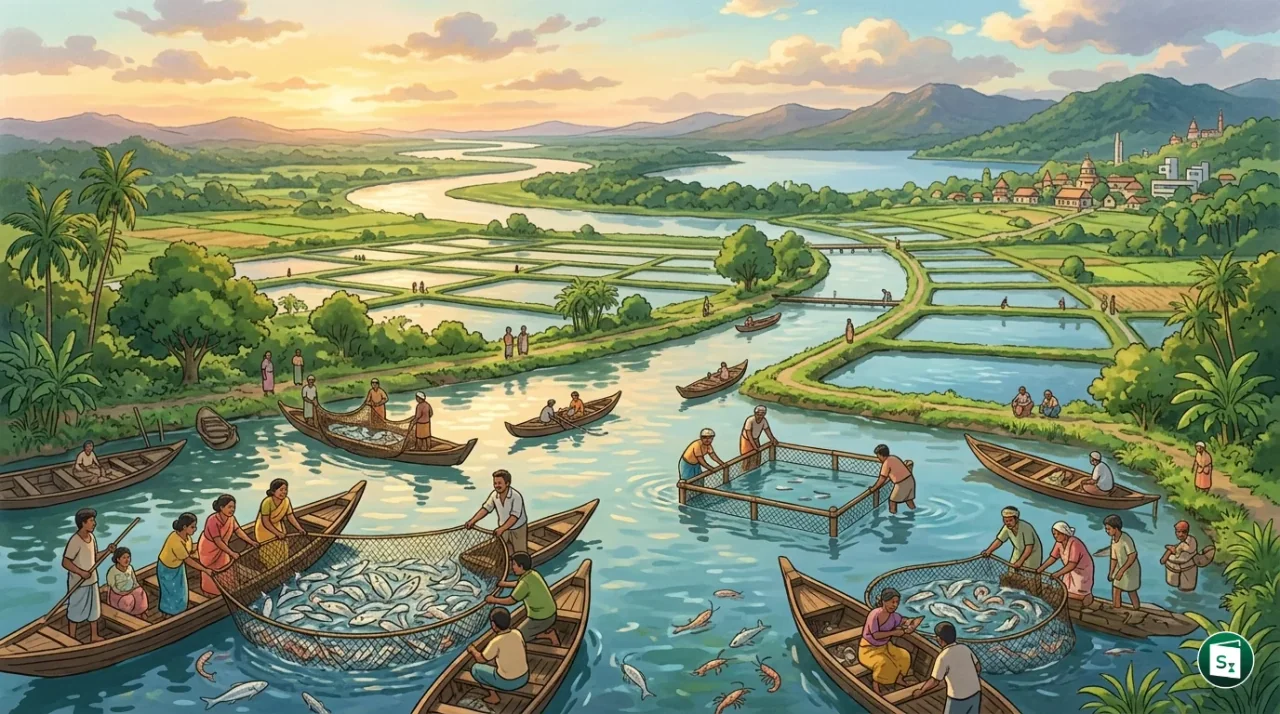
India produced 9% of the world’s aquatic animals in 2024, making it the second-largest producer globally after China, according to the State of World Fisheries and Aquaculture (SOFIA) 2026 report released by the Food and Agriculture Organization (FAO). The country also ranked first in the world in inland water catches, harvesting 2.2 million tonnes from rivers, lakes, and freshwater systems. These findings place India firmly among the world’s leading fisheries and aquaculture powers, reflecting decades of policy support and sectoral growth.
About the SOFIA Report
The State of World Fisheries and Aquaculture (SOFIA) is the flagship biennial publication of the Food and Agriculture Organization (FAO) of the United Nations. First published in 1995, it is widely regarded as the most authoritative global assessment of the fisheries and aquaculture sector, covering production trends, trade, consumption, sustainability, and policy frameworks.
FAO, established in 1945 and headquartered in Rome, Italy, is a specialized UN agency with a mandate to defeat hunger, improve nutrition, and ensure food security. It has 194 member nations and operates in over 130 countries.
The SOFIA 2026 edition was released on 16 June 2026 at the 11th Our Ocean Conference in Mombasa, Kenya. Its theme, “Blue Transformation: Turning Vision into Impact”, highlights how FAO is working with member countries to translate sustainable aquaculture and fisheries management goals into measurable outcomes on the ground. The report is organized into three parts: a global review of production and trade data, transformational actions being undertaken by stakeholders, and an outlook on future trends up to 2034.
India’s Global Standing in Fisheries and Aquaculture
India’s performance across multiple metrics in the SOFIA 2026 report underscores its emergence as a global fisheries powerhouse. The country contributed 9% of the world’s aquatic animal output in 2024, placing it second only to China. In aquaculture specifically, India ranked second globally, accounting for 12% of total farmed aquatic animal production.
India is part of an elite group of five countries, along with China, Indonesia, Vietnam, and Bangladesh, that together produce 82% of the world’s farmed aquatic animals and 84% of total global aquaculture output. This concentration highlights Asia’s dominance in the sector, driven by favourable climatic conditions, abundant water resources, and sustained policy support.
India’s total fish production has more than doubled over the past decade, rising from 9.6 million tonnes in 2013-14 to an estimated 19.8 million tonnes in 2024-25, marking a growth of over 106%. The fisheries sector contributed approximately 1.12% to India’s national Gross Value Added (GVA) and about 7.3% to the agricultural GVA in 2022-23. It supports the livelihoods of over 28 million people, including fishers, fish farmers, and those engaged in allied activities such as processing and marketing.
India’s Dominance in Inland Capture Fisheries
The standout finding of the SOFIA 2026 report is India’s top ranking in inland capture fisheries. India harvested 2.2 million tonnes of fish from rivers, lakes, reservoirs, and freshwater systems in 2024, well ahead of Bangladesh in second place at 1.4 million tonnes. Inland capture fisheries refer to fish caught directly from natural freshwater bodies rather than raised through aquaculture.
India’s vast and productive river systems, particularly the Ganga-Brahmaputra basin and the peninsular rivers such as the Godavari, Krishna, and Mahanadi, provide the foundation for this achievement. The country also possesses one of the world’s largest reservoir networks, covering over 3 million hectares, which offers immense potential for further fisheries development. Floodplain wetlands and upland lakes add to this rich resource base.
Inland fisheries account for nearly 75% of India’s total fish production, with the remaining quarter coming from marine sources. The leading inland fish-producing states are Andhra Pradesh, West Bengal, Uttar Pradesh, Bihar, and Odisha. Key freshwater species include Rohu and Katla, both major carps that form the backbone of India’s freshwater fisheries.
Global Trends: Aquaculture Drives Record Production
The SOFIA 2026 report paints a picture of a global fisheries sector at a historic inflection point. World fisheries and aquaculture production reached a record 235 million tonnes in 2024, comprising 195 million tonnes of aquatic animals and 40 million tonnes of algae. This represented an increase of 5.2% compared to 2022.
The most significant structural shift highlighted in the report is that aquaculture has, for the first time, surpassed capture fisheries as the dominant source of aquatic animal food. Aquaculture production of aquatic animals reached 103 million tonnes in 2024, crossing the 100-million-tonne mark for the first time. It now provides 53% of total aquatic animal production and over 59% of aquatic animal food meant for direct human consumption. Including algae, total aquaculture output stood at 141 million tonnes, valued at $391 billion.
Capture fisheries, by contrast, have plateaued at about 92 million tonnes, remaining within the 86-to-94-million-tonne range since the late 1980s. Of this, 80 million tonnes came from marine fisheries. However, inland capture fisheries globally reached a record 12.3 million tonnes, with India leading that category.
Global trade in aquatic animal products reached $184 billion, now rivaling the terrestrial meat trade in value. Over one-third of all aquatic production is traded internationally. Global per capita availability of aquatic animal food averaged 21.3 kg in 2024, with wide regional variations: Asia recorded 26.3 kg per person while Africa lagged at just 9.1 kg.
| Metric | Value (2024) |
|---|---|
| Total global production | 235 million tonnes |
| Aquatic animals | 195 million tonnes |
| Algae | 40 million tonnes |
| Aquaculture (aquatic animals) | 103 million tonnes (first time above 100 MT) |
| Capture fisheries | 92 million tonnes |
| Aquaculture share of aquatic animal production | 53% |
| Global trade value | $184 billion |
| Per capita aquatic food availability | 21.3 kg |
| People employed in sector | Over 600 million livelihoods |
The report projects that total aquatic animal production will reach 214 million tonnes by 2034, though the annual growth rate is expected to slow compared to the previous decade, reflecting biological limits in capture fisheries and environmental constraints on aquaculture expansion.
India’s Policy Push: PMMSY and the Blue Revolution
India’s rise in global fisheries rankings is underpinned by strong and sustained policy intervention. The flagship scheme driving this transformation is the Pradhan Mantri Matsya Sampada Yojana (PMMSY), approved by the Union Cabinet on 20 May 2020 and formally launched on 10 September 2020. Implemented by the Department of Fisheries under the Ministry of Fisheries, Animal Husbandry and Dairying, with the National Fisheries Development Board (NFDB) as the nodal agency, PMMSY was conceived with a total investment of ₹20,050 crore over five years from 2020-21 to 2024-25.
The scheme aims to address critical gaps across the fisheries value chain, including production, productivity, quality, technology infusion, post-harvest infrastructure, and fishers’ welfare. Its key objectives include doubling fishers’ incomes, generating 15 lakh direct jobs, boosting seafood exports, and enhancing fish production to 22 million tonnes by 2024-25.
PMMSY succeeded the earlier Blue Revolution scheme, which ran from 2015-16 with a central outlay of ₹3,000 crore and laid the groundwork for sectoral modernisation. A sub-scheme, the Pradhan Mantri Matsya Kisan Samridhi Sah-Yojana (PM-MKSSY), was launched in 2024 with an outlay of ₹6,000 crore to formalise the fisheries sector and support micro and small enterprises.
The results of these interventions are visible in India’s export performance. Seafood exports reached ₹62,408 crore in FY 2024-25, with frozen shrimp as the leading export commodity and the United States and China as the top markets. The government has also promoted advanced aquaculture technologies such as Recirculatory Aquaculture Systems (RAS), Bio-floc technology, and cage culture to boost productivity. These efforts are part of India’s broader Blue Economy vision, which recognises the oceans and inland waters as drivers of economic growth, food security, and employment.
Challenges and the Road Ahead
Despite the record production numbers, the SOFIA 2026 report flags serious concerns about the sustainability of global fisheries. The share of fish stocks classified as biologically sustainable declined to 62.4% in 2023, down from 64.5% in the previous report. By catch volume, 72.6% of landings still came from sustainable stocks, indicating that larger and better-managed fisheries tend to perform well while smaller stocks remain vulnerable.
Climate change poses a growing threat. Under high emissions scenarios, exploitable fish biomass is projected to decline by more than 10% by 2050 in several regions. Rising ocean temperatures, acidification, and changing weather patterns are already affecting fish distribution and productivity.
Regional inequalities remain stark. While Asia enjoys 26.3 kg of aquatic animal food per person annually, Africa’s availability stands at just 9.1 kg, highlighting the need for targeted policies to improve access in underserved regions.
FAO’s Blue Transformation Roadmap 2022-2030 provides the global framework to address these challenges. It promotes science-based governance, spatial planning, climate-smart aquaculture, and stronger fisheries management through regional fishery bodies. The roadmap also emphasises combating illegal, unreported, and unregulated fishing and implementing the Voluntary Guidelines for Securing Sustainable Small-Scale Fisheries.
For India, sustaining its leadership position will require balancing production growth with ecological responsibility. Priorities include strengthening fisheries data collection, expanding sustainable aquaculture technologies, protecting riverine ecosystems from pollution and habitat degradation, and building climate resilience into fisheries management. Continued investment in infrastructure, cold chains, and value addition will also be essential to maintain export competitiveness.
Key Takeaways
- India ranked second globally in aquatic animal production in 2024, contributing 9% of world output, as per the FAO SOFIA 2026 report.
- India ranked first in the world in inland capture fisheries, producing 2.2 million tonnes from rivers, lakes, and freshwater systems.
- India is the second-largest aquaculture producer globally, accounting for 12% of total farmed aquatic animal output.
- Global fisheries and aquaculture production hit a record 235 million tonnes in 2024, with aquaculture crossing 100 million tonnes for the first time.
- Aquaculture now provides 53% of total aquatic animal production, marking a structural shift from capture-dominated to farmed-dominated supply.
- The Pradhan Mantri Matsya Sampada Yojana (PMMSY), launched in 2020 with an outlay of ₹20,050 crore, has been the key policy driver behind India’s fisheries growth.
- The share of biologically sustainable fish stocks declined to 62.4% in 2023, underscoring the need for stronger fisheries management globally.