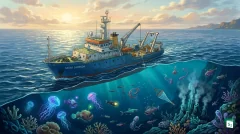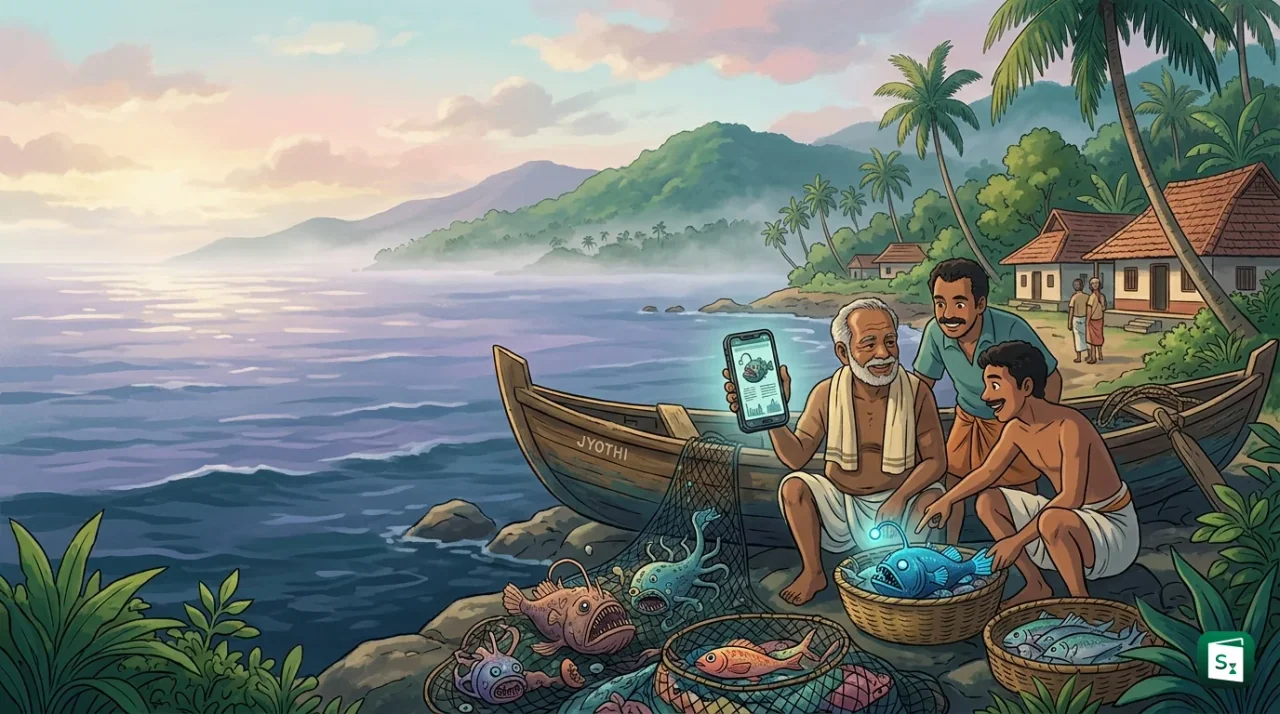
The ICAR-Central Marine Fisheries Research Institute (ICAR-CMFRI) has launched a mobile application called DeepDATA in Kochi, Kerala, to digitally document India’s deep-sea fish species. The app was developed under the Deep Ocean Mission of the Ministry of Earth Sciences (MoES) and provides scientifically verified information on deep-sea fish biodiversity. It is currently available on the Google Play Store for anyone to use.
What Is DeepDATA?
DeepDATA stands for Deepsea Digitally Automated Taxonomy Assistant. It is an Android application designed as both a learning platform and a documentation tool for students, researchers, fishermen, and marine enthusiasts.
The app contains detailed species-level information on deep-sea fish, including their taxonomy, distinguishing characteristics, distribution, and conservation status. Users can browse photographs of deep-sea fish species and access curated scientific data about each one. The app is meant to serve as a digital reference for anyone interested in exploring India’s largely unexplored deep-sea biodiversity.
Beyond being a reference tool, DeepDATA allows users to upload their own photographs and observations of deep-sea fishes encountered during fishing trips, research cruises, or coastal visits. Every submission goes through a verification process where CMFRI experts scrutinize and authenticate each record before it is added to the national database. This ensures that the repository maintains scientific accuracy and reliability.
Who Developed the App?
The app was developed by the IT unit of CMFRI, led by Dr Eldho Varghese, who is in charge of the institute’s IT division. The project is led by Dr Rekha J Nair, Principal Scientist at CMFRI. The institute’s Director, Dr Grinson George, has highlighted the role that fishermen can play in enriching the database, since they regularly encounter species from offshore and deep-sea fishing grounds.
ICAR-CMFRI and Its Role in Marine Research
The ICAR-Central Marine Fisheries Research Institute (CMFRI) was established on 3 February 1947 under the Ministry of Agriculture and Farmers Welfare. In 1967, it became part of the Indian Council of Agricultural Research (ICAR) family. The institute’s headquarters is located in Kochi, Kerala, and it has four regional centres at Mandapam, Visakhapatnam, Mangalore, and Vizhinjam, along with several research stations across India’s coastline.
CMFRI is one of the world’s leading tropical marine fisheries research institutes. Its mandate includes monitoring and assessing the marine fisheries resources of India’s Exclusive Economic Zone (EEZ), conducting basic and strategic research in mariculture, and acting as a repository of geo-spatial information on marine fishery resources and habitats.
The institute has been responsible for estimating India’s annual marine fish landings, maintaining the National Marine Fisheries Data Centre (NMFDC) with over 9 million catch and effort data records covering more than 1,000 fished species. CMFRI has also described 255 marine species new to science and contributed to the development of the National Policy on Marine Fisheries (NPMF) 2017.
Deep Ocean Mission: The Bigger Picture
DeepDATA was developed under the Deep Ocean Mission (DOM), a flagship initiative of the Ministry of Earth Sciences launched in 2021. The mission was approved with a budget of ₹4,077 crore for a five-year period, with the first phase (2021-2024) allocated ₹2,823.4 crore. It is one of the nine key initiatives identified by the Prime Minister’s Science, Technology, and Innovation Advisory Council (PMSTIAC).
Six Components of the Deep Ocean Mission
| Component | Focus Area |
|---|---|
| Deep-sea mining technologies | Development of a manned submersible (Matsya 6000) and an integrated mining system to extract polymetallic nodules from the Central Indian Ocean |
| Ocean climate change advisory | Establishment of observational networks and climate models for oceanic change projections |
| Deep-sea biodiversity exploration | Inventorization, archival of specimens, and DNA banking of deep-sea fauna |
| Deep-ocean survey and exploration | Identifying potential sites for multi-metal hydrothermal sulphide mineralization along mid-oceanic ridges |
| Ocean energy and freshwater | Developing systems to extract renewable energy and freshwater from the ocean |
| Advanced Marine Station for Ocean Biology | Promoting research in marine biology and biotechnology |
DeepDATA directly supports the third component: exploration and conservation of deep-sea biodiversity. By creating a digital repository of species observations with expert verification, the app contributes to inventorizing India’s deep-sea fauna and establishing a baseline for future research.
India’s Strategic Position in Deep-Sea Exploration
India holds a 75,000 sq km area in the Central Indian Ocean Basin, allocated by the International Seabed Authority (ISA), for exploring polymetallic nodules. These nodules contain valuable metals such as manganese, nickel, cobalt, and copper used in electronics and batteries. In 2025, India secured another contract from ISA to explore the Carlsberg Ridge, becoming the first nation to hold two simultaneous contracts for deep-sea exploration.
The Matsya 6000 submersible, being developed by the National Institute of Ocean Technology (NIOT) under DOM, is designed to carry three people to a depth of 6,000 metres. With this capability, India is set to join an elite group of nations including the US, Russia, China, France, and Japan that can conduct crewed deep-sea missions.
Citizen Science and Expert Verification
A notable feature of DeepDATA is its citizen science approach. The app allows ordinary users such as fishermen, students, researchers, and coastal visitors to contribute field observations and photographs of deep-sea fishes. This model of public participation in scientific data collection has been increasingly used in biodiversity surveys, species mapping, and environmental monitoring worldwide.
The key strength of this approach is the scale it enables. India has a coastline of over 7,500 km with thousands of fish landing centres. Scientists alone cannot cover every location. Fishermen who venture into offshore and deep-sea fishing grounds on a daily basis can provide valuable data on species distribution, the appearance of rare or lesser-known fishes, and changes in occurrence patterns over time.
However, DeepDATA ensures data quality through a multi-step verification process. Every photograph and observation uploaded to the platform is reviewed by CMFRI scientists before being added to the national database. This expert validation ensures that the repository remains scientifically accurate and reliable for research, conservation planning, and policy development.
Analogy · Digital Species Catalog Expand analogy
DeepDATA works like a Wikipedia for deep-sea fish, but with a crucial difference. Anyone can submit an entry, but unlike Wikipedia where anyone can also edit, only CMFRI scientists can approve what goes into the database. This ensures the information meets scientific standards and can be trusted for research and policymaking.
Key Takeaways
- DeepDATA stands for Deepsea Digitally Automated Taxonomy Assistant, an Android app for documenting deep-sea fish species.
- It was launched by ICAR-CMFRI in Kochi, Kerala, and is available on the Google Play Store.
- The app was developed under the Deep Ocean Mission of the Ministry of Earth Sciences (MoES), a flagship initiative launched in 2021 with a budget of ₹4,077 crore.
- ICAR-CMFRI was established on 3 February 1947 and its headquarters is in Kochi, Kerala. It joined the ICAR family in 1967.
- The app combines citizen science with expert verification, where CMFRI scientists validate every user submission before it enters the national database.
- The Deep Ocean Mission includes six components, with DeepDATA supporting the deep-sea biodiversity exploration and conservation pillar.