Welcome to Scoreclever ⏳ Current Affairs 🌏

  • 👉 Detailed daily current affairs on website
  • 👉 Crisp current affairs on daily PDFs
  • 👉 Easy memorization and revision with app

National Broadcasting Day: The Journey of All India Radio from 1927 to Today

SUMMARY

National Broadcasting Day is observed on July 23 to commemorate the first radio broadcast in India by the Indian Broadcasting Company in 1927. This article traces the evolution from IBC to All India Radio, the adoption of the name Akashvani, and the creation of Prasar Bharati.

Exam Oriented Concise Information

Important Banking

National Broadcasting Day

Day – July 23

Commemorating – The establishment of the private radio station 'Indian Broadcasting Company' (IBC) (now All India Radio) in Mumbai in 1927

This information is solely enough for Banking and SSC exam preparation. It is 5 times concise compared to other top current affairs sources that offers elaborative content, but outperforms them. The comprehensive details below are just for additional reference, context, and UPSC preparation. Visit the performance page to know more about our content performance on recent exams.

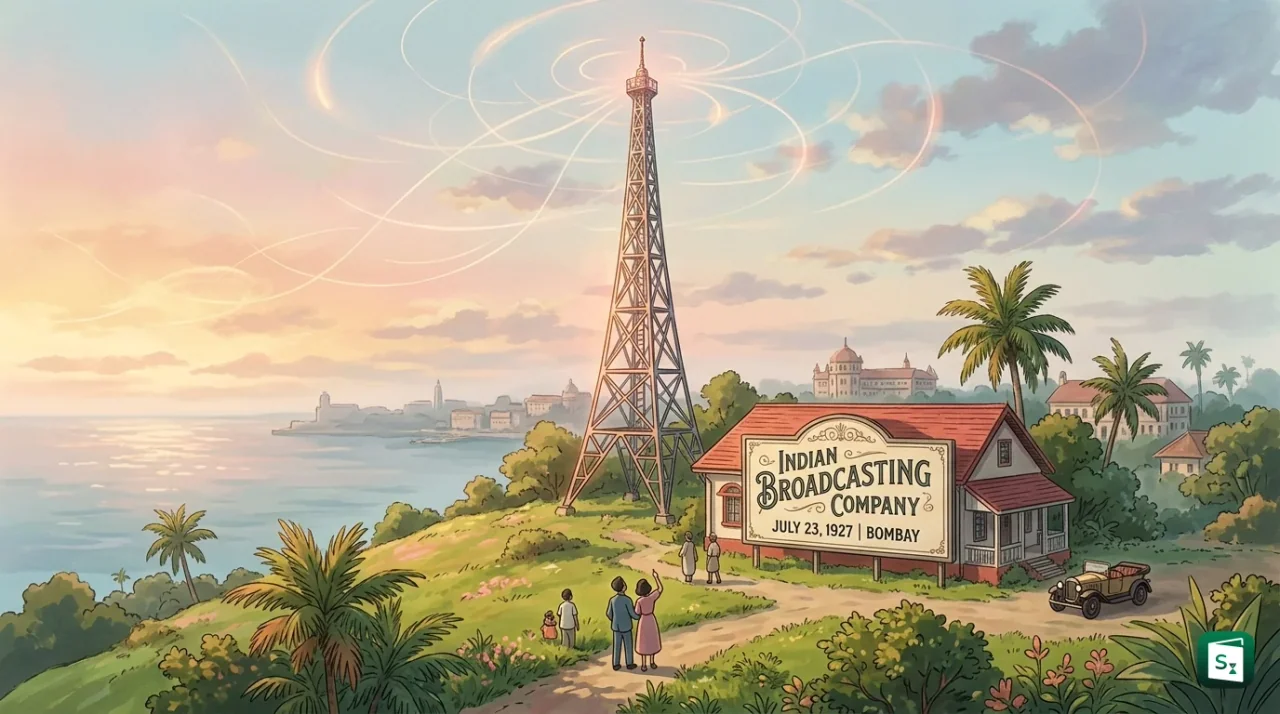
India observes National Broadcasting Day on July 23 every year to mark the first organised radio broadcast in the country. On this day in 1927, the Indian Broadcasting Company (IBC), a private venture, went on air from Bombay (now Mumbai) for the first time. That single broadcast planted the seed for what would grow into All India Radio (AIR), one of the largest broadcasting networks in the world.

From Radio Clubs to the Indian Broadcasting Company

Organised radio broadcasting in India began well before the IBC was formed. In June 1923, the Radio Club of Bombay made the first ever broadcast in the country. Later that year, the Calcutta Radio Club followed, and in July 1924, the Madras Presidency Radio Club started its own broadcast service. These clubs were run by enthusiastic amateurs using low-power transmitters.

The success of these clubs encouraged the formation of a commercial entity. On July 23, 1927, the Indian Broadcasting Company (IBC) was incorporated as a private company in Bombay. It began regular transmissions from its Bombay station and soon set up a second station in Calcutta. However, the IBC struggled financially. Falling advertising revenue and high operating costs meant the company could not sustain itself. In March 1930, the IBC went into liquidation, barely three years after its launch.

The British government stepped in to fill the gap. In April 1930, the Indian State Broadcasting Service (ISBS) was established under the Department of Industries and Labour on an experimental basis.

The Birth of All India Radio and Early Milestones

In August 1935, Lionel Fielden, a senior producer from the BBC, was appointed the first Controller of Broadcasting in India. A month later, Akashvani Mysore, a private radio station set up by the Maharaja of Mysore, began broadcasting. On June 8, 1936, the Indian State Broadcasting Service was renamed All India Radio, and AIR aired its first official broadcast on January 19, 1936.

AIR’s signature tune, a melody familiar to generations of Indians, was composed in 1936 by Walter Kaufmann, a Jewish refugee from Czechoslovakia who served as AIR’s director of music. The tune is based on Raga Shivaranjani and was played on the violin by Mehli Mehta, the father of the celebrated conductor Zubin Mehta.

In August 1937, AIR established the Central News Organisation (CNO), which later split into the News Services Division and the External Services Division. AIR came under the Department of Communications in 1937 and moved to the Department of Information and Broadcasting in 1941.

At the time of India’s independence in 1947, AIR had just six radio stations: Delhi, Bombay, Calcutta, Madras, Tiruchirapalli, and Lucknow. The other three stations at Peshawar, Lahore, and Dacca went to Pakistan after Partition. AIR’s coverage then was a mere 2.5 percent of India’s area and only 11 percent of its population.

Akashvani: The Voice from the Sky

AIR formally adopted the name Akashvani in 1956. The word, which means “voice from the sky” or “celestial announcement” in Sanskrit, was taken from a poem written by Rabindranath Tagore in 1938 for the inauguration of AIR’s shortwave service in Calcutta. The poet Narendra Sharma reportedly suggested the name for official use.

In 1952, AIR broadcast its first National Programme of Music, and a year later, the National Programme of Talks in English began. The annual Radio Sangeet Sammelan, a flagship event promoting Indian classical music, was first held in 1954 under the leadership of Information and Broadcasting Minister B. V. Keskar.

A defining moment came in 1957. AIR had lost many listeners to Radio Ceylon, which broadcast popular Hindi film music that AIR had stopped playing. To win back its audience, AIR launched the Vividh Bharati Service on October 3, 1957, with popular film music as its main offering. The service became an instant hit and remains one of AIR’s most beloved channels.

Prasar Bharati and the Autonomy Question

For decades, AIR and its television counterpart Doordarshan (which began as an experimental AIR transmission in 1959 and was separated in 1976) operated directly under government control. Two expert committees examined the need for greater autonomy: the Chanda Committee (1964) and the Verghese Committee (1977). Both recommended creating an independent body to oversee public broadcasting.

These recommendations led to the Prasar Bharati (Broadcasting Corporation of India) Act, 1990, which was passed by Parliament to grant autonomy to the broadcasters. However, the Act was not implemented until September 15, 1997, when Prasar Bharati officially came into existence as the country’s public service broadcaster. Headquartered in New Delhi, Prasar Bharati operates both AIR and Doordarshan.

All India Radio Today

From its modest beginnings in 1927, AIR has grown into one of the world’s largest radio networks. It currently operates 262 broadcasting centres and 482 broadcast stations with 652 transmitters. Its signals reach 92 percent of India’s geographical area and are accessible to 99 percent of the population.

FeatureDetails
Broadcasting centres262
Languages23 languages, 146 dialects
Daily news bulletins647, totalling nearly 56 hours
External Services11 Indian and 16 foreign languages, reaching 100+ countries
FM channels18 AIR FM Rainbow (urban entertainment), 4 AIR FM Gold (news and entertainment)
Digital transitionSwitching to Digital Radio Mondiale (DRM) technology

AIR’s News Services Division broadcasts 314 news headlines every hour from 41 FM stations, while 44 Regional News Units originate 469 daily bulletins in 75 languages. The External Services Division beams programmes to listeners in over 100 countries, keeping the Indian diaspora connected to developments at home.

National Broadcasting Day is not just a date in the calendar. It marks the beginning of a journey that took Indian broadcasting from a single private station in Bombay to a vast public network that unites a diverse nation across languages, regions, and cultures. Over the decades, AIR has chronicled every major chapter of modern Indian history: Independence, Partition, wars, elections, natural disasters, and the daily stories of ordinary citizens.

Key Takeaways

  • National Broadcasting Day is observed on July 23 to commemorate the first broadcast by the Indian Broadcasting Company (IBC) in 1927 from Bombay.
  • The IBC went into liquidation in 1930 and was replaced by the Indian State Broadcasting Service, which was renamed All India Radio on June 8, 1936.
  • AIR’s signature tune, based on Raga Shivaranjani, was composed in 1936 by Walter Kaufmann and played by violinist Mehli Mehta.
  • AIR formally adopted the name Akashvani in 1956, a word coined by Rabindranath Tagore meaning “voice from the sky.”
  • Prasar Bharati, established by the Prasar Bharati Act, 1990, came into existence on September 15, 1997, as the autonomous public service broadcaster overseeing AIR and Doordarshan.
  • Today, AIR operates 262 broadcasting centres and reaches 99 percent of India’s population in 23 languages and 146 dialects.

Check your understanding

Attempt quiz on this news with three level of difficulty

National Broadcasting Day: The Journey of All India Radio from 1927 to Today - Quiz

Test your knowledge about National Broadcasting Day and the history of All India Radio.

1 Questions Passing: 50%

Explore by Topic

Topics

About Scoreclever

Your Complete Learning Ecosystem

Scoreclever helps you master Current Affairs, English Language, and General Awareness for Banking, SSC & other government exams. The Scoreclever app has innovative learning technique that make memorization and revision effortless.

Explore Scoreclever

CA League Leaderboard

1 day left in July
Profile photo of Vijay V

Vijay

227.3
2
S

Sam

258.3
1
Profile photo of Pradeepa P

Pradeepa

219.8
3
4
Profile photo of 𝗠𝘂𝗥𝗮𝗟𝗶 𝗩𝗶𝗝𝗮𝗬
𝗠𝘂𝗥𝗮𝗟𝗶 𝗩𝗶𝗝𝗮𝗬
5
S
SALOCHAN
6
Profile photo of Gautham
Gautham
7
M
Maha
8
S
Sahasra!
9
H
Hema
10
E
Elakiya
11
H
Hariniii🦋
12
Profile photo of Devadharshini Senthil
Devadharshini Senthil
13
Profile photo of Vasumathi
Vasumathi
14
Profile photo of Kohila Mohan
Kohila Mohan
15
Profile photo of Sharu
Sharu
16
Profile photo of Dhanush
Dhanush
17
I
I'm
18
SS
Shruthi Sekaran

Current Affairs 🌏 quiz are conducted on our telegram channel at 8 PM 🕗 everyday as a league 🏆. New League will start 🚀 every month. Marks obtained by the participants are added from day 1 until the end of the month 🗓️ and top 3 winners 🥇🥈🥉 will receive exciting rewards.

Join CA league

Memorize Current Affairs effortlessly with the Scoreclever App

The app has a new & unique learning technique that will
Predict when you will forget
Make you to revise accordingly
Testimonials

Loved by Aspirants

Reviews collected across various platforms

"The memorising technique in the Scoreclever automatically stores the news in my mind and it saves time."

S
Sarika
IBPS PO

"It is very helpful platform to study current affairs. It has memory technique which saves lots of time during preparartion."

C
Chidambaram
SBI PO

"Came across Editorial Vocabulary podcast video accidentally and really loved the idea. Its really useful for my preparation."

M
Minnie
SSC CGL

"Wonderful session. Thank you so much and really hats off to you for making current affairs and editorial an easy one."

A
Amit
SSC CPO

"This is one the best app for Current Affairs. The content is cut and short whichever is required and is easy to remember with flashcards."

H
Hari
IBPS PO

"Thx to daily quizzes. It played a big role in revisions. April 2024 - April 2025 I missed quizzes 3 or 4 days only. It's that interesting."

N
Naveen
UBI LBO

"Best app to learn current affairs in an effective way. I usually forgot current affairs easily and now I can easily remember everything."

L
Linu
RRB NTPC

"I studied current affairs only in Scoreclever and its really a time saver. Thanks Scoreclever team for all your efforts."

N
Nithya
RRB Clerk

"Just wow. Haven't seen anyone explaining editorials like this. Crystal clear explanations with word by word. Thanks so much."

S
Shyam
UPSC CAPF

"This app is very useful to the persons who find difficult to go through the bunch of PDFs, and spending lots of time for revision."

H
Hema
IBPS PO

"The memorising technique in the Scoreclever automatically stores the news in my mind and it saves time."

S
Sarika
IBPS PO

"It is very helpful platform to study current affairs. It has memory technique which saves lots of time during preparartion."

C
Chidambaram
SBI PO

"Came across Editorial Vocabulary podcast video accidentally and really loved the idea. Its really useful for my preparation."

M
Minnie
SSC CGL

"Wonderful session. Thank you so much and really hats off to you for making current affairs and editorial an easy one."

A
Amit
SSC CPO

"This is one the best app for Current Affairs. The content is cut and short whichever is required and is easy to remember with flashcards."

H
Hari
IBPS PO

"Thx to daily quizzes. It played a big role in revisions. April 2024 - April 2025 I missed quizzes 3 or 4 days only. It's that interesting."

N
Naveen
UBI LBO

"Best app to learn current affairs in an effective way. I usually forgot current affairs easily and now I can easily remember everything."

L
Linu
RRB NTPC

"I studied current affairs only in Scoreclever and its really a time saver. Thanks Scoreclever team for all your efforts."

N
Nithya
RRB Clerk

"Just wow. Haven't seen anyone explaining editorials like this. Crystal clear explanations with word by word. Thanks so much."

S
Shyam
UPSC CAPF

"This app is very useful to the persons who find difficult to go through the bunch of PDFs, and spending lots of time for revision."

H
Hema
IBPS PO

"The memorising technique in the Scoreclever automatically stores the news in my mind and it saves time."

S
Sarika
IBPS PO

"It is very helpful platform to study current affairs. It has memory technique which saves lots of time during preparartion."

C
Chidambaram
SBI PO

"Came across Editorial Vocabulary podcast video accidentally and really loved the idea. Its really useful for my preparation."

M
Minnie
SSC CGL

"Wonderful session. Thank you so much and really hats off to you for making current affairs and editorial an easy one."

A
Amit
SSC CPO

"This is one the best app for Current Affairs. The content is cut and short whichever is required and is easy to remember with flashcards."

H
Hari
IBPS PO

"Thx to daily quizzes. It played a big role in revisions. April 2024 - April 2025 I missed quizzes 3 or 4 days only. It's that interesting."

N
Naveen
UBI LBO

"Best app to learn current affairs in an effective way. I usually forgot current affairs easily and now I can easily remember everything."

L
Linu
RRB NTPC

"I studied current affairs only in Scoreclever and its really a time saver. Thanks Scoreclever team for all your efforts."

N
Nithya
RRB Clerk

"Just wow. Haven't seen anyone explaining editorials like this. Crystal clear explanations with word by word. Thanks so much."

S
Shyam
UPSC CAPF

"This app is very useful to the persons who find difficult to go through the bunch of PDFs, and spending lots of time for revision."

H
Hema
IBPS PO