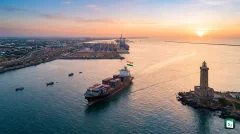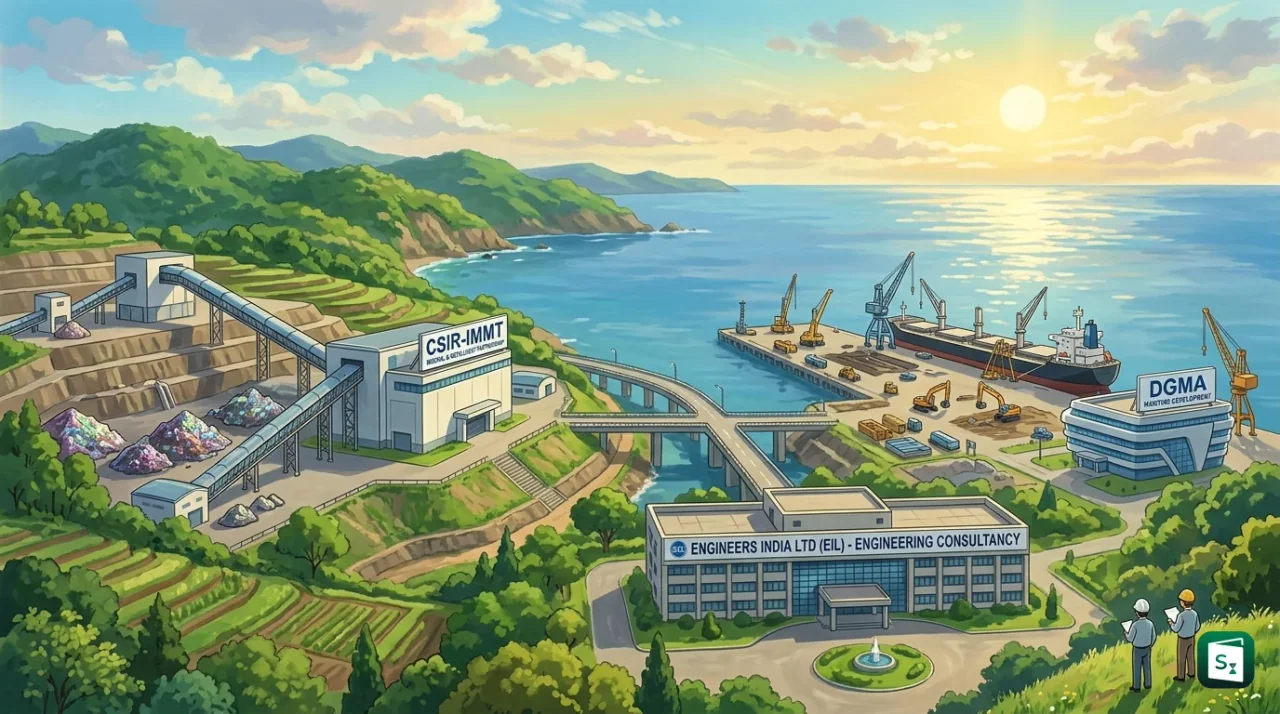
Engineers India Limited (EIL), a Navratna public sector undertaking under the Ministry of Petroleum and Natural Gas, signed two separate memorandums of understanding in July 2026, one with CSIR-IMMT Bhubaneswar for critical minerals research and another with the Directorate General of Maritime Administration (DGMA) for maritime infrastructure consultancy. The MoU with CSIR-IMMT, signed on July 23, aims to develop indigenous technologies across the critical and strategic minerals value chain, while the pact with DGMA, signed on July 24, provides a framework for EIL to offer engineering and project management services for modernising India’s maritime sector. Together, these agreements position EIL as a cross-sector technical partner in two areas of national strategic priority: resource security and maritime capability building.
What Is Engineers India Limited?
EIL is a Navratna public sector undertaking established in 1965 with the mandate of providing indigenous engineering solutions for India’s hydrocarbon sector. It was incorporated as a private limited company under an agreement between the Government of India and Bechtel International Corporation. Within two years, Bechtel exited and EIL became a wholly government-owned enterprise.
Headquartered in New Delhi, EIL provides design, engineering, procurement, construction (EPC), and project management consultancy services. Its core expertise lies in oil and gas, refining, and petrochemicals, but over the decades it has diversified into non-ferrous metallurgy, fertilisers, infrastructure, and renewable energy including green hydrogen and biofuels. The company was granted Navratna status in 2014, which gives it greater operational and financial autonomy.
EIL has a significant global footprint with ongoing projects across Africa, Asia, Latin America, and the Middle East. Its research and development centre in Gurgaon focuses on technology development, both in-house and in collaboration with other institutions. The company also has a wholly owned subsidiary, Certification Engineers International Limited (CEIL).
MoU with CSIR-IMMT: Strengthening Critical Minerals Capabilities
EIL signed its first MoU with the CSIR-Institute of Minerals and Materials Technology (CSIR-IMMT), Bhubaneswar, on July 23, 2026, at EIL’s head office in New Delhi. The agreement was signed by Rajiv Agarwal, Director (Technical) of EIL, and Dr Ramanuj Narayan, Director of CSIR-IMMT, in the presence of Atul Gupta, Chairman and Managing Director of EIL, and Dr Kali Sanjay, Head of Business Development and Centre of Excellence at CSIR-IMMT, along with senior officials from both organisations.
What the Agreement Covers
Under the MoU, EIL and CSIR-IMMT will jointly identify, evaluate, and undertake research and development initiatives in critical and strategic minerals. The collaboration covers the following areas:
- Mineral processing and advanced extraction techniques
- Extractive metallurgy and strategic mineral recovery methods
- Technology scale-up from laboratory innovations to pilot-scale and commercial deployment
- Exchange of technical expertise and capacity-building programmes
- Joint R&D projects focused on improving resource efficiency and maximising mineral recovery
A key focus is bridging the gap between scientific research and industrial application. CSIR-IMMT’s laboratory-scale innovations will be scaled up by EIL into commercially deployable technologies for the mining and processing industries.
About CSIR-IMMT
CSIR-IMMT, located in Bhubaneswar, Odisha, is a constituent laboratory of the Council of Scientific and Industrial Research (CSIR), which operates under the Ministry of Science and Technology. The institute was established in 1964 as the Regional Research Laboratory, Bhubaneswar, and was later renamed. Its research areas include mining and mineral processing, metal extraction, materials characterisation, process engineering, industrial waste management, and environmental sustainability. The institute employs around 140 scientists.
CSIR-IMMT has been recognised as a Centre of Excellence for Critical Minerals under the National Critical Mineral Mission (NCMM). This designation places it among seven premier institutions, including IIT Bombay, IIT Hyderabad, IIT (ISM) Dhanbad, IIT Roorkee, CSIR-NML Jamshedpur, and NFTDC Hyderabad, that have been tasked with driving research and innovation in critical minerals.
The National Critical Mineral Mission Context
The MoU directly supports India’s National Critical Mineral Mission (NCMM), which was launched in January 2025 for a seven-year period from 2024-25 to 2030-31. The mission has a proposed government expenditure of ₹16,300 crore and an expected investment of ₹18,000 crore from public sector undertakings and other stakeholders.
The NCMM was established because critical minerals, such as lithium, cobalt, nickel, graphite, and rare earth elements, are essential for clean energy technologies, electric vehicles, defence systems, and high-tech electronics, yet India currently imports most of these minerals. In 2023, the Ministry of Mines released a list of 30 critical minerals for India, including antimony, beryllium, bismuth, cobalt, copper, gallium, germanium, graphite, lithium, nickel, rare earth elements, titanium, tungsten, and vanadium, among others.
The mission targets include filing 1,000 patents across the critical minerals value chain by 2030-31, setting up seven Centres of Excellence for research, and creating a ₹1,500 crore incentive scheme to boost recycling capacity from secondary sources such as e-waste and lithium-ion battery scrap. The Mines and Minerals (Development and Regulation) Act was amended to empower the central government to exclusively auction mining leases for 24 of the 30 notified critical minerals, opening the sector to private investment.
By combining EIL’s project execution expertise with CSIR-IMMT’s scientific research capabilities, this MoU aims to reduce India’s dependence on imported critical minerals and imported processing technologies, both of which have become strategic vulnerabilities in an era of global supply chain competition.
MoU with DGMA: Modernising India’s Maritime Infrastructure
EIL signed its second MoU with the Directorate General of Maritime Administration (DGMA) on July 24, 2026. The agreement was signed by Shyam Jagannathan, IAS, Director General of Maritime Administration, and Atul Gupta, Chairman and Managing Director of EIL. Senior officials from both organisations attended the signing ceremony.
What the Agreement Covers
The MoU establishes a framework under which EIL will provide engineering, technical advisory, project management, and consultancy services to DGMA for the planning, development, modernisation, and implementation of projects across the maritime sector. The specific areas of cooperation include:
- Feasibility studies and infrastructure planning for maritime projects
- Technology integration and capacity enhancement of port and shipping facilities
- Port Reception Facilities for managing ship-generated waste
- Offshore safety training and certification standards
- Green fuels and bunkering infrastructure for cleaner shipping
- Shipbuilding and maritime asset development
- Digital solutions for maritime administration and operations
EIL will bring its deep experience in hydrocarbon, marine, and offshore engineering to bear on these projects. The company’s multidisciplinary capabilities in project management, digital solutions, sustainability, and infrastructure development are expected to support DGMA in implementing modern, efficient, and sustainable maritime infrastructure.
About DGMA
The Directorate General of Maritime Administration is the apex maritime authority of the Government of India. It was originally established in September 1949 as the Directorate General of Shipping and functioned under that name for over seven decades. In 2026, it was renamed to DGMA to reflect its expanded role and the broader scope of maritime regulation and administration.
DGMA operates as an attached office under the Ministry of Ports, Shipping and Waterways. Its responsibilities include ensuring the safety, security, and environmental sustainability of India’s shipping sector, vessel certification, maritime safety standards, and regulatory oversight of all shipping operations in Indian waters.
India’s Maritime Modernisation Drive
The MoU with DGMA aligns with the government’s broader push to develop world-class maritime infrastructure. India has a coastline of over 7,500 kilometres and handles roughly 90 per cent of its trade by volume through its ports, yet port infrastructure and shipping logistics have long been identified as bottlenecks in India’s logistics cost structure.
The government’s flagship Sagarmala Programme, launched in 2015, aims to promote port-led development through port modernisation, connectivity enhancement, and coastal community development. The programme has supported projects in port modernisation, new port development, and inland waterway infrastructure.
The partnership with EIL signals a strategic shift toward using established public sector engineering expertise for maritime infrastructure planning. EIL’s familiarity with government procurement frameworks and its institutional experience in large-scale project management give it a distinct advantage in supporting DGMA’s modernisation agenda.
Why These Two MoUs Matter
Although the two MoUs address different sectors, they share a common thread: both are aimed at reducing India’s strategic vulnerabilities by building domestic capability.
In the critical minerals space, the MoU between EIL and CSIR-IMMT is not just an R&D agreement. It is a direct response to India’s near-total dependence on imports for minerals like lithium, cobalt, and rare earth elements, which are essential for electric vehicles, renewable energy storage, semiconductors, and defence systems. By bringing together an engineering consultancy with project execution capability and a research institute with deep scientific expertise, the partnership targets the specific gap where India has historically struggled: moving from lab-scale innovation to commercial-scale production.
In the maritime sector, the MoU with DGMA addresses a different kind of vulnerability. India’s vast coastline handles the overwhelming majority of the country’s external trade, yet port infrastructure and shipping logistics have lagged behind global benchmarks. The partnership brings EIL’s engineering depth into the maritime planning process at a time when the government is pushing for rapid infrastructure modernisation, green fuel adoption, and improved safety standards. EIL’s experience in offshore engineering and large project management makes it a natural partner for the maritime regulator.
Together, these agreements also demonstrate how a single PSU can be leveraged across multiple strategic domains. EIL, originally set up to serve the hydrocarbon sector, is now being deployed in critical minerals and maritime infrastructure, showing the flexibility of public sector engineering expertise in meeting India’s evolving strategic needs.
Key Takeaways
- Engineers India Limited (EIL) is a Navratna PSU established in 1965 under the Ministry of Petroleum and Natural Gas, headquartered in New Delhi.
- EIL signed an MoU with CSIR-IMMT Bhubaneswar on July 23, 2026 to collaborate on critical minerals processing, extractive metallurgy, and the value chain of strategic minerals.
- CSIR-IMMT, established in 1964, is a CSIR laboratory recognised as a Centre of Excellence for Critical Minerals under the National Critical Mineral Mission (NCMM).
- The National Critical Mineral Mission, launched in January 2025, has a proposed outlay of ₹16,300 crore and targets 1,000 patents by 2030-31.
- EIL signed a second MoU with the Directorate General of Maritime Administration (DGMA) on July 24, 2026 to provide engineering consultancy for modernising India’s maritime infrastructure.
- DGMA, formerly the Directorate General of Shipping, was established in 1949 and operates under the Ministry of Ports, Shipping and Waterways.