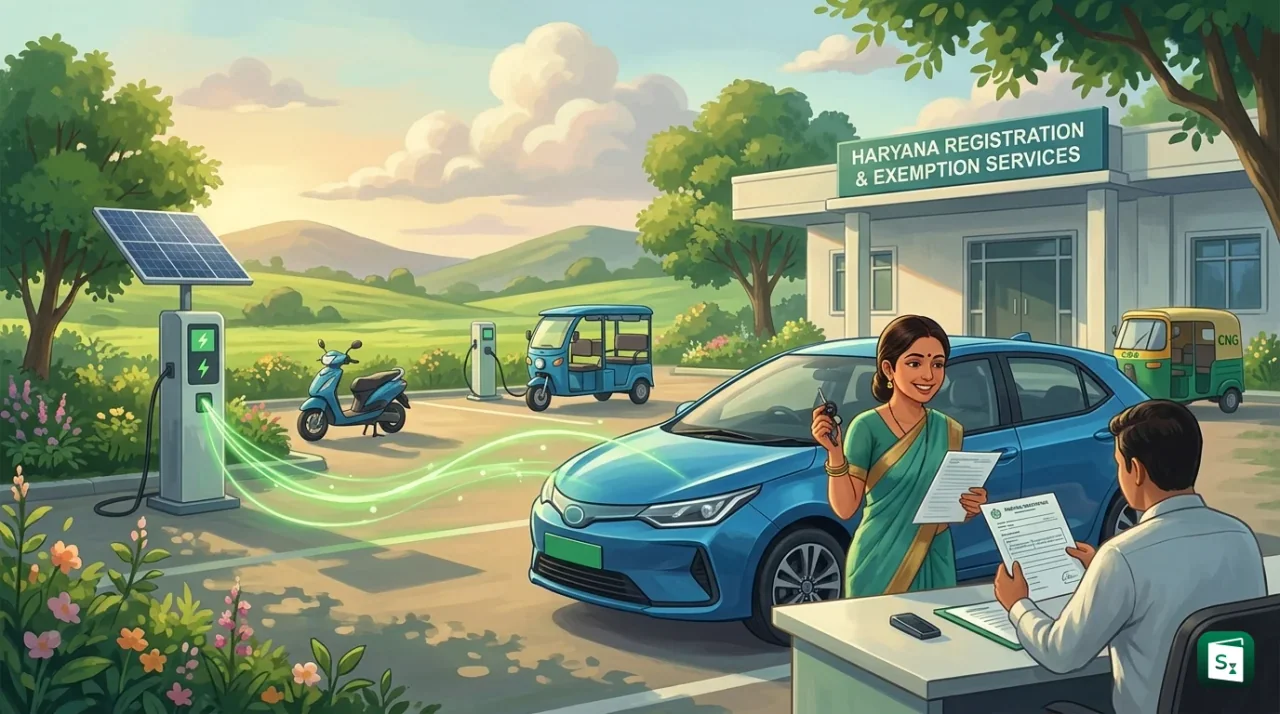
The Haryana Cabinet, chaired by Chief Minister Nayab Singh Saini, has approved a 100% exemption from motor vehicle tax for new electric vehicles priced up to ₹30 lakh, making EV ownership significantly more affordable in the state. Battery-operated two-wheelers, three-wheelers, and four-wheelers registered in Haryana will attract no motor vehicle tax at the time of registration, while EVs priced above ₹30 lakh will receive a 50% tax exemption. The decision, which fulfils an announcement made in the Haryana Budget 2026-27, also introduces a 1% motor vehicle tax rebate for non-transport vehicles registered in the name of women.
What the Cabinet Has Approved
The exemption covers all new pure electric and battery-operated two-wheelers, three-wheelers (including autos and e-rickshaws), and four-wheelers at the point of registration in Haryana. The benefit is available on vehicles with an ex-showroom price of up to ₹30 lakh. For EVs priced above this threshold, a 50% exemption on motor vehicle tax will apply.
The decision was taken under the Haryana Motor Vehicles Taxation Act, 2016, which empowers the state government to prescribe motor vehicle tax rates for different categories of vehicles registered and operated in Haryana. Motor vehicle tax is a one-time levy paid at the time of registration and forms part of the vehicle’s on-road price. Removing it reduces the upfront purchase cost substantially.
The exemption will come into effect after the state government issues an official notification detailing the implementation date and eligibility conditions.
| Category | Previous Benefit | New Benefit |
|---|---|---|
| EVs priced up to ₹30 lakh | 20% tax exemption | 100% exemption |
| EVs priced above ₹30 lakh | 20% tax exemption | 50% exemption |
| CNG vehicles | 20% tax exemption | No change (20%) |
From 20% to 100%: Strengthening the EV Incentive
Haryana first introduced a 20% rebate on motor vehicle tax for electric, battery-operated, and CNG vehicles under its earlier EV policy framework. The state’s dedicated EV Policy 2022 had offered incentives including a 100% exemption on motor vehicle tax for the first 30,000 electric two-wheelers purchased and registered during the policy period, alongside electricity duty exemptions for EV charging infrastructure.
The latest decision significantly broadens this scope. By raising the exemption to 100% for all EVs up to ₹30 lakh without a cap on the number of vehicles, the state has removed a major financial barrier for buyers. Haryana’s motor vehicle tax rates for personal vehicles range from 5% to 10% of the ex-showroom price depending on the vehicle’s value. For a mid-range EV priced at ₹20 lakh, the exemption translates to a saving of approximately ₹1.6 lakh on the on-road price.
The enhanced benefit aligns Haryana with neighbouring Delhi and Chandigarh, which already offer zero registration charges on eligible electric vehicles. The proposal was actively pushed by Transport Minister Anil Vij, who had signalled in May 2026 that the government was considering a full tax exemption on the lines of these neighbouring territories.
The Women’s Vehicle Tax Rebate
In a separate but concurrent decision, the Cabinet approved a 1% motor vehicle tax rebate on non-transport vehicles purchased and registered in the name of women, provided the vehicle’s ex-showroom price does not exceed ₹20 lakh. This fulfils a commitment made by the Chief Minister in the Haryana Budget 2026-27, which was presented on March 2, 2026.
The rebate is applicable over and above the existing motor vehicle tax and is aimed at encouraging women to register vehicles in their own names, promoting financial independence and greater participation in economic activities. For example, on a non-transport vehicle priced at ₹15 lakh, the rebate would reduce the tax burden by ₹15,000.
It is important to note that this rebate is separate from the EV tax exemption. A woman purchasing an eligible electric vehicle priced up to ₹20 lakh could potentially avail both benefits, subject to the final notification and applicable conditions.
Stemming the Registration Outflow to Delhi
The decision also addresses a practical concern that had been troubling Haryana’s automobile dealers for some time. Customers were reportedly buying vehicles from Haryana showrooms but registering them in Delhi or Chandigarh, where registration taxes were lower or non-existent for EVs. This not only cost the state revenue but also distorted local sales data and discouraged dealers from promoting EVs aggressively.
By matching the tax benefits available in neighbouring territories, Haryana has removed the incentive for cross-border registration. This is expected to retain both tax revenue from higher-priced vehicles and boost local EV registrations, giving the state a clearer picture of actual EV adoption within its boundaries.
Key Takeaways
- The Haryana Cabinet has approved a 100% motor vehicle tax exemption for new electric vehicles priced up to ₹30 lakh, covering two-wheelers, three-wheelers, and four-wheelers.
- EVs priced above ₹30 lakh will receive a 50% tax exemption.
- The existing 20% tax rebate on CNG vehicles remains unchanged.
- A 1% motor vehicle tax rebate has been introduced for non-transport vehicles priced up to ₹20 lakh and registered in the name of women.
- The decisions were taken under the Haryana Motor Vehicles Taxation Act, 2016 and fulfil announcements made in the Haryana Budget 2026-27.
- The exemption brings Haryana on a par with Delhi and Chandigarh in EV tax benefits, addressing the problem of cross-border vehicle registrations.