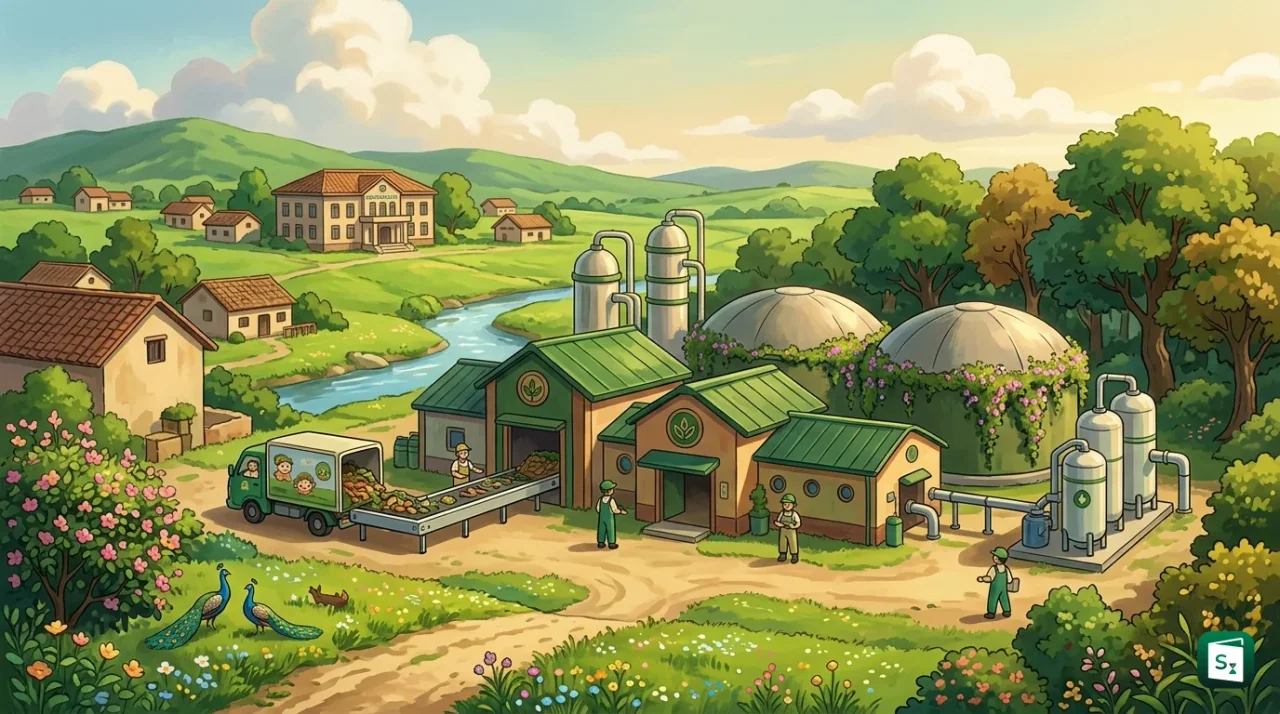
OIL Green Energy Ltd (OGEL), the wholly owned green arm of Oil India Limited, signed Memoranda of Understanding (MoUs) with four Haryana municipalities on 30 August 2026 to set up integrated Compressed Biogas (CBG) and Waste-to-Energy projects. The facilities will come up in Gurugram, Faridabad, Ambala and Hisar and together process 5,000 tonnes per day (TPD) of municipal solid waste to produce 70 to 75 TPD of CBG and 50 MW of green power. The move links Haryana’s urban waste challenge directly to India’s clean energy push under the GOBARdhan National Circular Bioenergy Scheme and OIL’s low-carbon expansion.
What Is Compressed Biogas and How Does It Differ from Biogas and CNG?
Compressed Biogas (CBG), also called Bio-CNG, is a purified and compressed form of biogas. Biogas is produced naturally when organic matter such as cattle dung, agricultural residue, food waste, press mud from sugar mills and the organic fraction of Municipal Solid Waste (MSW) breaks down without oxygen, a process known as anaerobic digestion. Raw biogas typically contains 55 to 65 percent methane, 30 to 40 percent carbon dioxide, along with small amounts of hydrogen sulphide, moisture and nitrogen. Its calorific value is around 19.5 megajoules per kilogram, which limits its direct use as a transport fuel.
CBG is made by cleaning this raw biogas to remove carbon dioxide, hydrogen sulphide and moisture and then compressing it to about 250 bar pressure. The final product must meet the Bureau of Indian Standards specification IS 16087:2016, which requires more than 90 percent methane and less than 4 percent carbon dioxide. Its calorific value rises to 47 to 52 megajoules per kilogram, very close to Compressed Natural Gas (CNG) which is around 50 to 56 megajoules per kilogram. Because of this similarity, CBG can replace CNG in vehicles, industries and city gas networks without major changes to engines or pipelines. The Ministry of Road Transport and Highways permitted the use of Bio-CNG as an automotive fuel on 16 June 2015.
The difference is also important for energy security. CNG is a fossil fuel extracted from underground reserves and India imports nearly 50 percent of its natural gas requirement. CBG is a renewable fuel made from waste, so its carbon dioxide released on burning is considered biogenic. Common questions such as whether biogas can be compressed have a clear answer. Yes, after purification, biogas can be compressed into cylinders and transported in cascades to fuel stations, or injected into the City Gas Distribution (CGD) pipeline network where connectivity exists.
Who Is OIL Green Energy Ltd and What Is Its Mandate?
Oil India Limited (OIL) is India’s second largest national oil and gas exploration and production company and a Maharatna Central Public Sector Enterprise under the Ministry of Petroleum and Natural Gas. Its origins go back to the discovery of oil at Digboi in Assam in 1889, and it was formally incorporated as Oil India Private Limited on 18 February 1959 as a joint venture between the Burmah Oil Company and the Government of India. It became a wholly owned Government of India enterprise in 1981, was listed on the stock exchanges in 2009, was granted Navratna status in 2010 and was elevated to Maharatna in August 2023 as the 13th Maharatna CPSE. Its registered and field headquarters is at Duliajan, Assam, with its corporate office at Noida, Uttar Pradesh. OIL is engaged in exploration, production and transportation of crude oil and natural gas, production of liquefied petroleum gas, and holds a major stake in Numaligarh Refinery Limited.
OIL Green Energy Ltd (OGEL) is a wholly owned subsidiary of OIL created to lead the parent company’s low-carbon and renewable energy portfolio. While OIL remains a hydrocarbon company, OGEL focuses on projects such as Compressed Biogas, Waste-to-Energy, green hydrogen and other clean energy solutions. OIL is currently working to establish 25 CBG plants across India using MSW, agricultural waste and other organic feedstock. In May 2026, OGEL also signed a 50:50 joint venture agreement with Hindustan Waste Treatment Pvt Ltd (HWT), a subsidiary of SFC Environmental Technologies Ltd, to jointly develop CBG and Waste-to-Energy projects. HWT brings experience in design, engineering, construction and operation of MSW-based bioenergy plants, including a plant operating for over a decade in North Goa. The Haryana MoUs mark one of OGEL’s largest cluster-level moves so far and fit its mandate to scale integrated waste-to-clean-energy solutions.
The Haryana Agreement: Four Integrated CBG and Waste-to-Energy Projects
The MoUs were signed with the municipalities and municipal corporations of Gurugram, Faridabad, Hisar and Ambala in the presence of Chief Minister Nayab Singh Saini, along with senior state ministers, Members of Parliament and officials of the Haryana government and OIL/OGEL. The signing was held at an event in Nuh on 29 and 30 August 2026, according to official releases. The four facilities are planned as integrated CBG and Waste-to-Energy projects under a cluster approach, so that waste from adjoining urban local bodies can be aggregated at one site.
Together, the projects will have a combined scientific processing capacity of 5,000 tonnes per day of Municipal Solid Waste (MSW). MSW includes domestic waste, commercial and institutional waste, street sweepings, horticulture waste and market waste generated within municipal limits. Out of this total, the facilities are expected to produce 70 to 75 TPD of CBG and generate 50 MW of green power every day.
Capacity Break-up Across Gurugram, Faridabad, Ambala and Hisar
Each cluster has a different scale based on waste generation and catchment area:
| Cluster | Area Covered | Processing Capacity | Expected Power Generation |
|---|---|---|---|
| Gurugram | Gurugram district | 2,000 TPD | 20 MW minimum |
| Faridabad | Faridabad urban cluster | 1,600 TPD | 16 MW minimum |
| Ambala | Ambala, Yamunanagar and Panchkula urban local bodies | 900 TPD | 9 MW minimum |
| Hisar | Hisar, Hansi, Fatehabad and Jind urban local bodies | 500 TPD | 5 MW minimum |
| Total | Four Haryana clusters | 5,000 TPD | 50 MW |
The two National Capital Region clusters, Gurugram and Faridabad, account for more than 70 percent of the total capacity, reflecting the high waste generation in the rapidly urbanising NCR belt. The Bandhwari landfill in Gurugram, which has grown into a large legacy dumpsite, has been cited by state officials as a key reason for prioritising scientific processing in this region.
All four plants are to be developed in line with the Solid Waste Management Rules, 2026, and are expected to become operational by October 2028.
How Will the Integrated Waste Processing Model Work?
The projects use an integrated waste processing and resource recovery approach rather than simply burning mixed waste. This is central to the Waste-to-Energy concept and to India’s Solid Waste Management Rules, 2016, which mandate that only non-recyclable, non-biodegradable and non-combustible inert waste should go to sanitary landfills.
The flow proposed by Oil India in its regulatory filing begins with scientific pre-processing and segregation, where mixed municipal waste passes through sorting lines to separate different fractions. Next, recyclables such as plastics, metals, glass and paper are recovered and sent for recycling. The wet and biodegradable fraction, which includes food waste, vegetable market waste and other organic matter, is fed into anaerobic digesters for biomethanation. The raw biogas produced is then purified and compressed to produce Compressed Biogas, while the by-product, fermented organic manure or bio-slurry, can be processed into organic fertiliser. Finally, the remaining dry non-recyclable fraction that has calorific value but cannot be recycled or digested is used as fuel in Waste-to-Energy facilities to generate electricity through combustion, gasification or other approved thermal technologies.
This layered design aims to maximise both material recovery and energy recovery while minimising waste sent to landfills. For a state like Haryana, where urban local bodies generate several thousand tonnes of MSW daily, such a model helps address three problems at once, namely landfill pressure, methane emissions from dumpsites, and local demand for clean fuel and power.
A common question is how a Waste-to-Energy plant works. In simple terms, the dry fraction is burnt at high temperature to produce heat, which converts water into steam. The steam drives turbines to generate electricity. In the CBG route, microbes do the work without oxygen, producing gas that after cleaning becomes a direct substitute for natural gas.
Under the GOBARdhan Initiative, Organic and Cattle Waste Is Converted Into Which Clean Fuel?
Compressed Biogas (CBG), also called Bio-CNG, is the clean fuel produced from cattle dung, agricultural residue, food waste and municipal organic waste under the GOBARdhan initiative. Organic matter undergoes anaerobic digestion to form biogas, which is purified and compressed to over 90 percent methane for transport and piped gas use.
The Haryana projects are aligned with the Centre’s flagship GOBARdhan, the National Circular Bioenergy Scheme, which the Union Cabinet approved on 6 August 2026 with a total outlay of ₹23,731 crore for implementation from FY 2026-27 to FY 2035-36. The scheme’s full name is Galvanizing Organic Bio-Agro Resources Dhan.
GOBARdhan was first launched in 2018 under the Swachh Bharat Mission Gramin as a solid and liquid waste management programme focused on converting cattle dung and organic waste into biogas and slurry. The 2026 version is a much larger national unified scheme for Compressed Biogas administered by the Ministry of Petroleum and Natural Gas. It brings under one framework several earlier measures including the Sustainable Alternative Towards Affordable Transportation (SATAT) initiative, Market Development Assistance for organic manure, Biomass Aggregation Machinery support, pipeline connectivity and Central Financial Assistance (CFA) under the National Bioenergy Programme of the Ministry of New and Renewable Energy (MNRE).
GOBARdhan aims to increase domestic CBG production nearly tenfold, mobilise large private investment, create a ₹75,000 crore industry and save more than ₹40,000 crore in foreign exchange by replacing imported fossil fuel. Key features include assured demand through the CBG Blending Obligation, under which City Gas Distribution companies must blend CBG into CNG and piped natural gas, starting at 1 percent in FY 2025-26 and rising to 5 percent by FY 2028-29, with the GOBARdhan framework extending a trajectory of 3 percent in FY 2026-27, 4 percent in FY 2027-28 and 5 percent from FY 2028-29 in the transport and domestic segments. A second feature is stable pricing through a government-backed administered price of ₹2,110 per Metric Million British Thermal Unit (MMBTU) with a ten year horizon to give revenue visibility to producers. A third is capital assistance of up to ₹2 crore per TPD of installed CBG capacity for eligible greenfield projects, also covering feedstock aggregation and manure processing assets, with brownfield expansion also eligible. The fourth is pipeline and credit support, which provides financial help for connecting CBG plants to trunk pipelines and CGD networks, plus a credit guarantee mechanism for MSME-based projects and a CBG Ecosystem Challenge Fund for biomass mapping and aggregation.
SATAT, launched on 1 October 2018, is the foundation on which GOBARdhan now builds. Under SATAT, state-owned Oil Marketing Companies such as IOCL, BPCL, HPCL, GAIL and IGL offer fifteen year commercial agreements to procure CBG at an assured price, earlier at ₹46 per kilogram on an ex-plant basis for gas meeting IS 16087 standards, transported in cascades to retail outlets. Under the new framework, marketing companies continue to be the offtakers, ensuring long term demand for plants like those planned in Haryana. As of 2022, over 3,694 Letters of Intent had been issued and about 58 CBG plants had been commissioned under SATAT, while the overall number of operating plants nationally was around 200 to 300, well below the original target of 5,000 plants. GOBARdhan is intended to bridge this gap.
What Is Waste-to-Energy and Why Does It Matter for Urban India?
Waste-to-Energy (WtE) refers to technologies that convert waste into usable forms of energy such as biogas, Bio-CNG or CBG, electricity, or producer gas and syngas. In India, the concept is closely linked to Municipal Solid Waste Management.
Several definitions are important for exam recall. Municipal Solid Waste (MSW) is defined under the Solid Waste Management Rules, 2016 to include domestic, commercial, institutional, market, street sweepings, horticulture and dairy waste, but it excludes industrial waste, biomedical waste and e-waste. Biomethanation is the microbial conversion of biodegradable waste into methane-rich biogas. Refuse Derived Fuel (RDF) is the combustible fraction of waste that is processed for use in cement kilns or power plants.
India generates about 1,61,157 TPD of municipal solid waste in urban areas, of which about 1,29,708 TPD or 80.49 percent is now processed, up from about 16 percent in 2014, according to the Ministry of Housing and Urban Affairs. Processing happens through Material Recovery Facilities (MRFs), composting, biomethanation and Waste-to-Energy plants.
The Ministry of New and Renewable Energy runs the Waste to Energy Programme under the umbrella National Bioenergy Programme (Phase I, FY 2021-22 to 2025-26), which provides Central Financial Assistance for projects generating biogas, Bio-CNG, CBG and power from urban, industrial and agricultural waste. Under the Swachh Bharat Mission Urban 2.0, launched on 1 October 2021, and under the 2023-24 budget announcement for 500 new Waste to Wealth plants under GOBARdhan, which includes 200 CBG plants with 75 in urban areas, support is extended for MSW-based CBG plants.
For Haryana, the driver is immediate. Towns such as Gurugram and Faridabad face pressure from mixed waste and legacy dumpsites. Converting waste into CBG and electricity reduces landfill dependence, cuts methane that would otherwise escape from dumps, and supports the circular economy principle where waste is treated as a resource. For comparison, Compressed Biogas versus CNG shows nearly identical energy content but different origins. CBG is renewable and locally produced, while CNG is imported or domestically extracted fossil gas. Similarly, Waste-to-Energy versus landfill shows that scientific processing recovers value, while dumping wastes land and creates long term pollution.
The Biogas versus CBG distinction is also exam relevant. Raw biogas is an intermediate product, CBG is the purified, compressed final fuel that can be sold commercially.
Funding, Timeline and Policy Support
Official statements at the signing event in Haryana indicated that the projects will be supported under the Centre’s Urban Challenge Fund model for waste infrastructure. Under this financing pattern shared by state officials, the Union Government will bear 25 percent of the total capital cost, another 25 percent will be shared by the State Government and Urban Local Bodies, while OGEL will invest the remaining 50 percent. Central support for CBG projects more broadly can also flow through GOBARdhan’s capital assistance, the MNRE Waste to Energy Programme, and priority sector lending provisions that the Reserve Bank of India extended to CBG projects in September 2020.
The plants are to be established in accordance with the Solid Waste Management Rules, 2016 and the updated Solid Waste Management Rules, 2026 framework cited by the state government. Environmental safeguards, including pollution control norms prescribed by the Central Pollution Control Board, will apply to both the biomethanation and thermal routes.
The state government has indicated that all four facilities are to become operational by October 2028, within about two years of the MoU signing. This timeline aligns with typical project development periods of 24 months for general Waste-to-Energy projects and 36 months for MSW-to-power projects from in-principle approval under MNRE guidelines. The Chief Minister also stressed segregation at source by households and institutions, which is essential for efficient biomethanation, as only segregated biodegradable waste gives high CBG yields.
Once commissioned, the plants will feed CBG into the gas network for automotive and industrial use and supply green power to the grid, with by-products such as bio-manure approved under the Fertilizer Control Order, 1985 through the Market Development Assistance route, offering an additional revenue stream.
Significance for Haryana and India’s Low-Carbon Energy Transition
For Haryana, the agreement addresses both waste management and energy. Haryana is one of the most urbanised states in the north, with Gurugram and Faridabad among the largest generators of MSW in the National Capital Region. Scientific processing of 5,000 TPD will substantially reduce daily landfill additions and support remediation of sites like Bandhwari. It also strengthens compliance with Swachh Bharat Mission Urban goals and the national aim of zero waste to landfill through decentralised and centralised processing.
For Oil India and OGEL, the MoUs represent a strategic shift. A company historically associated with hydrocarbons in Assam is now building a low-carbon energy portfolio at scale in a northern state. This diversification supports India’s broader energy transition, which rests on four pillars announced by the government, namely energy access, energy efficiency, energy sustainability and energy security.
At the national level, the projects illustrate how Waste-to-Wealth and the circular economy can be operationalised. Each CBG plant creates a local ecosystem for feedstock collection, transportation, plant operation and organic manure production, generating rural and urban employment. The government estimates that the GOBARdhan ecosystem could generate over 1.5 lakh jobs, add more than ₹75,000 crore to GDP, produce 250 million tonnes of organic fertiliser, and cut more than 40 million tonnes of carbon dioxide emissions while displacing 10 million tonnes of fossil fuel. The Haryana clusters will also contribute to reducing natural gas imports, which currently meet about half of India’s needs and pass largely through chokepoints such as the Strait of Hormuz that carries 55 to 60 percent of India’s LNG imports.
In plain terms, the model turns a cost centre, which is waste collection and dumping, into a value chain that produces fuel, fertiliser and electricity. Whether this scales will depend on steady feedstock supply, source segregation, stable pricing under GOBARdhan, and timely grid and pipeline connectivity, but the MoUs provide the institutional anchor for that test in four key Haryana cities.
Key Takeaways
- OGEL, the wholly owned subsidiary of Oil India Limited (OIL), signed MoUs on 30 August 2026 with Gurugram, Faridabad, Ambala and Hisar municipalities for integrated CBG and Waste-to-Energy projects.
- The four clusters will together process 5,000 TPD of municipal solid waste, with capacities of 2,000 TPD in Gurugram, 1,600 TPD in Faridabad, 900 TPD in Ambala and 500 TPD in Hisar, to produce 70 to 75 TPD of CBG and 50 MW of green power.
- The integrated model will recover recyclables, convert the wet biodegradable fraction into Compressed Biogas through anaerobic digestion, and use the dry non-recyclable fraction to generate electricity in Waste-to-Energy facilities.
- Compressed Biogas is purified biogas with more than 90 percent methane meeting IS 16087:2016 and a calorific value of 47 to 52 megajoules per kilogram, interchangeable with CNG in vehicles and city gas networks.
- The projects are aligned with GOBARdhan, the National Circular Bioenergy Scheme, approved on 6 August 2026 with an outlay of ₹23,731 crore for FY 2026-27 to FY 2035-36 under the Ministry of Petroleum and Natural Gas, which provides an administered CBG price of ₹2,110 per MMBTU and capital assistance up to ₹2 crore per TPD.
- SATAT, launched on 1 October 2018, provides the offtake backbone through 15 year procurement agreements by IOCL, BPCL, HPCL, GAIL and IGL for CBG as a green transport fuel.
- Oil India Limited, founded on 18 February 1959 and headquartered at Duliajan, Assam, is a Maharatna CPSE since August 2023 and plans 25 CBG plants nationally through OGEL, which also has a 50:50 joint venture with Hindustan Waste Treatment Pvt Ltd signed in May 2026.