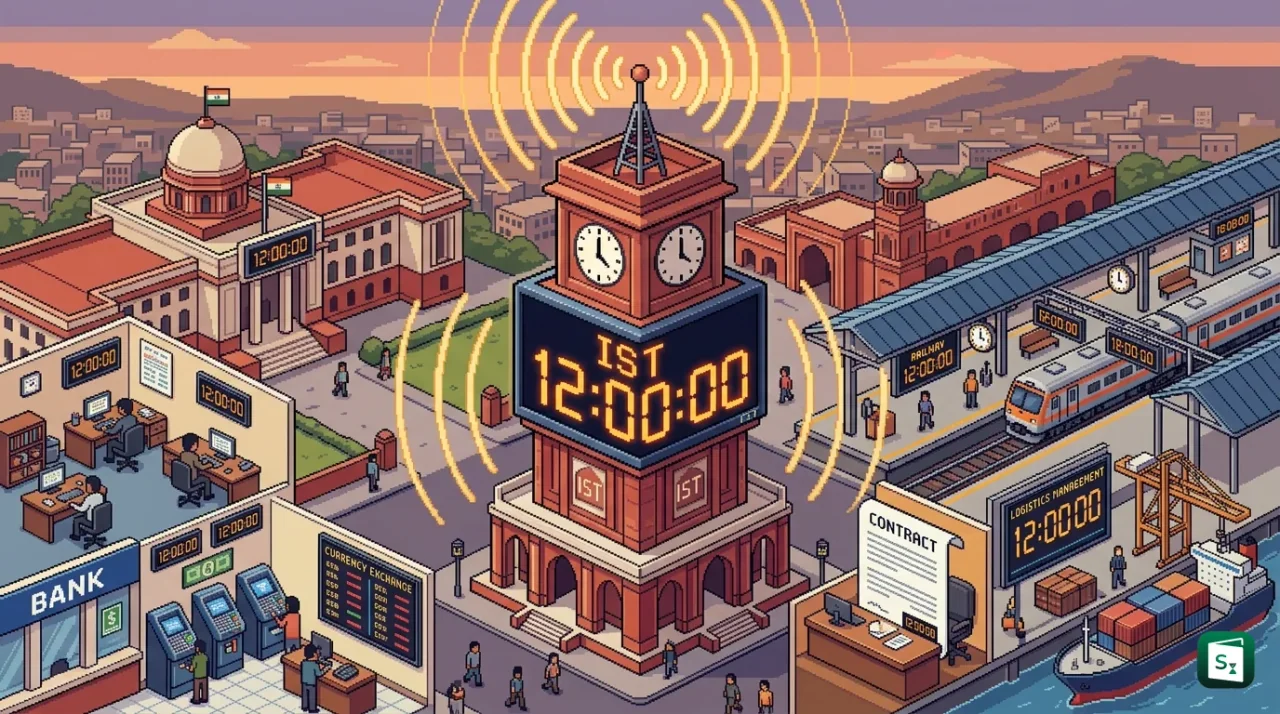
The Department of Consumer Affairs notified the Legal Metrology (Indian Standard Time) Rules, 2026 on 27 August 2026, making Indian Standard Time (IST) the sole and compulsory time reference for all legal, administrative, commercial and official purposes in India. The rules will come into force 180 days after publication in the Official Gazette, giving departments, banks, telecom operators and other organisations time to align their systems. This is the first time India has given its national clock the force of law under the push for One Nation, One Time.
What Is Indian Standard Time?
Indian Standard Time (IST) is the official civil time followed across the whole of India. It is set at 5 hours 30 minutes ahead of Coordinated Universal Time, written as UTC plus 5:30. In simple terms, when it is midnight under UTC, it is 5:30 in the morning in India.
IST is calculated from the 82 degrees 30 minutes East longitude, commonly written as 82.5 degrees East. This line passes near Mirzapur in Uttar Pradesh, where a clock tower marks the reference point. Since the earth turns 360 degrees in 24 hours, each degree of longitude equals four minutes of time. So 82.5 multiplied by 4 gives 330 minutes, which is exactly 5 hours and 30 minutes ahead of Greenwich.
The IST meridian passes through five states, which are Uttar Pradesh, Madhya Pradesh, Chhattisgarh, Odisha and Andhra Pradesh. India stretches from about 68 degrees East in Gujarat to about 97 degrees East in Arunachal Pradesh, a spread of nearly 29 degrees. This creates a solar time difference of almost two hours between the far west and the far east, yet the entire country follows one single time zone.
| Fact About IST | Detail |
|---|---|
| UTC offset | UTC plus 5:30 |
| Reference meridian | 82 degrees 30 minutes East |
| Reference town | Mirzapur, Uttar Pradesh |
| States on meridian | Uttar Pradesh, Madhya Pradesh, Chhattisgarh, Odisha, Andhra Pradesh |
| Standardised in | 1906 |
| Single zone since Independence | 1947 |
| Daylight saving | Not observed |
| Custodian | CSIR National Physical Laboratory (CSIR-NPL), New Delhi |
IST was standardised in 1906 during British rule, replacing earlier local times such as Bombay Time, Calcutta Time and Madras Time. After Independence in 1947, it continued as the official time for the whole country. India does not follow daylight saving, so clocks remain unchanged through the year.
To understand IST, two global standards matter. Greenwich Mean Time (GMT) is the mean solar time at the Prime Meridian (0 degree longitude) at the Royal Observatory in Greenwich, London. Coordinated Universal Time (UTC) is the present global standard for civil time. It is kept by a worldwide network of highly accurate atomic clocks and is adjusted with leap seconds to match the rotation of the earth. In practice, IST equals both GMT plus 5:30 and UTC plus 5:30, but UTC is the precise scientific reference used for atomic timekeeping.
What the Legal Metrology (Indian Standard Time) Rules, 2026 Mandate
The rules were issued by the Department of Consumer Affairs under the Ministry of Consumer Affairs, Food and Public Distribution through notification G.S.R. 761(E) on 27 August 2026. They were framed using the power to make rules under Section 52 of the Legal Metrology Act, 2009. That Act, which received assent on 13 January 2010, establishes standards of weights and measures and regulates trade in goods sold by weight, measure or number. Time is now being treated on the same footing as other legal units of measurement.
The core provision is simple. IST will be the common time reference for legal, administrative, commercial and other official purposes across the country. This covers contracts, court and government records, office time displays, transport schedules, financial transactions and digital systems. The draft version had stated that no other time reference should be used unless the government gives explicit approval, with narrow allowance for specialised fields such as astronomy, navigation and scientific research.
The rules will come into force 180 days after publication in the Official Gazette. This transition window is meant to let government departments, businesses, banks, telecom firms and other institutions review their systems and complete technical changes. Periodic audits and penalties under the Legal Metrology framework will support compliance after the rules take effect.
| Rule Element | Detail |
|---|---|
| Notifying body | Department of Consumer Affairs |
| Legal authority | Section 52, Legal Metrology Act, 2009 |
| Notification | G.S.R. 761(E), 27 August 2026 |
| Time reference | IST as sole common reference |
| Coverage | Legal, administrative, commercial and official purposes |
| Commencement | 180 days after Gazette publication |
Why a Single Time Reference Matters for Banking, Telecom and Power
Modern infrastructure runs on time stamps. When two computers record the same event with clocks that differ by even a few milliseconds, payments can fail, call records can mismatch and power faults become hard to trace. With the rapid growth of digital and network based systems, the government has said that differences between time sources directly affect coordination and record keeping.
A common IST reference will support accurate time stamping of banking and digital payment transactions, where settlement, audit trails and fraud detection depend on exact sequencing. It will help railways, airports and other transport operators run on coordinated schedules. Telecommunication and internet networks need synchronised clocks for stable calls, data routing and billing. Power systems need precise timekeeping to detect faults and manage load across the national grid. Government and legal records, along with emergency and other time sensitive services, also need one trusted clock to establish what happened and when.
There is also a security reason. Accurate and matching time stamps allow investigators to connect events across many systems during a cyber incident. The Indian Computer Emergency Response Team (CERT-In) Guidelines on Information Security Practices for Government Entities, 2023 already advise synchronisation of information technology systems with standard sources such as the National Physical Laboratory (NPL) and the National Informatics Centre (NIC). A legally backed common time makes that correlation reliable and admissible across institutions.
How IST Is Maintained and Disseminated Across India
CSIR-NPL, NavIC and Regional Laboratories
CSIR National Physical Laboratory (CSIR-NPL) in New Delhi is India’s National Metrology Institute and the custodian of IST. Its full name is the Council of Scientific and Industrial Research National Physical Laboratory. It keeps national time with a bank of caesium atomic clocks and a hydrogen maser. These clocks are so stable that they would gain or lose one second only over lakhs of years. NPL time, called UTC (NPLI), is traceable to Coordinated Universal Time maintained through the International Bureau of Weights and Measures (BIPM) near Paris.
Legal backing alone cannot deliver time to every server and substation. The government is therefore building Indian dissemination infrastructure through Indian institutions and Legal Metrology laboratories. Secondary timescales have been set up at five Regional Reference Standard Laboratories (RRSLs) located at Ahmedabad, Bengaluru, Bhubaneswar, Faridabad and Guwahati. These laboratories allow traceable IST to be shared regionally instead of depending on a single point in Delhi.
The rules also provide for the use of NavIC and other approved Indian timing sources. NavIC, which expands to Navigation with Indian Constellation, is India’s regional satellite navigation system developed by the Indian Space Research Organisation (ISRO), headquartered in Bengaluru. At present many Indian systems take time from foreign satellite systems such as the Global Positioning System (GPS). An Indian satellite option improves availability and reduces dependence on external sources, especially if foreign signals are disrupted or degraded.
Time is shared using standard methods. Network Time Protocol (NTP) is used for general computer synchronisation over the internet, while Precision Time Protocol (PTP) provides far higher accuracy for telecom, power and financial networks. Satellite dissemination through NavIC extends coverage to places where fibre links are weak.
White Rabbit Technology Demonstration at Bengaluru
As part of the One Nation, One Time initiative, a White Rabbit Technology based IST Dissemination Demonstration Network was commissioned at RRSL Bengaluru in July 2026. The project was jointly developed by the Department of Consumer Affairs, CSIR-NPL and ISRO. White Rabbit is a high precision timing technology first developed at CERN, the European particle physics laboratory. It combines PTP with fibre optic links to deliver accuracy at the level of a fraction of a nanosecond, which is a billionth of a second.
The demonstration has shown IST dissemination for banking, telecommunications, power, transportation and digital governance. In a key trial, secure IST was sent between RRSL Bengaluru and the National Stock Exchange (NSE) facility in Chennai using White Rabbit links provided with support from BSNL. The trial involved CSIR-NPL, ISRO, the Securities and Exchange Board of India (SEBI) and NSE. SEBI, established in 1988 and given statutory powers through the SEBI Act, 1992, is headquartered in Mumbai and regulates the securities market. For stock exchanges, where trades are stamped in microseconds, a common and tamper resistant clock is central to fair settlement and audit.
Legal Backing and the Road to One Nation, One Time
Legal metrology is the branch of measurement law that ensures weights, measures and weighing instruments used in trade are accurate and uniform. In India it is governed by the Legal Metrology Act, 2009 and rules such as the Legal Metrology (General) Rules, 2011 and the Legal Metrology (Packaged Commodities) Rules, 2011. By placing IST inside this framework, the government has made time a legal unit like the kilogram or the metre. Breach of rules made under Section 52 can attract a fine, and offences under the framework can be compounded on payment as prescribed.
The journey to these rules was phased. A draft was placed for public comments in January 2025, with suggestions invited till 14 February 2025. A round table on time dissemination was held in June 2025 under Consumer Affairs Minister Pralhad Joshi, where telecom, finance, railways and technology stakeholders supported notification. An inter ministerial process since 2018 involving NPL, ISRO, the Indian Institute of Technology Kanpur, the National Informatics Centre, CERT-In, SEBI and user departments shaped the technical plan. The 180 day period after the August 2026 notification is now the final preparation window for stakeholders to test synchronisation, adopt NTP or PTP feeds from Indian sources, and align NavIC receivers where needed.
The larger goal is One Nation, One Time, which means one authoritative, indigenous and tamper resistant IST available to all critical operators. If implemented fully, it will strengthen digital sovereignty, improve reliability of payments, telecom and power, and place India among the countries with sovereign precision time networks. The immediate test will be whether banks, exchanges, telecom firms and transport utilities complete the shift from mixed foreign and local sources to a single NPL traceable clock before the rules take full effect.
Key Takeaways
- The Legal Metrology (Indian Standard Time) Rules, 2026 were notified on 27 August 2026 through G.S.R. 761(E) under Section 52 of the Legal Metrology Act, 2009.
- Indian Standard Time (IST), set at UTC plus 5:30 from the 82.5 degrees East meridian near Mirzapur, is now the sole time reference for legal, administrative, commercial and official purposes.
- The IST meridian passes through Uttar Pradesh, Madhya Pradesh, Chhattisgarh, Odisha and Andhra Pradesh, and IST was standardised in 1906.
- CSIR-NPL in New Delhi maintains IST with caesium atomic clocks, with secondary timescales at RRSLs in Ahmedabad, Bengaluru, Bhubaneswar, Faridabad and Guwahati.
- Time will be disseminated through NTP, PTP, NavIC and White Rabbit Technology, whose demonstration network at RRSL Bengaluru was tested on the Bengaluru to NSE Chennai link in July 2026.
- The rules come into force 180 days after Gazette publication to support the One Nation, One Time vision for banking, telecom, power, transport and cybersecurity.