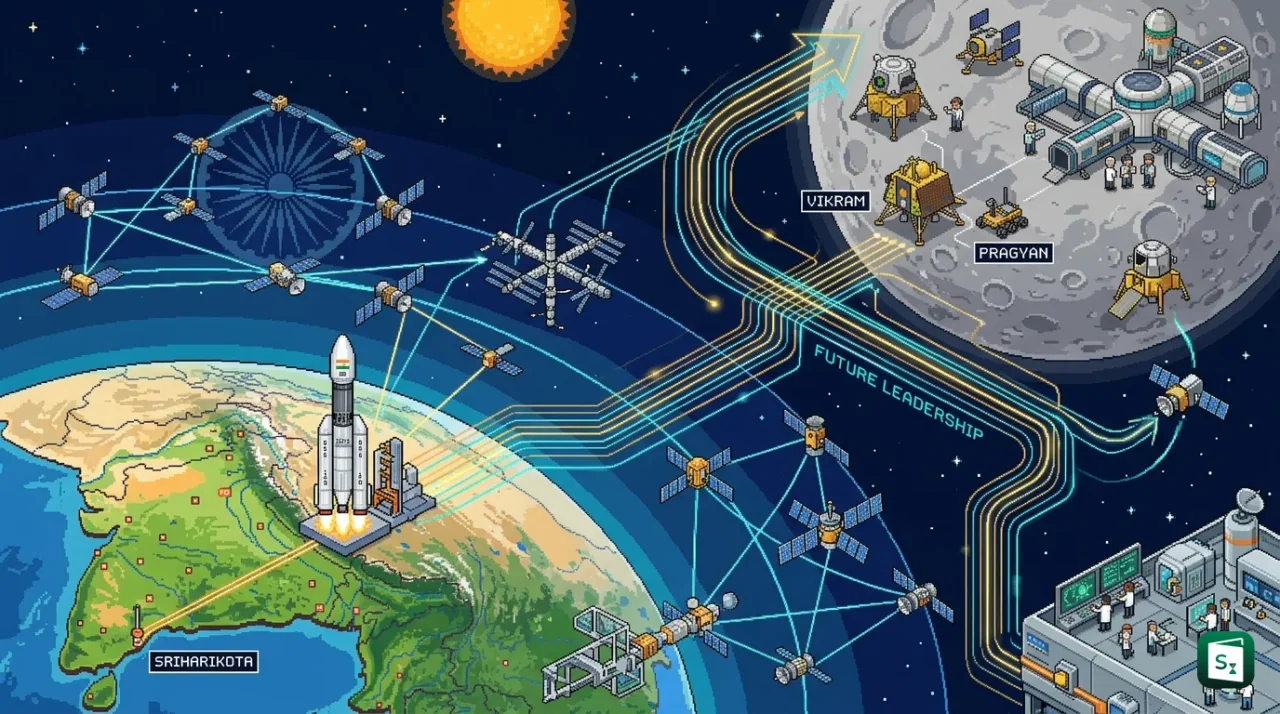
India observed its third National Space Day on 23 August 2026 to commemorate the historic soft landing of Chandrayaan-3’s Vikram lander near the Moon’s south pole on 23 August 2023. The 2026 celebrations were held under the theme “Towards Viksit Bharat: Innovating, Collaborating and Aspiring to Global Space Leadership”, with the main event organised by the Indian Space Research Organisation (ISRO) at Ahmedabad. The day honours a mission that made India the fourth country to achieve a lunar soft landing and the first to reach the lunar south polar region.
What Is National Space Day and Why Is It Celebrated on 23 August?
National Space Day is observed in India every year on 23 August to commemorate one of the country’s biggest milestones in space exploration. It is a national observance dedicated to celebrating achievements in space science and technology, honouring scientists and engineers, and inspiring young people to pursue careers in Science, Technology, Engineering and Mathematics (STEM).
The date was chosen because on 23 August 2023, the Vikram lander of Chandrayaan-3 made a successful soft landing near the Moon’s south pole. The landing site was later named Shiv Shakti Point. Prime Minister Narendra Modi, while addressing scientists of the Indian Space Research Organisation (ISRO) at Bengaluru on 26 August 2023, declared that 23 August would be celebrated every year as National Space Day.
The day is not a public holiday. It is observed through nationwide outreach, exhibitions, and educational events led by ISRO and central government departments. Its larger purpose is to build public awareness about how space technology supports everyday life, from communication and navigation to weather forecasting, disaster management, agriculture, and telemedicine, and to strengthen national pride in India’s scientific progress.
How National Space Day Began: From Chandrayaan-3 Success to Annual Observance
The story of National Space Day starts with Chandrayaan-3. The mission was launched on 14 July 2023 aboard the LVM3-M4 rocket from the Satish Dhawan Space Centre (SDSC) SHAR in Sriharikota, Andhra Pradesh. After about 40 days of Earth and lunar orbit manoeuvres, the Vikram lander separated from the Propulsion Module on 17 August 2023 and touched down softly on the lunar surface at 18:03 IST on 23 August 2023. Hours later, the Pragyan rover, weighing 26 kg, rolled out and began in-situ exploration.
To recognise the achievement, the Government of India declared 23 August as National Space Day. The first ever National Space Day was celebrated on 23 August 2024 with a two-day finale at Bharat Mandapam, New Delhi, in the presence of the President of India. That year’s events also included a month-long campaign in July and August, with ISRO centres conducting outreach across the country.
The Indian Space Research Organisation (ISRO), India’s national space agency, led the mission. ISRO was established on 15 August 1969 as successor to the Indian National Committee for Space Research (INCOSPAR) set up in 1962, and is headquartered in Bengaluru, Karnataka. It functions under the Department of Space (DoS), which is overseen by the Prime Minister, and its Chairman also serves as Secretary of DoS and Chairman of the Space Commission. The current Chairman is Dr V. Narayanan, who assumed charge on 13 January 2025. ISRO’s motto is “Space technology in the service of humankind.”
Theme for 2026: Towards Viksit Bharat and Themes of Previous Years
What Is the Theme of National Space Day 2026?
The theme for the third National Space Day in 2026 is “Towards Viksit Bharat: Innovating, Collaborating and Aspiring to Global Space Leadership”. The phrase was announced by ISRO as the focus for celebrations held throughout July and August 2026.
The theme links India’s space programme to the larger national vision of Viksit Bharat 2047, the goal of making India a developed nation by the time it completes 100 years of independence in 2047. It emphasizes three ideas. Innovating refers to building indigenous technologies, from launch vehicles and docking systems to deep-space science. Collaborating points to closer partnerships between ISRO, private startups, industry, academia, and international agencies. Aspiring to Global Space Leadership signals India’s ambition to move from being a low-cost launch provider to a leading power in human spaceflight, space stations, and lunar exploration.
Themes Since the First Observance
Each year, ISRO has given National Space Day a distinct theme to highlight a different dimension of the space journey:
| Year | Theme |
|---|---|
| 2024 | Touching Lives while Touching the Moon: India’s Space Saga |
| 2025 | Aryabhatta to Gaganyaan: Ancient Wisdom to Infinite Possibilities |
| 2026 | Towards Viksit Bharat: Innovating, Collaborating and Aspiring to Global Space Leadership |
The 2024 theme underlined how space applications touch everyday life, while the 2025 theme connected ancient Indian astronomical heritage, symbolised by Aryabhatta, the 5th century mathematician and astronomer, to the future human spaceflight mission Gaganyaan. The 2026 theme builds on both, framing space as a driver of national development and global competitiveness.
The theme also reflects current policy direction. Since the space sector reforms of 2020 and the creation of IN-SPACe (Indian National Space Promotion and Authorisation Centre) and NSIL (NewSpace India Limited), India has seen rapid growth in private participation, with more than 440 space startups reported by ISRO in 2026. The government has positioned this ecosystem as central to achieving the Viksit Bharat goals.
The Mission It Honours: Chandrayaan-3, Vikram Lander and Pragyan Rover
What Was Chandrayaan-3?
Chandrayaan-3 is ISRO’s third lunar exploration mission and a follow-on to Chandrayaan-2. Its sole objective was to demonstrate end-to-end capability in safe landing and roving on the lunar surface. The spacecraft had three parts: a Propulsion Module (PM), the Vikram lander, and the Pragyan rover. It weighed about 3,900 kg at launch and was launched by the Launch Vehicle Mark-3 (LVM3).
The Propulsion Module carried the lander and rover to a 100 km lunar orbit and carried the Spectro-polarimetry of Habitable Planet Earth (SHAPE) payload to study Earth from lunar orbit. After the successful landing, the Propulsion Module continued operating in lunar orbit.
Vikram and Pragyan: Names, Science and Landing Site
The lander is named Vikram after Dr Vikram Sarabhai, the father of India’s space programme, who founded INCOSPAR and is credited with establishing ISRO. The rover is named Pragyan, a Sanskrit word meaning wisdom. Measuring about 917 mm x 750 mm x 397 mm and weighing 26 kg, Pragyan runs on 50 W of solar power, moves at about 1 cm per second, and uses a rocker-bogie suspension to cross rugged terrain. It communicates with Earth via Vikram.
The landing site near 69.37 degrees South, 32.34 degrees East, in the lunar highlands, was named Shiv Shakti Point, announced by the Prime Minister in 2023. The south polar region is significant because it is largely unexplored, has permanently shadowed craters, and is believed to hold reserves of water ice crucial for future human missions.
Science payloads were designed for in-situ study:
| Module | Payload | Purpose |
|---|---|---|
| Vikram lander | ChaSTE (Chandra’s Surface Thermophysical Experiment) | Measure temperature and thermal conductivity of lunar surface |
| Vikram lander | ILSA (Instrument for Lunar Seismic Activity) | Measure seismic activity around landing site |
| Vikram lander | Langmuir Probe (LP) | Estimate plasma density and its variations |
| Vikram lander | Laser Retroreflector Array (NASA, passive) | For lunar laser ranging studies |
| Pragyan rover | APXS (Alpha Particle X-ray Spectrometer) | Determine elemental composition near landing site |
| Pragyan rover | LIBS (Laser Induced Breakdown Spectroscope) | Determine elemental composition near landing site |
Pragyan operated for about one lunar day, or 14 Earth days, covering more than 100 metres and confirming the presence of elements including sulphur. Its electronics were not designed to survive the extreme cold of the lunar night (around minus 200 degrees Celsius), so after being put into sleep mode in early September 2023, it did not revive as hoped. The mission nonetheless completed all its primary science goals, validating technologies for future interplanetary missions.
How India Celebrates National Space Day
National Space Day is marked by a month-long outreach led by ISRO centres in July and August each year, culminating in a national finale on 23 August.
The 2026 Celebration at Ahmedabad
In 2026, the inaugural national event was held on 23 August at Ahmedabad, Gujarat. The venue was chosen for the presence of the Space Applications Centre (SAC) and a rapidly growing startup ecosystem around the city. Union Minister of Culture and Tourism Gajendra Singh Shekhawat was the chief guest, Arjunbhai Devabhai Modhwadia, Minister for Forests and Environment, Climate Change and Science and Technology of Gujarat, was the Guest of Honour, and Dr V. Narayanan, Secretary, Department of Space and Chairman, ISRO, presided. Dr Pawan Kumar Goenka, Chairman of IN-SPACe, and Dr C. V. N. Rao, Director of SAC, also participated.
Key highlights included felicitation of the private startup Skyroot Aerospace for its Vikram-1 orbital launch, awards for winners of quizzes and other competitions, and addresses on the need for greater responsibility and collaboration to realise Viksit Bharat 2047. Gujarat’s invitation to startups to set up manufacturing at Gujarat Space Park was also spotlighted.
Prime Minister Narendra Modi, in his National Space Day message on 23 August 2026, described India’s space sector as a magnet for global investors and credited Gen Z engineers, designers, coders and scientists working on propulsion systems, composite materials, rocket stages and satellite platforms.
Celebrations in 2024 and 2025
The first celebration in 2024 was a two-day finale at Bharat Mandapam, New Delhi, with exhibitions, high-level sessions with ministries, industry, startups and academia, and the launch of the Space on Wheels mobile exhibition buses by ISRO and Vijnana Bharati (VIBHA). The buses visited universities and colleges to showcase ISRO missions.
The second celebration in 2025 was also held at Bharat Mandapam on 23 August 2025, with the theme focussing on heritage and human spaceflight. That year’s programme unveiled a model of the upcoming Bharatiya Antariksh Station (BAS) and expanded student engagement. According to ISRO, outreach in 2025 reached about 1.5 lakh students and 15,000 teachers through ISRO Space Tutors, a network of about 120 registered outreach educators, workshops, exhibitions, and activities such as the Bharatiya Antariksh Hackathon and ISRO Robotics Challenge (IRoC-U 2026).
Typical activities across schools and colleges include quiz competitions, drawing and poster making, essay and speech contests, slogan writing, hackathons, model exhibitions, board decoration, and workshops. ISRO streams the main ceremony live on its website and YouTube channel, and institutions such as Vikram Sarabhai Space Centre (VSSC), Thiruvananthapuram, organise regional events. Platforms like MyGov also host National Space Day quizzes that attract large student participation.
How Chandrayaan-3 Differs from Chandrayaan-2 and Where India Stands Globally
Chandrayaan-2 vs Chandrayaan-3
To understand why Chandrayaan-3 was a national landmark, it helps to compare it with its predecessor.
| Aspect | Chandrayaan-2 (2019) | Chandrayaan-3 (2023) |
|---|---|---|
| Launch | 22 July 2019, LVM3 | 14 July 2023, LVM3-M4 |
| Configuration | Orbiter, Vikram lander and Pragyan rover | Propulsion Module, Vikram lander and Pragyan rover (no orbiter, as Chandrayaan-2 orbiter still operates) |
| Landing attempt | 7 September 2019, crash due to higher than expected velocity and software issues at about 2.1 km altitude | 23 August 2023, successful soft landing after failure-based design improvements |
| Lander engines | Five thrusters | Four thrusters with better fault tolerance and expanded landing area |
| Design philosophy | Success-based | Failure-based design, meaning Vikram could still land even if multiple sensors or systems failed |
| Outcome | Lander lost, rover not deployed, but orbiter continues to provide data from 100 km orbit | Lander and rover operated successfully for one lunar day, achieving all primary objectives |
The lessons from Chandrayaan-2 led to stronger landing legs, wider velocity margins, improved hazard detection, and more rigorous testing for Chandrayaan-3.
India Among Global Lunar Powers
Chandrayaan-3 made India the fourth country to achieve a soft landing on the Moon, after the Soviet Union (now Russia), the United States, and China. It was the first country to land near the lunar south pole, a region targeted but not reached by other recent missions. For comparison, Russia’s Luna 25, launched in August 2023, crashed while attempting a south pole landing days before Vikram succeeded.
ISRO and NASA: Different Scale, Shared Ambition
Search interest often compares ISRO and NASA (National Aeronautics and Space Administration), the United States space agency established in 1958 and headquartered in Washington, D.C. NASA’s annual budget is many times larger and its programme spans human exploration, planetary science, and deep-space telescopes. ISRO, with its lower-cost approach, has built a reputation for cost-effective missions, such as Chandrayaan-1 (2008), which discovered evidence of water molecules on the Moon, Mangalyaan (2013), India’s successful Mars Orbiter Mission, and the NISAR Earth observation mission with NASA launched in July 2025. The comparison underscores complementarity rather than direct rivalry, as seen in joint missions like NISAR (NASA-ISRO Synthetic Aperture Radar), cooperation with Japan on LUPEX/Chandrayaan-5 for polar water exploration, and with the European Space Agency (ESA) and France on missions like TRISHNA.
Why National Space Day Matters: Significance and Space Vision 2047
National Space Day is more than a remembrance of a landing. It serves four broad purposes.
First, it honours scientific perseverance. The journey from the setback of Chandrayaan-2 in 2019 to the success of Chandrayaan-3 in 2023 showed how failure analysis and redesign can produce success. It also celebrates the thousands of scientists, engineers and technicians across ISRO, SAC, VSSC, URSC and other centres.
Second, it inspires the next generation. By showcasing working models, launch videos, and direct interactions with scientists, the day encourages students to see space science as a career path. The focus on Gen Z talent in 2026 underlined how young engineers are now leading work on propulsion, materials and satellite platforms.
Third, it highlights the societal value of space. Satellite data underpins agriculture advisories, water resource management, weather forecasting, navigation through NavIC (Navigation with Indian Constellation), disaster warnings, telemedicine networks with nearly 179 nodes including in Ladakh, Leh and Siachen, and educational broadcasting under PM e-Vidya. Space technology, in this sense, touches daily life even for those who never look at the Moon.
Fourth, it anchors Space Vision 2047, India’s long-term roadmap. Approved by the Government of India, the vision includes:
-
The Gaganyaan human spaceflight programme, approved in 2019, to send up to three Indians to 400 km low Earth orbit for up to three days. An uncrewed human-robot mission Vyommitra is planned before the crewed flight, now targeted for 2027. Indian astronaut Group Captain Shubhanshu Shukla’s participation in the Axiom-4 mission to the International Space Station in 2025, where he conducted seven microgravity experiments, provided valuable preparation.
-
The Bharatiya Antariksh Station (BAS), a planned five-module space station in low Earth orbit. The first module is targeted for launch by 2028, with the full station by 2035, to support microgravity research in life sciences, medicine and materials.
-
A crewed Indian Moon landing by 2040, announced by Science and Technology Minister Dr Jitendra Singh on National Space Day 2025, when he said an Indian astronaut would proclaim Viksit Bharat 2047 from the lunar surface.
-
Future deep-space missions such as Chandrayaan-4 (lunar sample return), LUPEX with Japan to search for water ice at the poles, and the Venus Orbiter Mission planned for 2028.
-
Technology leaps such as the Space Docking Experiment (SpaDeX) in January 2025, which made India the fourth country after the United States, Russia and China to demonstrate autonomous docking and undocking, a key capability for BAS and lunar missions. The success also validated the indigenous Bharatiya Docking System and power transfer between docked spacecraft.
Together, these goals position the space sector as a strategic asset for development, technological self-reliance, and global influence, aligning with the Viksit Bharat 2047 ambition.
The Way Forward
The 2026 theme asks for more than celebration. It calls for building a full national ecosystem around space. Three priorities are clear.
First, deepen innovation and private participation. With reforms and the support of IN-SPACe, startups are now expected to contribute small satellites, launch services and applications in Earth observation, communications and disaster management. The government aims to support more than 100 satellite launches in the coming years, about 70 percent of them small satellites, with expanding industry involvement.
Second, strengthen STEM pathways. Continued expansion of Space Tutors, Hackathons, Robotics Challenges, and Space on Wheels tours will be needed to convert inspiration into skills. The experience of 2025, with over 61,000 students across 8,744 teams in the Bharatiya Antariksh Hackathon, shows the scale of interest that must be sustained.
Third, deliver on flagship missions on time. Gaganyaan, BAS, Chandrayaan-4, LUPEX and the Venus Orbiter Mission will test India’s ability to manage complex, multi-year projects and international partnerships. Success will depend on retaining the failure-based, redundancy-focused engineering culture that made Chandrayaan-3 succeed, and on managing cost, quality and timelines as the frequency of missions rises.
If these steps progress together, National Space Day can evolve from an annual commemoration into a yearly audit of how far India has moved toward becoming a leader that innovates at home, collaborates abroad, and uses space to improve life on Earth.
Key Takeaways
- National Space Day is observed every year on 23 August to commemorate the soft landing of Chandrayaan-3’s Vikram lander near the Moon’s south pole on 23 August 2023.
- The day was declared by Prime Minister Narendra Modi on 26 August 2023 at Bengaluru and was first celebrated on 23 August 2024 at Bharat Mandapam, New Delhi.
- The 2026 theme is “Towards Viksit Bharat: Innovating, Collaborating and Aspiring to Global Space Leadership”, linked to the Viksit Bharat 2047 vision.
- Previous themes were “Touching Lives while Touching the Moon: India’s Space Saga” in 2024 and “Aryabhatta to Gaganyaan: Ancient Wisdom to Infinite Possibilities” in 2025.
- Chandrayaan-3 was launched on 14 July 2023 by LVM3-M4 from SDSC SHAR, Sriharikota, and made India the fourth country to soft-land on the Moon and the first to land near the lunar south pole at Shiv Shakti Point.
- The 26 kg Pragyan rover (Sanskrit for wisdom) and Vikram lander carried payloads including ChaSTE, ILSA, Langmuir Probe, APXS and LIBS, and the landing was facilitated by the Propulsion Module carrying SHAPE.
- The third National Space Day 2026 main event was held at Ahmedabad, home to the Space Applications Centre (SAC), presided over by ISRO Chairman Dr V. Narayanan, who took charge on 13 January 2025 at ISRO Headquarters, Bengaluru, established on 15 August 1969.
- India’s Space Vision 2047 targets the Bharatiya Antariksh Station by 2035 (first module by 2028), Gaganyaan crewed flight by 2027, and an Indian Moon landing by 2040.