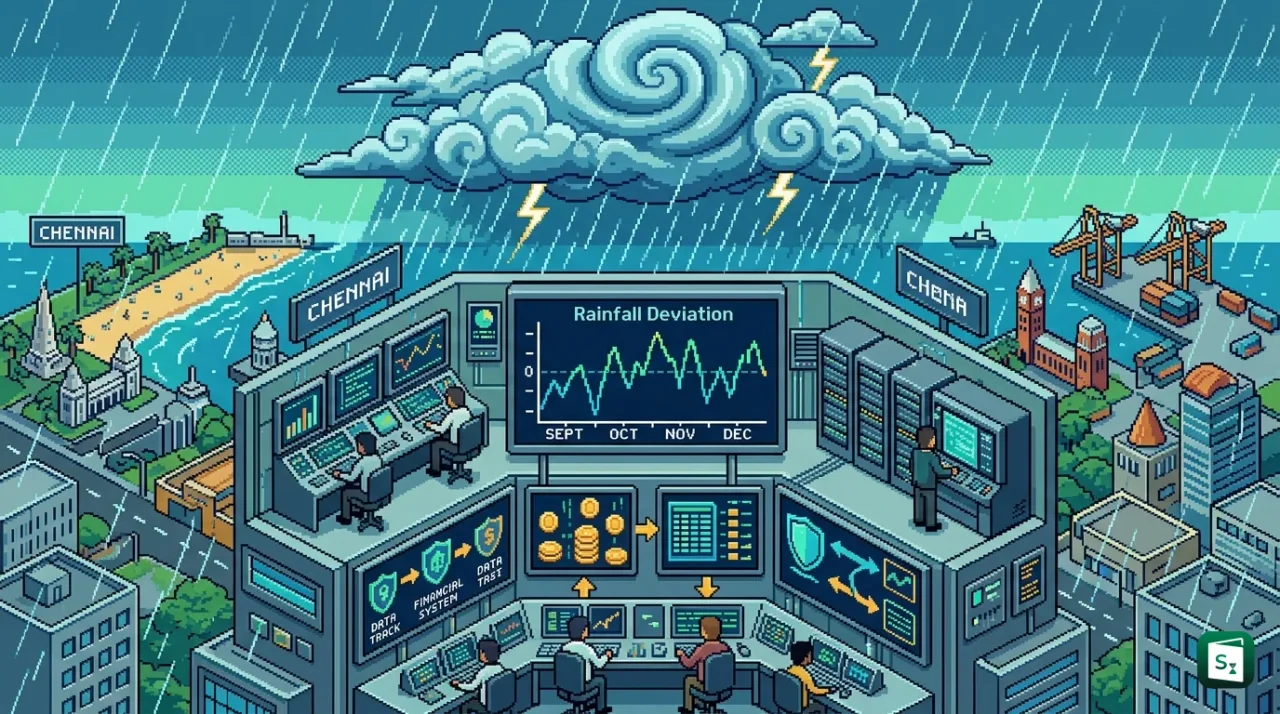
The National Commodity and Derivatives Exchange Limited (NCDEX) launched RAINCHNNAI on 31 August 2026, a Chennai-focused rainfall-based weather derivatives futures contract to hedge risks from the Northeast monsoon. The cash-settled, exchange traded commodity derivatives contract tracks rainfall deviation between September and December, the four months that bring nearly 70 percent of Chennai’s annual rain. Together with its earlier RAINMUMBAI contract, it completes a June to December monsoon hedging cycle on a regulated platform.
What Is RAINCHNNAI and Why Has NCDEX Launched It?
RAINCHNNAI is an exchange traded futures contract whose underlying is not a commodity like gold or wheat, but a weather index, the Cumulative Deviation Rainfall (CDR) for Chennai. Launched by the National Commodity and Derivatives Exchange Limited (NCDEX), which was established on 23 April 2003 and began operations on 15 December 2003 and is headquartered in Mumbai, the contract is regulated by the Securities and Exchange Board of India (SEBI). SEBI has regulated commodity derivatives markets since 28 September 2015 under the Securities Contracts (Regulation) Act, 1956, after the repeal of the Forward Contracts (Regulation) Act, 1952.
The objective is straightforward. Many businesses lose income when rainfall is too low or too high, even if no physical asset is destroyed. NCDEX has created a transparent, standardised platform where participants can hedge this volumetric risk and discover a market price for rainfall risk, with financial settlement and no physical delivery obligation.
According to the exchange, the new contract expands its monsoon risk management framework that began with RAINMUMBAI in May 2026. While RAINMUMBAI covers the Southwest monsoon period of June to September centred on Mumbai, RAINCHNNAI covers the Northeast monsoon window of September to December centred on Chennai. Kedar Deshpande, Chief Business Officer of NCDEX, noted that the two products together cover both of India’s major monsoon systems from June through December.
What Are Weather Derivatives and Exchange Traded Commodity Derivatives?
A derivative is a financial contract whose value is derived from an underlying asset, index or event, rather than having intrinsic value on its own. In simple words, its price depends on something else. A commodity derivative is a derivative where the underlying is a commodity or, as notified for weather contracts under the Securities Contracts (Regulation) Act, a commodity-like good such as weather. An exchange traded commodity derivative (ETCD) is a standardised derivative traded on a regulated exchange with uniform contract size, expiry and settlement rules, cleared by a clearing corporation and backed by margins.
Weather derivatives are a subset where the payout is linked to a measurable weather index such as temperature, rainfall, snowfall or wind speed, not to a stock price or interest rate. Globally, the modern market started in the late 1990s in the United States for energy companies hedging temperature risk, and the CME Group in Chicago now lists heating degree day and cooling degree day futures for multiple cities. In India, weather was formally notified as goods in 2024, enabling SEBI-regulated exchanges to launch such contracts.
How Does a Rainfall-Based Futures Contract Work?
A futures contract is a legally binding agreement to buy or sell an underlying at a predetermined price on a future date, traded on an exchange. The buyer takes a long position and gains if the final settlement value rises above the contracted price, while the seller takes a short position and gains if it falls below. Prices are marked to market daily, and margins are collected to manage risk.
In a rainfall derivative, the underlying is an index such as Cumulative Deviation Rainfall. If actual rainfall is above the long-term average, the index moves in one direction, and if it is below, it moves in the other. Participants who lose income during deficit rain can buy protection, while those who lose during excess rain can sell, or vice versa, depending on the contract design. The contract does not require proof of crop failure or property damage, it settles on recorded data.
What Is Cash Settlement and Cumulative Deviation Rainfall?
Cash settlement, also called financial settlement, means the contract is settled by paying the cash difference between the contracted price and the final settlement price, with no physical delivery of any goods. This matters for weather because rainfall cannot be delivered. On expiry, the winning side receives cash and the losing side pays cash, based on the official index value multiplied by a lot multiplier.
Cumulative Deviation Rainfall (CDR) is the specific index used here. It is calculated as the difference between actual cumulative rainfall recorded at specified weather stations and the Long Period Average (LPA), which is the average rainfall over a long historical period, typically 30 to 50 years. For RAINCHNNAI, CDR tracks deviation from LPA at Chennai’s Meenambakkam and Nungambakkam stations, using data from the India Meteorological Department (IMD), the national weather agency under the Ministry of Earth Sciences established in 1875 and headquartered in New Delhi. If Chennai receives less rain than the long-term average, CDR turns negative, and if it receives more, CDR turns positive. The futures price reflects market expectations of that deviation.
Inside the RAINCHNNAI Contract: Key Specifications
RAINCHNNAI is a futures contract with Chennai as the basis and CDR from LPA as the underlying index. It is fully cash-settled with rainfall data sourced from IMD surface observations. The design mirrors RAINMUMBAI, which was developed in collaboration with IIT Bombay and is anchored in IMD data, to ensure scientific consistency.
Key specifications announced for RAINCHNNAI include:
| Parameter | Detail |
|---|---|
| Contract name | RAINCHNNAI (Chennai Rainfall) |
| Exchange | NCDEX |
| Regulator | SEBI |
| Index design | Cumulative Deviation Rainfall (CDR) from Long Period Average |
| Weather stations | Meenambakkam and Nungambakkam, Chennai |
| Data source | India Meteorological Department (IMD) |
| Contract months | September, October, November, December |
| Underlying | Deviation in mm from LPA |
| Tick size | 1 mm |
| Lot multiplier | ₹50 per mm |
| Maximum order size | 50 lots |
| Initial margin | 10 percent minimum |
| Daily price limit | 6 percent initial, plus 3 percent enhanced, aggregate 9 percent |
| Trading hours | Monday to Friday, 10:00 AM to 11:55 PM |
| Last trading day | Business day immediately preceding the last calendar day of expiry month |
| Settlement | Cash-settled, final settlement price based on CDR spot value on expiry day |
Trading is available for each of the four Northeast monsoon months as separate expiries, allowing participants to hedge monthly or seasonal exposure. The multiplier means every 1 mm deviation in CDR translates to ₹50 per lot for settlement, making position sizing directly linked to rainfall deviation.
The methodology is benchmarked against decades of IMD rainfall records. Unlike an insurance claim, settlement does not require loss assessment, government notification, or field survey. If the index value deviates from the contracted level, the payout is automatically calculated from recorded data, which enables faster settlement and greater operational efficiency.
What Is the Northeast Monsoon and Why Does Chennai Depend On It?
India has two major monsoon systems. The Southwest monsoon, which runs from June to September, brings about 75 percent of India’s annual rainfall and is driven by moist winds from the Arabian Sea. It waters most of the country and is critical for kharif crops. The Northeast monsoon, also known as the retreating monsoon because it marks the withdrawal of the Southwest monsoon, runs from October to December, with September acting as a transition month in southern India. During this phase, winds reverse from northeasterly direction, blowing from land towards the Bay of Bengal and picking up moisture that precipitates over the southeast coast.
For most of India, the Northeast monsoon accounts for only about 11 percent of annual rainfall, but its geography is highly concentrated. It primarily impacts Tamil Nadu, coastal Andhra Pradesh, Rayalaseema, parts of Karnataka and Kerala, and the city of Chennai. In Chennai, the four-month September to December period contributes nearly 70 percent of the city’s annual rainfall, as measured at Meenambakkam and Nungambakkam. This concentration makes the city and its economy highly sensitive to even small deviations in this seasonal rain, with deficit leading to water scarcity and excess causing urban flooding, transport disruption and industrial shutdowns.
The IMD’s Regional Meteorological Centre in Chennai, which monitors the Northeast monsoon, typically declares its onset in mid-October after the Southwest monsoon withdraws, and its behaviour is closely linked to low-pressure systems and cyclonic activity over the Bay of Bengal.
From RAINMUMBAI to RAINCHNNAI: Completing the Monsoon Risk Cycle
RAINCHNNAI is the second leg of NCDEX’s weather derivatives programme. The first, RAINMUMBAI, was announced on 20 May 2026 and launched on 29 May 2026 as India’s first SEBI-approved, exchange-traded weather derivatives contract. It is based on Mumbai rainfall during the Southwest monsoon months of June to September, and is designed with scientific inputs from IIT Bombay.
RAINMUMBAI uses the same CDR methodology, but anchored to Mumbai’s Santacruz and Colaba IMD stations, with a Long Period Average of 2,206.7 mm. The contract also has a multiplier of ₹50 per mm and is cash-settled. By replicating this framework for Chennai, NCDEX has standardised the product structure across cities, which helps market participants understand pricing and risk in a consistent way.
Together, the two contracts cover a continuous hedging window from June through December. A power utility whose demand falls in a dry monsoon, a construction firm facing work stoppages from excess rain, or a bank with agricultural loan exposure can now manage Southwest monsoon risk through RAINMUMBAI and Northeast monsoon risk through RAINCHNNAI, without needing separate over-the-counter deals. NCDEX has described the pair as the foundation of a new asset class for India’s climate economy and a complete rainfall risk management ecosystem.
How Are Weather Derivatives Different From Insurance?
Rainfall derivatives are often confused with insurance, but their structure and purpose are distinct. Insurance compensates for proven physical loss, while a weather derivative compensates for the deviation in a weather index, regardless of physical damage.
| Feature | Weather Derivative (RAINCHNNAI) | Traditional Crop Insurance | Parametric Insurance |
|---|---|---|---|
| Payout trigger | IMD-measured rainfall deviation (CDR) | Assessed crop loss or damage | Pre-defined weather parameter crossing a threshold |
| Proof of loss required | No, settles on data alone | Yes, field survey and claim process | No, but usually a bilateral contract |
| Settlement | Cash-settled, exchange-traded, standardised | Claim-based, often delayed | Bilateral, often customised |
| Marketplace | Regulated exchange (NCDEX) with clearing corporation | Insurance company | Insurance company or OTC provider |
| Liquidity and transferability | Tradable until expiry, can be exited early | Not tradable | Typically not tradable |
| Target risk | Volumetric and income risk from weather variability | Physical damage from weather or other perils | Income risk linked to weather parameter |
For participants, the cash-settled, data-driven model has three advantages. First, it offers speed, as there is no waiting for government declarations or loss adjustment. Second, it offers transparency, as IMD data and the CDR formula are public and auditable. Third, it allows both hedging and price discovery, so a trader, farmer cooperative, or retailer can take a view on rainfall just as they would on commodity prices. Basis risk remains, which is the mismatch between the rainfall at a specific farm or locality and the index measured at Meenambakkam and Nungambakkam, but standardisation reduces negotiation and credit risk compared to private deals.
Significance for Farmers, Businesses and the Derivatives Market
The derivatives market in India, where buyers and sellers trade contracts derived from underlying assets, plays a central role in risk management and price discovery. A commodity exchange is a marketplace where such commodity-linked contracts are traded under SEBI oversight. By adding a rainfall index, NCDEX is expanding the derivatives market beyond traditional commodities into climate risk, which affects nearly every sector in a monsoon-dependent economy.
The potential users are broad. Farmers and Farmer Producer Organisations in Tamil Nadu and neighbouring states can hedge lower crop yields or delayed sowing linked to Northeast monsoon deviation, complementing minimum support price and insurance mechanisms. Agri-input companies, food processors and commodity traders who face volume risk when rainfall shortfall reduces arrivals can lock in protection. Power utilities, construction and logistics firms whose output, billing or timelines depend on dry or wet days can smooth revenue variability. Banks and non-bank lenders with large agricultural portfolios can hedge portfolio-level monsoon exposure rather than individual loan defaults. Retail and institutional traders can provide liquidity by taking the opposite side of hedgers, earning a premium for bearing weather risk.
For the exchange, this builds a new, uncorrelated asset class. Rainfall outcomes have little correlation with equity or interest rate cycles, which makes weather derivatives attractive for diversification and demonstrates how exchange traded commodity derivatives can serve the real economy beyond price speculation.
How Does NCDEX Compare With MCX and Other Exchanges?
India has two major commodity derivatives exchanges and several stock exchanges, each with a distinct focus.
| Exchange | Full Form | Headquarters | Primary Focus | Regulator | Popular Contracts |
|---|---|---|---|---|---|
| NCDEX | National Commodity and Derivatives Exchange Limited | Mumbai | Agricultural commodities and now weather | SEBI | Jeera, guar, chana, RAINMUMBAI, RAINCHNNAI |
| MCX | Multi Commodity Exchange of India Limited | Mumbai | Metals, energy, bullion | SEBI | Gold, silver, crude oil, natural gas |
| NSE | National Stock Exchange of India Limited | Mumbai | Equities, equity derivatives, currency | SEBI | Nifty futures, stock options |
| BSE | Bombay Stock Exchange Limited | Mumbai | Equities, debt, mutual funds | SEBI | Sensex futures |
NCDEX, promoted by institutions including NSE, ICICI Bank, CRISIL, NABARD, LIC and IFFCO, has historically focused on agricultural price discovery for small participants. MCX dominates in non-agricultural commodity volumes. With weather derivatives, NCDEX is differentiating itself by offering a product tailored to India’s monsoon economy, while operating under the same SEBI risk management framework of margins, daily price limits and clearing guarantees.
The Way Forward
The launch of RAINCHNNAI signals three directions for the market. First, the product creates a template that can be replicated for other rain-sensitive cities where IMD maintains long, audited station records. If liquidity and hedging demand are sustained in Mumbai and Chennai, exchanges could extend coverage to other Northeast monsoon-dependent locations or to temperature and wind indices.
Second, success will depend on awareness and access. For farmer cooperatives, small agri-businesses and municipal utilities to use such contracts, brokers will need to explain CDR, margin calls and basis risk in simple terms, and demonstrate how a futures position offsets real income volatility. SEBI’s margin and price band framework provides safety, but education will determine adoption.
Third, weather derivatives will complement, not replace, government relief and crop insurance. While insurance pays after loss assessment, an exchange-traded hedge pays on data and can be used pre-emptively for planning, inventory, and credit decisions. Over time, a liquid weather market could also generate price signals for climate risk that inform investment in irrigation, drainage, warehousing and urban flood management.
Key Takeaways
- NCDEX launched RAINCHNNAI on 31 August 2026, a cash-settled rainfall-based weather derivatives futures contract for Chennai to hedge Northeast monsoon risks.
- The contract covers September to December and tracks Cumulative Deviation Rainfall (CDR) from the Long Period Average at Meenambakkam and Nungambakkam stations using IMD data.
- The Northeast monsoon, also known as the retreating monsoon, contributes nearly 70 percent of Chennai’s annual rainfall.
- Key contract terms include a tick size of 1 mm, multiplier of ₹50 per mm, maximum order size of 50 lots, 10 percent minimum initial margin, and trading hours of 10:00 AM to 11:55 PM, Monday to Friday.
- RAINCHNNAI complements RAINMUMBAI, launched on 29 May 2026 for Mumbai’s June to September Southwest monsoon, together creating a June to December exchange-traded monsoon hedging cycle.
- NCDEX, established on 23 April 2003 and regulated by SEBI since 2015, operates alongside MCX, which focuses on metals and energy, while NCDEX focuses on agricultural and weather derivatives.