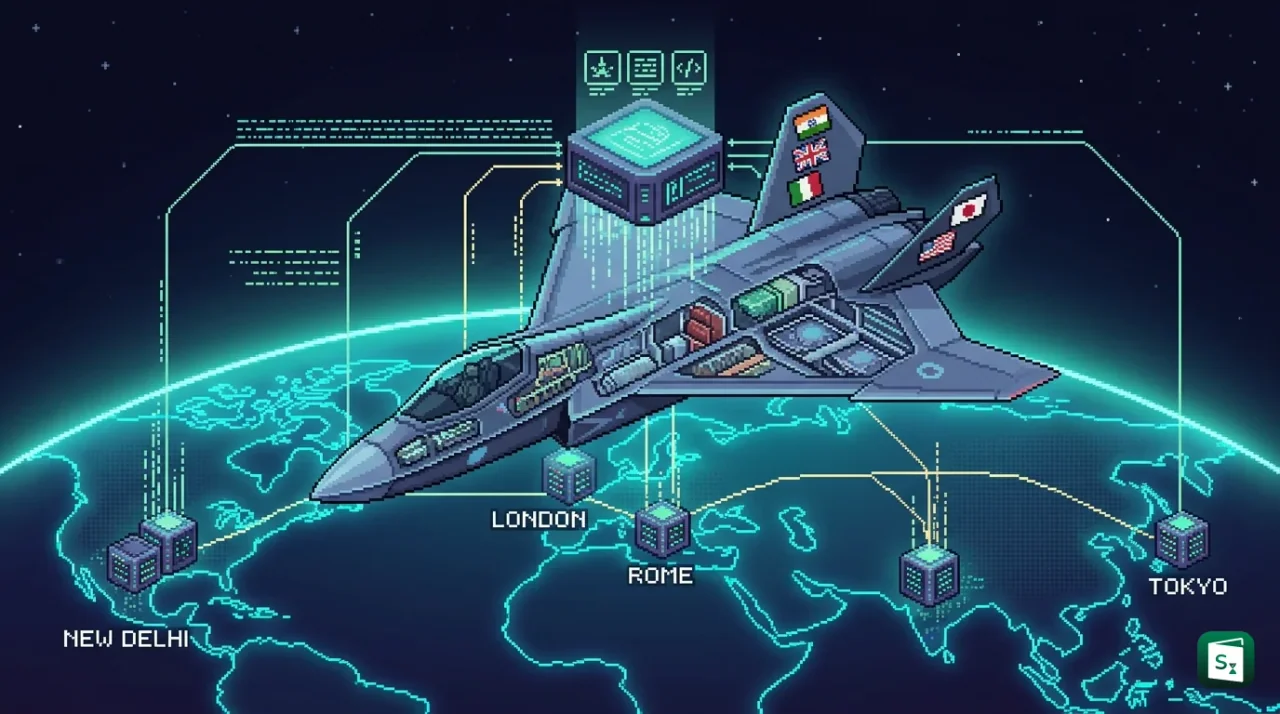
India has formally secured dialogue partner status in the Global Combat Air Programme (GCAP), the United Kingdom, Japan and Italy led project to build the Tempest sixth generation fighter jet. The status gives New Delhi access to high level discussions on the design, technology and capabilities of the future aircraft, though it does not make India a co developer or buyer. The move comes as India pushes ahead with its own fifth generation Advanced Medium Combat Aircraft (AMCA) while China tests sixth generation prototypes and the global race for future air power intensifies.
What Is GCAP and What Does Dialogue Partner Status Mean?
GCAP stands for the Global Combat Air Programme. It is a joint project of the United Kingdom, Japan and Italy to design and build a crewed sixth generation stealth fighter, widely called Tempest. The programme aims to put the new aircraft into service by 2035 to replace the Eurofighter Typhoon in British and Italian service and the Mitsubishi F-2 in Japanese service.
Dialogue partner status means the three core members have agreed to hold structured talks with India about the fighter, its progress, technology direction and operational ideas. It does not make India a buyer, co developer or funding member, and it does not give access to classified design data or protected technologies. It also gives India no vote in programme governance or work share decisions. In simple terms, India now has a seat at the discussion table, but not yet a share in the factory.
This limited entry is different from full membership or observer status. Canada joined GCAP as an observer on 21 July 2026, which is a formal watching role inside the process. India’s dialogue channel came after detailed talks between New Delhi and London and fits within the broader India-UK Vision 2035 framework, which includes a ten year Defence Industrial Roadmap for co design, co development and co production. Officials have said the arrangement will help Indian planners understand the concept of a sixth generation system in its broadest sense before any decision on deeper participation.
How GCAP Evolved From Tempest to a Trilateral Programme
The roots of GCAP lie in the British Tempest project, unveiled at the Farnborough Airshow in July 2018 as a future replacement for the Eurofighter Typhoon. The early work was led by Team Tempest, a group formed around BAE Systems for the airframe, Rolls-Royce for engines, Leonardo UK for electronics and MBDA UK for weapons. Italy signed a statement of intent to join Tempest in September 2019, building on earlier joint work on the Tornado and Typhoon aircraft.
Japan was separately developing its own next generation fighter under the Mitsubishi F-X project to replace its ageing F-2 fleet. Japan had already flown the Mitsubishi X-2 technology demonstrator between 2016 and 2018 and tested the XF9 engine demonstrator through IHI Corporation. Since British, Italian and Japanese needs for long range, stealth, advanced sensors and full freedom to upgrade the jet were closely aligned, the three countries agreed to merge Tempest and F-X into a single programme.
The merger was formally announced on 9 December 2022 by the leaders of the three countries, Prime Minister Rishi Sunak of the United Kingdom, Prime Minister Giorgia Meloni of Italy and Prime Minister Fumio Kishida of Japan. In December 2023, their defence ministers signed a treaty in Tokyo to create the GCAP International Government Organisation (GIGO). The treaty was ratified by all three parliaments during 2024, and GIGO is now headquartered in Reading, United Kingdom, with Japan providing its first chief executive.
How GCAP Is Governed and Built
GCAP has two delivery arms, one government and one industrial. On the government side, the GCAP Agency, overseen by a joint Steering Committee under GIGO, acts as the customer and manages requirements, timelines and contracts. On the industry side, design and manufacturing are led by Edgewing, a joint venture formally launched in June 2025 and owned in equal 33.3 percent shares by BAE Systems of the United Kingdom, Leonardo of Italy and the Japan Aircraft Industrial Enhancement Company (JAIEC), a consortium led by Mitsubishi Heavy Industries.
The wider supply chain brings in engine makers Rolls-Royce, IHI and Avio Aero, electronics firms Leonardo UK, Mitsubishi Electric and ELT Group, and weapons makers grouped as Sovereign Effects Partners including MBDA units and Mitsubishi firms. Funding has now moved from national studies to joint contracts. Edgewing received a £686 million stopgap international contract in April 2026, followed by a £4.6 billion contract in July 2026 to complete concept work and advance detailed design. The United Kingdom has earmarked £8.6 billion over four years under its Defence Investment Plan, while Italy approved €8.8 billion in further funding in February 2026.
What Makes the Tempest a Sixth Generation Fighter Jet?
A sixth generation fighter jet is not just a faster or more stealthy version of current jets. It is designed as a flying system of systems, a crewed command centre that collects, processes and shares data across satellites, ships, other aircraft and uncrewed drones in real time. While a fifth generation jet like the F-35 focuses on stealth and sensor fusion within the aircraft itself, a sixth generation jet focuses on connection and control across the whole battle space through what is called a combat cloud.
The Tempest is being built around this idea. It will be a large, twin engine, supersonic stealth aircraft with all aspect stealth shaping, which means it is shaped to avoid radar detection from all sides and also reduces heat signals. Its electronics core is called ISANKE, which stands for Integrated Sensing and Non Kinetic Effects, combined with an Integrated Communications System (ICS). In simple words, radar, infrared search, electronic warfare and secure links are fused into one picture, so the pilot gets a complete live view and can jam enemy systems without firing a shot.
Other planned features include artificial intelligence (AI) assistance for the pilot, manned unmanned teaming with loyal wingman drones that fly alongside the crewed jet, and far higher electrical power to run sensors, data links and future directed energy weapons, which are laser based defences. The engine is a next generation turbofan being developed jointly by Rolls-Royce, IHI and Avio Aero, aimed at higher thrust, longer range and more cooling for hot electronics. British outlines have spoken of roughly double the weapon payload of an F-35A, internal fuel for very long Pacific and Mediterranean missions, and an open software design that allows upgrades through its planned service life beyond 2070.
| Feature | Fifth Generation Jets (like F-35) | Sixth Generation Tempest (planned) |
|---|---|---|
| Core idea | Stealth plus own sensors | Stealth plus combat cloud control across forces |
| Stealth | Low radar visibility from front | All aspect stealth with lower heat signal |
| Team work | Limited link with other jets | Controls loyal wingman drones and shares data widely |
| Pilot support | Sensor fusion on displays | AI co pilot help, single pilot with decision support |
| Power and weapons | Fixed design with upgrades | High electrical power for lasers, hypersonic missiles and software upgrades |
A crewed supersonic demonstrator called the Combat Air Flying Demonstrator (CAFD), built by BAE Systems at Warton, is already under construction and is expected to fly in 2027. A second test aircraft, Excalibur, a modified Boeing 757, is testing radar and electronic warfare systems. The production design is expected to freeze in the late 2020s, with first production aircraft flying in the early 2030s and entry into service targeted for 2035. Leonardo has estimated that up to 350 aircraft could be ordered by the three core nations, and its chief executive said in July 2026 that service could even move forward by about two years if early requirements are kept simple.
Why India Joined Now and How It Links to AMCA
India joined the conversation at a time when its fighter fleet needs both numbers and new technology. The Indian Air Force is cleared for 42 squadrons but holds around 31 squadrons, and it still flies a mix of fourth generation aircraft such as the Su-30MKI, Rafale, Mirage 2000, Jaguar and the indigenous Light Combat Aircraft (LCA) Tejas. The Tejas, built by Hindustan Aeronautics Limited (HAL), is India’s home grown light fighter, while the LCA Mark 2, a larger and more capable version, is expected to make its first flight by June 2026. These programmes keep production lines running, but they do not give India stealth or sixth generation systems.
The main bridge to the future is the Advanced Medium Combat Aircraft (AMCA). AMCA is India’s planned twin engine stealth fighter in the 25 tonne class, with an internal weapons bay, low radar visibility, advanced sensor fusion and supercruise ability, which means flying faster than sound without using extra fuel guzzling afterburners. The project received sanction from the Cabinet Committee on Security (CCS) in March 2024 and is executed by the Aeronautical Development Agency (ADA) under the Defence Research and Development Organisation (DRDO). The plan is to build five prototypes, roll out the first prototype by the end of 2028 and fly it in early 2029, with induction aimed for 2034 to 2035 and around seven squadrons planned in the long run. The Mark 1 version will use American GE F414 engines, while the Mark 2 is planned around a more powerful 110 kN engine to be co developed, with early indigenous content targeted at 75 percent rising to 85 percent.
Dialogue access to GCAP helps this journey without replacing it. Indian planners can study how a sixth generation programme handles stealth shaping, high power engines, gallium nitride based radars, secure data links and teaming of a crewed jet with uncrewed wingmen. Defence Secretary Rajesh Kumar Singh has said India is weighing both GCAP and the French led Future Combat Air System (FCAS) because developing such jets alone needs very large funds and deep technology. The Parliamentary Standing Committee on Defence has also asked the Air Force to plan early so India does not fall behind in sixth generation air power as it did in the fifth generation, especially as China flies the J-20 and J-35 stealth fighters and has tested prototypes reported as the J-36 and J-50.
GCAP vs FCAS vs AMCA, How the Fighter Programmes Compare
India is tracking two separate sixth generation efforts abroad while building its own fifth generation jet at home. GCAP is the British, Japanese and Italian programme described above. FCAS stands for Future Combat Air System, a separate sixth generation system of systems centred on a crewed New Generation Fighter plus remote carrier drones and a combat cloud. It was launched in 2017 by France with Germany and later Spain, led on the fighter side by Dassault Aviation with Airbus as a key partner. In June 2026, France and Germany ended joint fighter development after disputes over design authority, work share, intellectual property and different needs on carrier use and nuclear roles. France has since kept the vision alive and held talks with India for co design, co development and co production.
The Defence Ministry told the Parliamentary Standing Committee on Defence in August 2026 that it has started concerted efforts to co join the French led FCAS, while it separately secured dialogue access to GCAP later that month. In simple terms, the FCAS track is about possible co development, while the GCAP track is at present only about structured dialogue and learning. Both tracks sit above the fully national AMCA track, which remains India’s assured path to a home built stealth fighter.
| Aspect | GCAP Tempest | FCAS New Generation Fighter | AMCA India |
|---|---|---|---|
| Partners | United Kingdom, Japan, Italy | France led, earlier with Germany and Spain, India in talks | India alone through ADA, DRDO and industry |
| Generation and type | Sixth generation crewed stealth fighter plus drones | Sixth generation system of systems with crewed fighter plus remote carriers | Fifth generation twin engine stealth fighter |
| Status and timeline | Design phase, demonstrator flight in 2027, service aimed for 2035 | Fighter on drawing board, first flight once talked for 2028 to 2029, timeline under reset after 2026 split | Design ready, prototype rollout by end 2028, first flight in early 2029, induction by 2034 to 2035 |
| India role today | Dialogue partner for talks, no buyer or developer tag | Exploratory talks for co development and work share | Full owner, five prototypes and private production partner model |
| Core gain for India | Insight into sixth generation design, propulsion and teaming ideas | Possible design share, engine and radar technology and production in India | Self reliance, jobs, supply chain and assured fleet numbers |
What This Means for India and the Way Forward
For the armed forces, early exposure to sixth generation thinking helps shape future choices on sensors, weapons, data links and how a crewed fighter will direct drones. For domestic industry, even talks level access signals trust and opens doors for later links in subsystems, materials, software and testing, if India moves closer. For foreign policy, engaging both GCAP and FCAS mirrors India’s wider approach of diversifying defence ties, with the United Kingdom under Vision 2035 on one side and the long standing partnership with France on Rafale jets, Scorpene submarines and jet engine work on the other.
The limits are equally clear. Dialogue status brings no technology transfer, no production share and no promise of delivery dates for India. A full move into GCAP would need the consent of all three core nations, a funding share running into billions, and care to protect the tight 2035 schedule that Japan in particular treats as urgent for replacing its F-2 fleet. Industry leaders have said any new partner would need to decide by the end of 2026 to avoid disturbing design freeze and production planning around 2030. A deeper FCAS role would also need hard answers on design authority, ownership of software and weapons integration freedom, an area where India learnt tough lessons after leaving the Russian Fifth Generation Fighter Aircraft (FGFA) project in 2018 over work share and capability concerns.
The practical path is therefore a parallel one. India will push AMCA prototypes, engine co development and private sector manufacturing through the Request for Proposal issued in May 2026 to three shortlisted groups, which sets a first flight within 30 months of contract and 1,800 test sorties across five prototypes within 84 months. At the same time, it will use GCAP dialogue meetings and FCAS talks to judge where outside collaboration truly adds value in combat cloud software, autonomous teaming and advanced propulsion. The Standing Committee has asked for a clear roadmap and tentative acquisition timeline, and the next decisions on money, work share and technology rights will show whether dialogue grows into development or stays as a learning window.
Key Takeaways
- India secured dialogue partner status in the Global Combat Air Programme (GCAP) in August 2026, giving access to talks but not buyer or developer rights.
- GCAP is a United Kingdom, Japan and Italy project launched on 9 December 2022 to build the Tempest sixth generation fighter for service by 2035.
- The programme is run by the GCAP International Government Organisation in Reading and built by Edgewing, owned equally by BAE Systems, Leonardo and JAIEC.
- Canada joined GCAP as an observer on 21 July 2026, while India holds a separate dialogue channel linked to India-UK Vision 2035.
- India’s home grown AMCA stealth fighter aims for prototype rollout by end 2028 and first flight in early 2029, with induction by 2034 to 2035.
- India is also holding talks to co join the French led Future Combat Air System (FCAS) after the France Germany fighter split in June 2026.