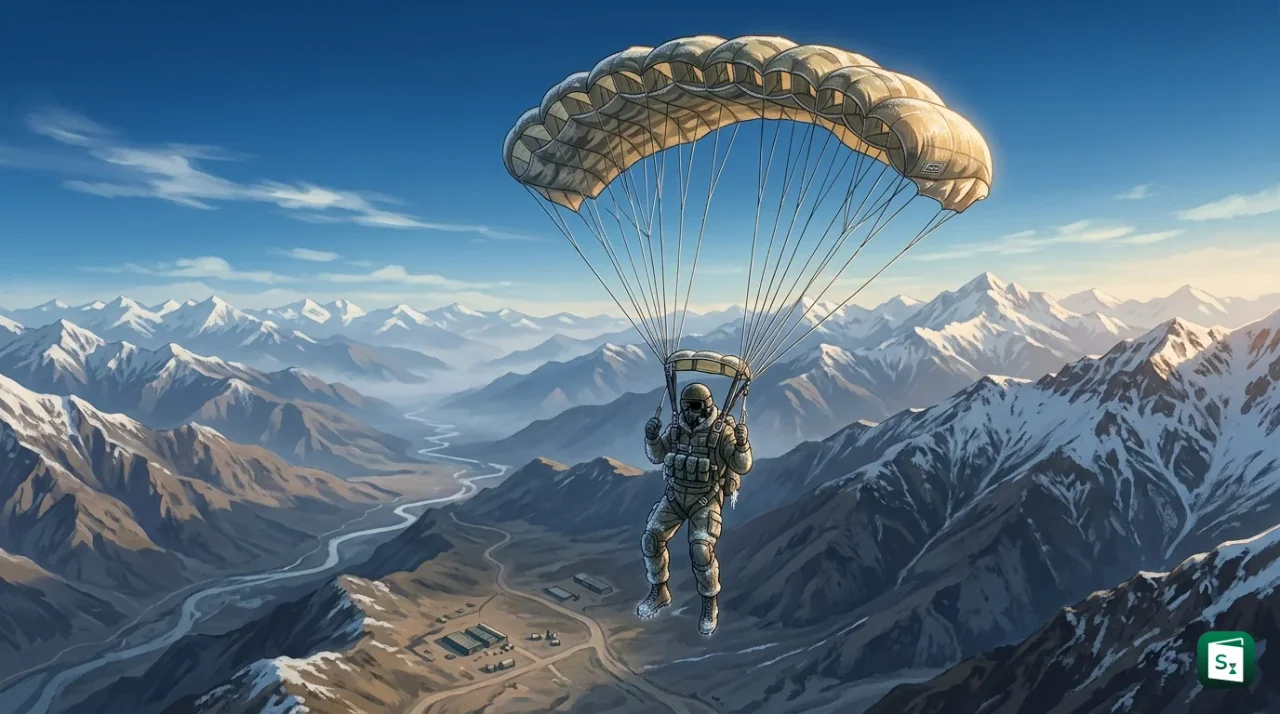
The Defence Research and Development Organisation tested its indigenous Military Combat Parachute System on 26 August 2026 at the Nyoma-Mudh Drop Zone in eastern Ladakh. Three test jumpers exited the aircraft at 22,000 feet above mean sea level in minus 15°C cold and landed safely at 13,700 feet. The trial proved that Indian special forces can now be inserted with combat loads in extreme high altitude conditions using home built equipment.
What Is the Military Combat Parachute System?
The Military Combat Parachute System (MCPS) is an indigenous parachute platform built for the silent insertion of special forces soldiers with full combat loads into marked operational areas. A soldier jumps from an aircraft, opens the parachute at a fixed height, steers it in the air and lands safely at the target point.
MCPS stands for Military Combat Parachute System. It is different from a normal adventure parachute because it is designed for military free fall from very high altitudes, for carrying heavy battle loads, and for accurate steering in thin air and strong winds. The system weighs about 22 kilograms and can carry a jumper with equipment weighing between 50 kilograms and 200 kilograms. It is cleared for free fall deployment up to 30,000 feet.
The system was developed against Joint Services Qualitative Requirement No. 1670, revised in 2022, for the three Services and the Special Frontier Force. Its qualification schedule follows international standards and has been approved and certified by the Centre for Military Airworthiness and Certification (CEMILAC), the body that certifies military aircraft and related stores in India.
How the Nyoma Trial Was Conducted
The trial took place on 26 August 2026 at the Nyoma-Mudh Drop Zone in Leh district of Ladakh. Nyoma is one of the highest drop zones in the world and sits close to the Line of Actual Control with China.
Three test jumpers of the Aerial Delivery Research and Development Establishment took part. They were Wing Commander Rahul Jha, the chief test jumper, Master Warrant Officer R J Singh and Master Warrant Officer Vivek Tiwari. They jumped from 22,000 feet above mean sea level where the temperature was around minus 15°C. Above mean sea level means height measured from the average sea surface, which is the standard way to state aircraft and parachute altitudes.
The team opened the main canopy at 20,000 feet and landed safely at 13,700 feet. That means they steered the parachute through a descent of more than 6,000 feet in very thin and cold air. They used the complete indigenous package during the jump, including the para computer, the oxygen breathing system and specially designed thermal jumpsuits. The para computer is a small onboard electronic device that helps with altitude sensing and automatic opening of the parachute if needed.
This was not the first high altitude success for MCPS. In October 2025, Indian Air Force test jumpers completed a combat free fall from 32,000 feet using the same system. That test made MCPS the only parachute system with the Indian Armed Forces that can be used above 25,000 feet.
What Makes MCPS Different: Design and Technical Features
MCPS is not a single canopy. It is a complete combat kit that combines the parachute with navigation, breathing and safety gear. The parachute part includes a main canopy assembly and a reserve canopy assembly, a container with harness, a carrying bag, a throw out pilot chute kept at the bottom of the container, a double deployment bag for static line jumps and an Automatic Activation Device (Military). The automatic device opens the reserve parachute on its own if the jumper is unable to do so at a set height.
The kit also carries a satellite navigation system, a magnetic compass, an altimeter and a radio pocket for communication. The altimeter is an instrument that shows height above the ground. The satellite navigation unit works with NavIC, which stands for Navigation with Indian Constellation. NavIC is India’s regional satellite navigation system built by the Indian Space Research Organisation. Using NavIC lowers dependence on foreign navigation signals and keeps the system working even if outside signals are blocked.
Two design qualities matter most for soldiers. The first is a lower rate of descent, which means the parachute comes down more slowly and lands with less shock. The second is better steering, which lets the jumper turn the canopy accurately toward the landing point. The oxygen pocket, oxygen breathing system and thermal jumpsuit protect the jumper from lack of oxygen and frostbite during the long fall through freezing air.
How HAHO, HAMO and HALO Jumps Work
MCPS supports three opening modes, and the commander can choose the mode based on the mission. HAHO stands for High Altitude High Opening. HAMO stands for High Altitude Medium Opening. HALO stands for High Altitude Low Opening. In all three, the aircraft flies high so that it stays away from enemy air defence, and the soldier jumps from that height.
In a HAHO jump, the soldier opens the parachute soon after leaving the aircraft and then glides a long distance under the canopy, sometimes more than 40 miles, to cross into enemy territory without the aircraft entering it. In a HALO jump, the soldier falls freely for a long time and opens the parachute very low, at about 3,000 to 4,000 feet above the ground. This keeps the canopy hidden from radar and eyes on the ground for most of the fall. HAMO is the middle path between the two. MCPS allows soldiers to use any of these three methods as the situation demands.
Who Built MCPS: ADRDE and DEBEL
The parachute system was designed and developed by the Aerial Delivery Research and Development Establishment (ADRDE), located in Agra, Uttar Pradesh. ADRDE is a laboratory of the Defence Research and Development Organisation (DRDO). DRDO stands for Defence Research and Development Organisation. It was formed in 1958 and works under the Ministry of Defence. It is headquartered at DRDO Bhawan in New Delhi and its motto is Balasya Mulam Vigyanam, which means strength has its origin in science. ADRDE specialises in parachutes, heavy drop systems that drop vehicles and supplies from aircraft, brake parachutes that slow down fighter jets on landing, recovery parachutes for space capsules and unmanned aircraft, and aerostats, which are large tethered balloons used for observation.
The high altitude oxygen breathing system and individual gear were developed by the Defence Bioengineering and Electromedical Laboratory (DEBEL), located in Bengaluru, Karnataka. DEBEL works on life sciences for soldiers, such as oxygen systems for pilots, protection against cold and high altitude sickness, and medical electronics. Keeping a jumper alive and active at 22,000 feet needs both parts to work together. ADRDE ensures the canopy opens and steers correctly in thin air, while DEBEL ensures the soldier can breathe, stay warm and think clearly during the descent.
| Organisation | Full Form | Location | Role in MCPS |
|---|---|---|---|
| DRDO | Defence Research and Development Organisation | New Delhi, formed in 1958 | Parent defence research agency under Ministry of Defence |
| ADRDE | Aerial Delivery Research and Development Establishment | Agra, Uttar Pradesh | Main and reserve canopy, harness, navigation gear, para computer |
| DEBEL | Defence Bioengineering and Electromedical Laboratory | Bengaluru, Karnataka | Oxygen breathing system, thermal jumpsuit and individual gear |
| CEMILAC | Centre for Military Airworthiness and Certification | Bengaluru, Karnataka | Certification of design and qualification tests |
Why Nyoma in Ladakh Matters for Special Operations
Nyoma is a town in the Changthang region of eastern Ladakh, on the southern side of the Indus river. The Mudh-Nyoma Air Force Station near it sits at about 13,700 feet and lies only about 23 to 35 kilometres from the Line of Actual Control. The Line of Actual Control is the unsettled boundary between India and China in Ladakh. The airfield was first built as a mud strip during the 1962 war with China, was revived as an Advanced Landing Ground in 2009, and was fully operationalised as a fighter capable base in November 2025 after the Border Roads Organisation built a 2.7 kilometre paved runway at a cost of about ₹218 crore.
Testing at Nyoma is different from testing on a comfortable range in the plains. At this height the air is thin, so the parachute fills more slowly and falls faster. The cold is severe, with winter temperatures falling to minus 30°C, and the trial itself faced minus 15°C. Low oxygen can cause loss of judgement or fainting, which is why the oxygen system and automatic opening device are so important. Navigation is also harder because winds are strong and landmarks are covered in snow.
There is a direct operational logic as well. Ladakh is the actual area where India may need high altitude insertion of the Para Special Forces and the Parachute Regiment. The Parachute Regiment is the airborne infantry regiment of the Indian Army, and its special forces battalions carry out covert insertion behind enemy lines. A successful jump at Nyoma shows the equipment works in the same cold, thin air and rugged terrain where soldiers would use it in a real mission.
Significance for Self Reliance and Future Induction
India has long imported high altitude parachutes and combat free fall gear for special forces. An indigenous system changes that position in three ways. First, it cuts import dependence for a critical combat capability and keeps repair, spares and upgrades within the country. Second, integration with NavIC and Indian made sensors makes the system more secure against jamming or denial of foreign signals. Third, local production allows faster supply to the Army, Air Force and Special Frontier Force.
The successful Nyoma trial does not mean immediate induction. A development trial is followed by user trials by the Army and Air Force, where soldiers test the system in real field conditions. Only after those trials and final clearance does bulk production begin, likely through transfer of technology to Indian industry. The earlier 32,000 feet test in October 2025 and the present 22,000 feet cold weather test together build the safety record needed for that next step. For Ladakh and other high altitude fronts, a certified home built combat parachute directly strengthens covert insertion, rapid reinforcement and high altitude warfare capacity.
Key Takeaways
- The Military Combat Parachute System (MCPS) was tested on 26 August 2026 at the Nyoma-Mudh Drop Zone in Leh, Ladakh.
- Test jumpers jumped from 22,000 feet in minus 15°C, opened the canopy at 20,000 feet and landed safely at 13,700 feet.
- MCPS was designed by ADRDE, Agra, while life support gear was built by DEBEL, Bengaluru and certified by CEMILAC.
- The system supports HAHO, HAMO and HALO modes and is integrated with NavIC, India’s regional satellite navigation system.
- In October 2025, MCPS completed a combat free fall from 32,000 feet, making it the only Indian system usable above 25,000 feet.
- DRDO was formed in 1958, works under the Ministry of Defence and is headquartered at DRDO Bhawan, New Delhi.