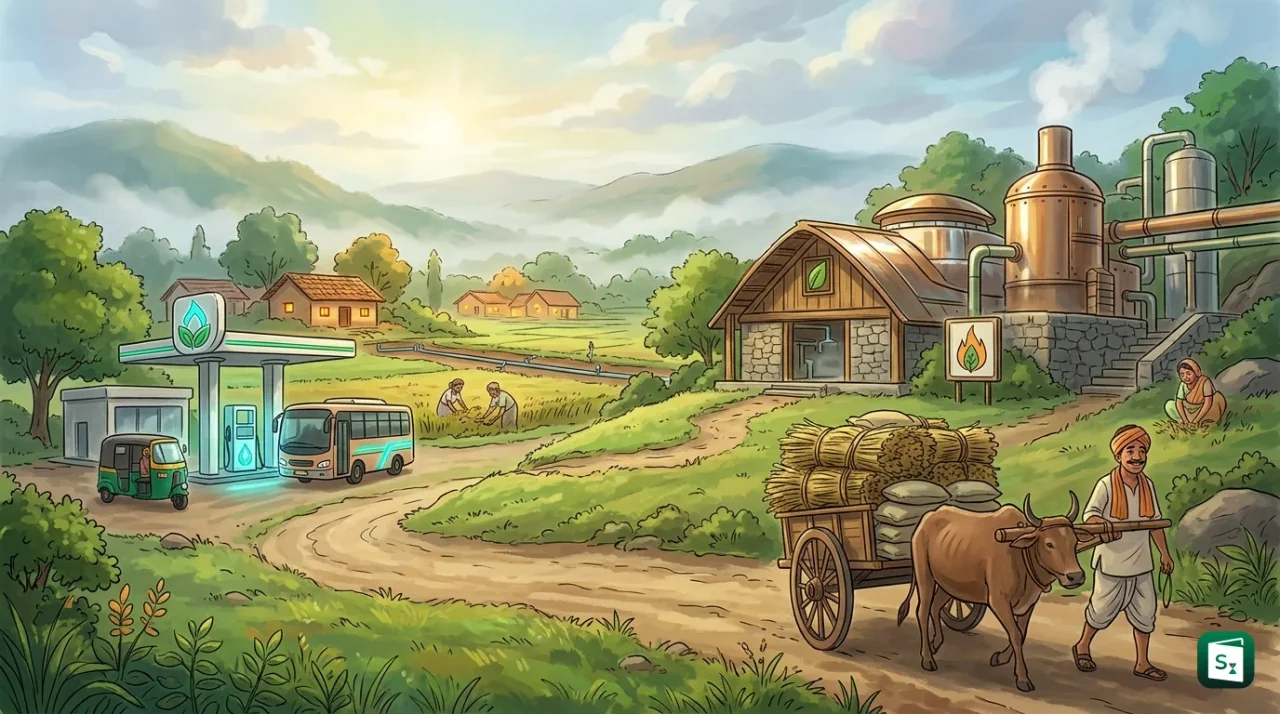
The Union Cabinet, chaired by the Prime Minister, approved the GOBARdhan National Circular Bioenergy Scheme on 6 August 2026 with a total outlay of ₹23,731 crore. Implemented from FY 2026-27 to FY 2035-36, the scheme aims to establish Compressed Biogas (CBG) as a major pillar of India’s energy mix and to grow domestic CBG production nearly ten-fold. It does so by bundling assured demand, stable pricing, capital support, pipeline connectivity, credit access and technology development into a single national framework.
What Is the GOBARdhan National Circular Bioenergy Scheme?
GOBARdhan stands for Galvanizing Organic Bio-Agro Resources Dhan. The name was introduced in the Union Budget 2018-19, and the initiative was formally launched on 30 April 2018 by the Department of Drinking Water and Sanitation as part of the Swachh Bharat Mission (Grameen). Its founding purpose was simple: turn cattle dung, agricultural residue and other organic waste into biogas, bio-CNG and manure, instead of letting it rot or burn.
Over time, GOBARdhan grew from a rural sanitation programme into an umbrella, whole-of-government initiative coordinating schemes across several ministries. The new National Circular Bioenergy Scheme, however, gives GOBARdhan a far bigger role. It is administered by the Ministry of Petroleum and Natural Gas (MoPNG), which has been designated the nodal ministry for CBG projects, and it folds several scattered support programmes into one integrated platform spanning the entire CBG value chain, from feedstock collection to retail dispensing.
The scheme’s stated ambitions are broad. It seeks to turn agricultural residue, cattle dung, press mud from sugar mills, municipal organic waste and other biomass into clean fuel, organic manure, rural income and national economic value. Officials describe the expected gains as nearly ten-fold growth in domestic CBG production, a fresh wave of private investment, cleaner waste management, lower greenhouse gas emissions and a larger organic manure economy.
Understanding Compressed Biogas (CBG)
Compressed Biogas (CBG), also called Bio-CNG, is purified and compressed biogas produced from organic waste. The process begins with anaerobic digestion, where bacteria break down organic matter in sealed tanks called digesters in the absence of oxygen. This yields raw biogas, which typically contains 55 to 65 percent methane, along with carbon dioxide, hydrogen sulphide and moisture.
Raw biogas must be upgraded before it can be used as vehicle fuel. Purification plants strip out the carbon dioxide and hydrogen sulphide, raising the methane content to over 90 percent, and the gas is then compressed to about 250 bar pressure. The result is a fuel that is chemically and energetically almost identical to Compressed Natural Gas (CNG), meeting the BIS standard IS 16087:2016. Because of this similarity, CBG can be blended directly into CNG and piped natural gas (PNG) supplies, injected into gas grids, or used in place of natural gas in industry.
A wide range of feedstocks can feed a CBG plant. The most common are agricultural residue such as paddy straw, cattle dung, press mud from the sugar industry, municipal organic waste, sewage sludge, food waste and poultry litter. Yield varies by feedstock: roughly 25 tonnes of press mud or about 50 tonnes of cattle dung are needed to produce a tonne of CBG. Studies estimate India’s total feedstock potential at around 472 million tonnes, capable of generating roughly 230 million standard cubic metres per day of biogas, with overall CBG potential put between 40 and 60 million tonnes per year.
The plants also leave behind a valuable by-product. The digested slurry is processed into Fermented Organic Manure (FOM), Liquid Fermented Organic Manure (LFOM) and Phosphate Rich Organic Manure (PROM), which are sold as organic fertilisers. This two-product model, clean fuel plus manure, is central to the economics of every CBG plant.
The CBG Blending Obligation: A Legal Demand Guarantee
The CBG Blending Obligation (CBO) is the mechanism that guarantees a market for CBG producers. In November 2023, the National Biofuels Coordination Committee (NBCC), chaired by the Union Petroleum Minister, decided to make blending of CBG with natural gas mandatory in a phased manner. The obligation applies to the Compressed Natural Gas (CNG) segment used in transport and the Piped Natural Gas (PNG) segment used in households, both part of the City Gas Distribution (CGD) network.
Blending was voluntary during FY 2024-25 and became mandatory from FY 2025-26. The trajectory requires CBG to form a rising share of total CNG and domestic PNG sales, as shown below:
| Financial Year | Mandatory CBG Blending Obligation |
|---|---|
| FY 2025-26 | 1% |
| FY 2026-27 | 3% |
| FY 2027-28 | 4% |
| FY 2028-29 onwards | 5% |
Compliance is monitored by the Petroleum Planning and Analysis Cell (PPAC), which acts as the Central Repository Body. City gas distributors and oil marketing companies submit quarterly reports on how much CBG they have blended. The GOBARdhan scheme converts this obligation into an offtake assurance framework, meaning CGD entities are effectively required to procure CBG, giving producers a predictable buyer.
Progress so far is encouraging but modest. The CNG and domestic PNG segments together consume roughly 34 to 35 million metric standard cubic metres per day (MMSCMD) of gas. Daily CBG sales touched about 0.66 MMSCMD in April 2026 and 0.63 MMSCMD in May 2026, equivalent to nearly 2 percent blending, double the level of a year earlier. The 1 percent target for FY 2025-26 has already been met, and officials say the sector is on track for the 3 percent obligation in the current financial year.
The Six Growth Engines of the Scheme
The government has structured GOBARdhan around six components, described as growth engines, each addressing a specific weakness that has held the CBG sector back:
| Component | What It Provides |
|---|---|
| Assured CBG Offtake | Mandatory procurement by City Gas Distribution entities to meet the CBG Obligation |
| Stable CBG Pricing | Administered price of ₹2,110 per MMBTU for a minimum of 10 years |
| Capital Assistance | Up to ₹2 crore per tonne per day of installed capacity for greenfield projects |
| Pipeline Infrastructure | Cluster-based and standalone pipelines connecting CBG plants to gas networks |
| Credit Guarantee Support | Risk-sharing to improve institutional credit for MSME-based projects |
| CBG Ecosystem Challenge Fund | District-level planning, feedstock mapping and value-chain support |
Assured Offtake and Stable Pricing
The administered CBG price of ₹2,110 per MMBTU is the scheme’s centrepiece. MMBTU stands for Million British Thermal Units, a standard unit of energy used to price gas. The government-backed pricing framework protects producers from price swings and gives lenders revenue certainty, while a market-based cost-sharing mechanism is meant to keep the burden on consumers manageable. The price is fixed for a minimum of 10 years.
For context, the earlier SATAT scheme offered CBG producers ₹46 per kilogram when it began in 2018, and the GAIL-run CBG-CGD synchronisation scheme currently works on a floor price of ₹770 per MMBTU. The new administered price is therefore a substantial step up in both level and certainty.
Analogy · An MSP for Clean Gas Expand analogy
Think of the administered CBG price as a Minimum Support Price (MSP), but for clean gas instead of crops. Just as an MSP assures a farmer a fixed return before the sowing season, this price lets a CBG developer sign loans and build a plant in the confidence that gas will fetch a fair, stable price for a decade.
Capital Assistance, Pipelines and Credit
Eligible greenfield CBG projects will receive capital assistance of up to ₹2 crore per tonne per day (TPD) of installed capacity. The support is not limited to core plant machinery. It extends to critical value-chain assets such as feedstock aggregation infrastructure, organic manure processing and value-addition units. Brownfield projects that expand their existing capacity are also eligible, a provision designed to reward plants that choose to grow.
The scheme supports both cluster-based and standalone pipeline infrastructure connecting CBG plants with trunk pipelines and CGD networks. Better connectivity lowers evacuation costs, improves reliability and widens the market for producers. A dedicated Credit Guarantee mechanism shares a portion of lending risk for MSME-based projects, cutting collateral requirements and widening access to affordable finance for first-time developers, women entrepreneurs and rural cooperatives.
CBG Ecosystem Challenge Fund
The CBG Ecosystem Challenge Fund is designed to accelerate implementation at the district level. It will finance feedstock resource assessment and mapping, feedstock aggregation infrastructure, district-level CBG development planning, technology adoption, process improvements, value addition of organic manure, capacity building and stakeholder awareness. The aim is to build strong local supply chains so that feedstock, the single biggest operational risk for CBG plants, is secured before projects are sanctioned.
Building on India’s CBG Foundation
GOBARdhan does not start from scratch. It consolidates support programmes that have nurtured the CBG sector over the past eight years.
The flagship among them is SATAT, the Sustainable Alternative Towards Affordable Transportation initiative, launched by MoPNG on 1 October 2018. SATAT set a target of 5,000 CBG plants producing 15 million tonnes of CBG a year, with state-owned oil marketing companies such as IOCL, BPCL, HPCL, GAIL and IGL offering to buy CBG at a fixed price of ₹46 per kilogram. The scheme issued well over a thousand letters of intent, but execution lagged. As of August 2026, only about 219 CBG plants are operational against the 5,000 target, even as roughly 210 plants have been commissioned, about 324 are under construction and another 1,200-plus are registered but yet to begin work.
Other building blocks include the Market Development Assistance (MDA) Scheme of the Department of Fertilizers, which pays ₹1,500 per tonne to promote the sale of FOM, LFOM and PROM produced at GOBARdhan and CBG plants, with a budget of ₹1,451.82 crore for FY 2023-24 to FY 2025-26. MoPNG separately runs the Biomass Aggregation Machinery (BAM) Scheme for feedstock collection equipment and the Development of Pipeline Infrastructure (DPI) Scheme for gas grid connectivity. The Ministry of New and Renewable Energy (MNRE) provides Central Financial Assistance (CFA) of up to ₹4 crore per 4,800 kilograms per day of Bio-CNG capacity under the National Bioenergy Programme, a scheme with an outlay of ₹858 crore for FY 2021-22 to FY 2025-26.
There is also the CBG-CGD Synchronisation Scheme, under which GAIL buys CBG from producers and sells it co-mingled with domestic gas at a uniform base price to all CGD entities, making blending technically simple. GOBARdhan now brings these threads together under one administrator, one pricing framework and one set of rules.
Why the Scheme Matters
The strategic logic of GOBARdhan rests on India’s deepening dependence on imported gas. India now imports roughly half of its natural gas requirement and is the fourth-largest importer of liquefied natural gas (LNG) in the world. Total gas demand stood around 192 MMSCMD in FY 2025-26, and price shocks, such as those triggered by the crisis in the Strait of Hormuz, directly expose households, transport and industry to global volatility. Every unit of domestically produced CBG is a unit of import substitution.
The scheme also advances the government’s long-standing goal of building a gas-based economy, under which the share of natural gas in India’s primary energy mix is to rise to 15 percent by 2030 from about 6 percent today. Because CBG is chemically identical to natural gas, it can plug into the existing gas grid without new consumer-side investment. The CGD network already covers about 300 geographical areas spanning roughly 98 percent of the population, giving CBG a ready distribution backbone.
Equally important are the rural and environmental dividends. CBG plants create demand for paddy straw, whose burning in fields is a major source of winter air pollution in northern India, and for cattle dung and press mud that would otherwise be waste. Every plant generates jobs in feedstock collection, transport, plant operations and manure marketing, and farmers gain a new income stream. The manure economy, pushed by the MDA Scheme, also reduces dependence on chemical fertilisers and improves soil health. Analysts estimate that scaling CBG could cut India’s gas import bill by about ₹17,000 crore a year by FY 2028-29.
The Way Forward
The biggest test for GOBARdhan will be execution. The SATAT experience showed that letters of intent do not translate automatically into working plants. Feedstock supply remains seasonal and fragmented, quality varies across sources, pipeline connectivity is still missing in many clusters, and disposal of the carbon dioxide co-product adds cost. The scheme answers each of these with assured offtake, a decade-long price, capital subsidies, pipeline support, credit guarantees and the Challenge Fund, but the response will only count if states and districts move quickly.
Government officials expect the improved incentives to support the commissioning of 600 to 700 additional CBG plants in the coming year alone. Large private players have already signalled intent: Reliance has announced plans to invest ₹1.4 lakh crore in CBG, Adani TotalEnergies is building plants including a 600-tonne-per-day facility in Uttar Pradesh, and Suzuki has lined up cattle-dung-based plants in Gujarat. A Model State CBG Policy has been circulated urging states to offer concessional land, feedstock security and other enablers.
If the trajectory holds, GOBARdhan could turn India’s rural organic waste into a national energy resource, reduce LNG imports, cut stubble-burning pollution and put cash in farmers’ hands, all while moving the country closer to its 2070 net-zero commitment and the vision of Viksit Bharat. For the moment, the scheme converts a promising sector into a policy-backed industry, and the next few years will show how quickly the promised ten-fold growth in compressed biogas becomes reality.
Key Takeaways
- The Union Cabinet approved the GOBARdhan National Circular Bioenergy Scheme on 6 August 2026 with an outlay of ₹23,731 crore, to run from FY 2026-27 to FY 2035-36.
- The scheme is administered by the Ministry of Petroleum and Natural Gas (MoPNG), the designated nodal ministry for Compressed Biogas projects.
- An administered CBG price of ₹2,110 per MMBTU has been fixed for a minimum of 10 years to give producers revenue certainty.
- The CBG Blending Obligation on City Gas Distribution entities rises from 3 percent in FY 2026-27 and 4 percent in FY 2027-28 to 5 percent from FY 2028-29 onwards in the CNG and domestic PNG segments.
- Eligible greenfield CBG projects receive capital assistance of up to ₹2 crore per tonne per day of installed capacity, with brownfield expansions also eligible.
- GOBARdhan was originally launched on 30 April 2018 under the Department of Drinking Water and Sanitation, while the earlier SATAT scheme, started on 1 October 2018, aimed at 5,000 CBG plants but has around 219 plants operational.