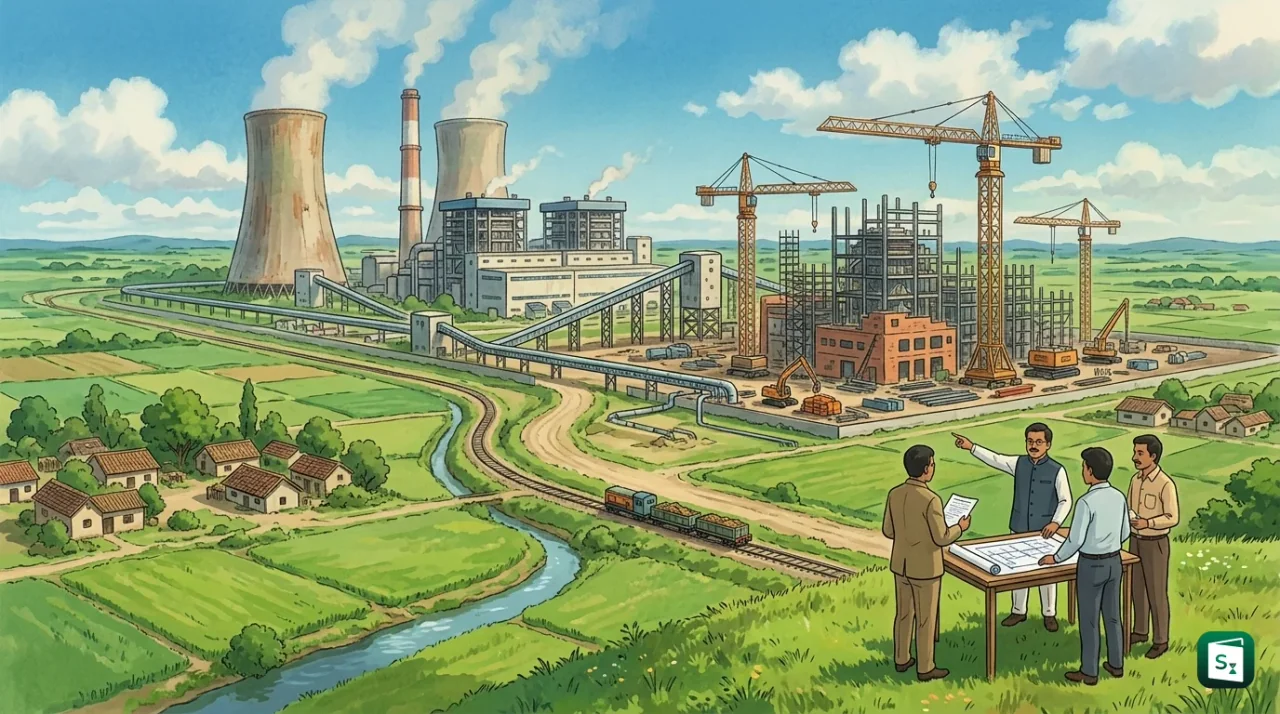
REC Limited and Power Finance Corporation (PFC) Limited signed a common loan agreement worth ₹26,850 crore with Meja Urja Nigam Private Limited (MUNPL) on 30 July 2026 in Prayagraj, Uttar Pradesh. The agreement finances the Stage-II expansion of the Meja Thermal Power Project, which will add 2,400 MW of generation capacity through three ultra-supercritical units of 800 MW each. With an estimated total project cost of ₹38,357.81 crore, the expansion represents one of the largest single thermal power investments in Uttar Pradesh and a critical step in strengthening the state’s energy security.
What Is the Meja Thermal Power Project?
The Meja Thermal Power Project is a coal-based power station located in Meja Tehsil of Prayagraj district in Uttar Pradesh. It is owned by Meja Urja Nigam Private Limited (MUNPL), a 50:50 joint venture between NTPC Limited and Uttar Pradesh Rajya Vidyut Utpadan Nigam Limited (UPRVUNL). MUNPL was incorporated on 2 April 2008 to set up and operate thermal power capacity in the state.
The project is being developed in two stages. Stage I consists of two units of 660 MW each, totalling 1,320 MW. Unit 1 was declared commercially operational in April 2019, and Unit 2 achieved commercial operation in January 2023. The Stage I plant uses supercritical technology and draws water from the Ganga River through a pipeline network of approximately 30 km from Bijora village.
Stage II is the expansion now under development. It will add three ultra-supercritical units of 800 MW each, bringing the total planned capacity at Meja to 3,720 MW. The Uttar Pradesh cabinet approved this expansion in May 2026 at an estimated investment of around ₹38,357 crore. The expansion will transform the Meja site from a 1,320 MW facility into one of the largest thermal power complexes in northern India.
The ₹26,850 Crore Loan Agreement
On 30 July 2026, REC Limited and PFC Limited signed a common loan agreement with MUNPL at Prayagraj. The loan amount of ₹26,850 crore will be funded equally by the two financiers on a 50:50 basis, with each contributing approximately ₹13,425 crore. REC Limited serves as the lead financier for the project.
The agreement was signed by Srinivasa Rao Gaddamanugu, Chief Executive Officer of MUNPL, Shambhu Shankar Gupta, Chief General Manager of REC’s Lucknow Regional Office, and Shelly Gupta, General Manager of PFC. The signing ceremony was attended by senior officials including Angshu Barua (CFO, MUNPL), H.K. Das (Executive Director, PFC), and D.B. Londhe (Executive Director, REC).
About the Financiers
Both REC and PFC are Maharatna Central Public Sector Enterprises (CPSEs) under the Ministry of Power. They are among India’s largest infrastructure financing non-banking financial companies (NBFCs), specialising in lending to the power sector.
REC Limited, formerly the Rural Electrification Corporation, was established in 1969 and is headquartered in New Delhi. It was granted Maharatna status in 2022 and provides financial assistance across the entire power value chain, including generation, transmission, and distribution.
Power Finance Corporation (PFC) was established in 1986, is also headquartered in New Delhi, and received Maharatna status in October 2021. PFC is recognised by the Reserve Bank of India as an Infrastructure Finance Company and has diversified into infrastructure and logistics financing in recent years. Notably, PFC acquired REC in 2018 and is now its parent company.
Ultra-Supercritical Technology and Air-Cooled Condenser System
Stage II of the Meja project will use ultra-supercritical (USC) technology, a significant step up from the supercritical units operating at Stage I. In thermal power generation, efficiency is determined by the temperature and pressure of the steam used to drive turbines. Subcritical plants operate below 374°C and 221 bar, while supercritical plants work at higher parameters, achieving thermal efficiency of around 41-42%. Ultra-supercritical plants push these parameters further, with steam temperatures above 600°C and pressures exceeding 275 bar, achieving thermal efficiency of approximately 46%.
This translates to lower coal consumption per unit of electricity generated and proportionally reduced carbon dioxide emissions compared to older subcritical plants, which operate at only about 32-38% efficiency. India’s Bharat Heavy Electricals Limited (BHEL), in association with the Indira Gandhi Centre for Atomic Research (IGCAR) and NTPC, has been developing indigenous advanced ultra-supercritical (AUSC) technology aimed at exceeding 50% efficiency, which would further reduce coal consumption by about 11% compared to supercritical plants.
The Meja Stage II units will also be equipped with an Air-Cooled Condenser (ACC) system. Traditional thermal power plants use water-cooled condensers, which require large volumes of water for cooling. An ACC system uses air instead of water for condensing steam back into water, significantly reducing the plant’s water footprint. This is particularly important given that the Meja site draws its water supply from the Ganga River, and conserving water is a priority for plants operating in water-stressed regions.
Why This Project Matters for Uttar Pradesh
Uttar Pradesh is India’s most populous state and one of its fastest-growing electricity markets. The state’s peak power demand has been rising steadily, driven by rapid urbanisation, expanding industrial corridors, and increasing agricultural consumption. The Uttar Pradesh government has been working to bridge the demand-supply gap by adding new generation capacity across multiple sources.
The Meja Stage II expansion directly supports these goals. Once commissioned, the 2,400 MW addition will provide reliable electricity to households, farms, industries, and growing urban centres across the state. The project is expected to create thousands of jobs during both the construction and operational phases and will boost local infrastructure development in the Meja tehsil area of Prayagraj district.
The project also fits within a broader national push to expand thermal generation capacity. While India is adding record renewable energy capacity, the government has acknowledged that thermal power remains essential for meeting baseload demand and ensuring grid stability. The draft National Electricity Policy 2026, notified in January 2026, has highlighted a multi-pronged approach to ensure energy security that includes both clean energy integration and expansion of efficient thermal capacity.
The levelised tariff for the Meja Stage II project is estimated at around ₹6.64 per unit at current prices, which could reduce to approximately ₹6.20 per unit after the plant is fully operational. This competitive pricing makes the power produced at Meja economically viable for distribution companies and consumers alike. The project is expected to be completed over a five-year construction timeline, adding substantial generation capacity to the UP grid by the end of the decade.
Key Takeaways
- REC Limited and PFC Limited signed a common loan agreement worth ₹26,850 crore with Meja Urja Nigam Private Limited (MUNPL) on 30 July 2026 to finance the 2,400 MW Meja Thermal Power Project Stage-II.
- The total estimated project cost is ₹38,357.81 crore, with REC serving as the lead financier and the debt facility funded equally (50:50) by REC and PFC.
- Stage-II will add three 800 MW ultra-supercritical units equipped with an Air-Cooled Condenser (ACC) system at Meja Tehsil, Prayagraj district, Uttar Pradesh.
- MUNPL is a 50:50 joint venture between NTPC Limited and Uttar Pradesh Rajya Vidyut Utpadan Nigam Limited (UPRVUNL), incorporated on 2 April 2008.
- REC Limited, established in 1969 and headquartered in New Delhi, and PFC, established in 1986 and also headquartered in New Delhi, are both Maharatna CPSEs under the Ministry of Power.
- Once complete, the project will raise the total capacity at the Meja site to 3,720 MW, making it one of the largest thermal power complexes in northern India.