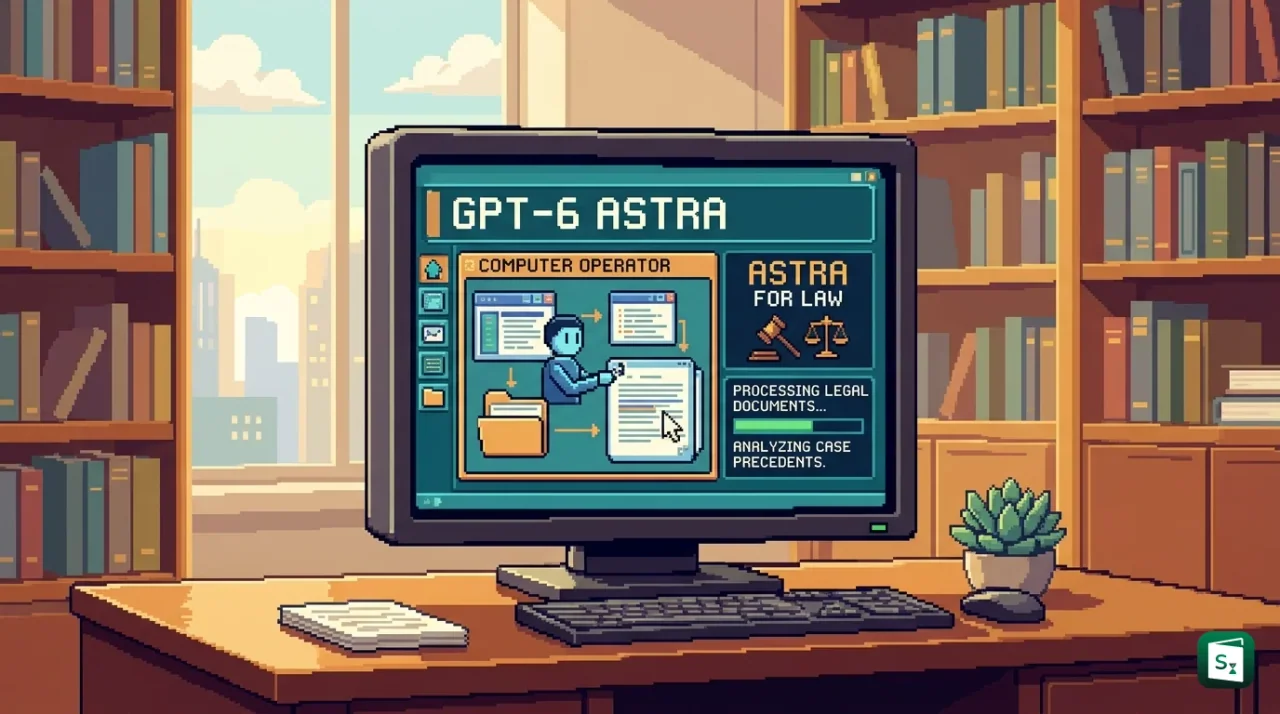
OpenAI launched GPT-6 Astra on 3 September 2026 as its most capable model yet, built to operate a computer the way a human does by seeing the screen and using a mouse and keyboard. The company, founded in 2015 and headquartered in San Francisco, California, followed this on 17 September 2026 with Astra for Law, a legal work configuration of the same model paired with a dedicated search index over more than 230 million US legal sources. Together, the two releases signal a shift from chat-only AI to an AI agent that can complete end-to-end professional work inside real software.
What Is GPT-6 Astra?
GPT-6 Astra is OpenAI’s frontier large language model released in September 2026, designed as a computer use AI that can see a graphical user interface and operate it with virtual mouse and keyboard actions. The OpenAI Astra model is built for complex reasoning, coding, browsing, software engineering, cybersecurity and scientific work, and is distinguished from earlier models by its ability to carry out multi-step workflows on a computer rather than only generating text answers. In plain terms, GPT stands for Generative Pre-trained Transformer, the architecture behind ChatGPT and all OpenAI GPT models.
OpenAI describes GPT-6 Astra as its most intelligent and aligned model so far. The OpenAI Astra system brings together advances in pre-training, reinforcement learning and alignment, and supports a large reasoning range from low to max effort levels. Astra accepts text and image input and returns text output, and it integrates tools such as web search, file search, image generation, code interpreter, hosted shell and computer use through the Responses API. The name Astra was chosen to reflect the model’s positioning as a star performer that can navigate any software built for humans.
OpenAI itself was founded on 8 December 2015 in San Francisco by a group including Sam Altman, Greg Brockman, Ilya Sutskever and Elon Musk, initially as a nonprofit research lab. Sam Altman is the Chief Executive Officer of OpenAI (as of September 2026), with Greg Brockman serving as President, and the company is headquartered in San Francisco, California. The product ChatGPT, launched in November 2022, remains the consumer front end for accessing GPT models, and GPT-6 Astra is the successor to the GPT-5.6 Sol, Terra and Luna family released earlier in 2026.
When Was GPT-6 Astra Released?
GPT-6 Astra was officially announced on 3 September 2026 and the API model gpt-6-astra was released on 4 September 2026, with Astra for Law following on 17 September 2026. OpenAI rolled out GPT-6 Astra first to a limited set of enterprise and cybersecurity Daybreak partners, then to all ChatGPT Plus, Pro, Business and Enterprise users over the coming days, and through the OpenAI API, Microsoft Azure and AWS Bedrock.
The rollout was phased. At launch, access inside ChatGPT was off by default for enterprise workspaces and required an admin to enable it. Users on Pro, Business and Enterprise plans also received access to GPT-6 Astra Pro, while usage for Plus and Business tiers followed within days. For developers, the model appeared as gpt-6-astra in the OpenAI API, as well as on Azure and Bedrock, with pricing and rate limits varying by usage tier. OpenAI noted that the training run for Astra was its largest to date, involving more than 100,000 GPUs at its Stargate site in Texas, which contributed to the need for staged scaling of compute capacity.
How Does the Computer Operator AI Work?
OpenAI’s computer operator is an AI agent that uses a computer as a person does. Instead of calling a dedicated software API for each service, the computer use AI agent looks at screenshots, understands the graphical user interface, and then decides to click, type, scroll, drag or press keys. This universal interface of screen, mouse and keyboard lets a single model work across browsers, desktop apps, spreadsheets, customer relationship management systems, calendars and code editors without needing custom integrations for every website.
The technical foundation for this goes back to OpenAI’s Computer-Using Agent (CUA), first previewed on 23 January 2025 as OpenAI Operator for ChatGPT Pro users in the United States at operator.chatgpt.com. CUA combined the vision capabilities of GPT-4o with reinforcement learning for GUI interaction and set early benchmarks of 38.1% on OSWorld, 58.1% on WebArena and 87% on WebVoyager. OpenAI later integrated Operator into ChatGPT agent on 17 July 2025, which unified browsing and deep research inside ChatGPT, and then deprecated the standalone Operator site on 31 August 2025. Astra represents the next generation of that line.
GPT-6 Astra marks a clear jump in speed, accuracy and safety for computer use. OpenAI reports that Astra can fill out online forms, update records in a CRM, organise a calendar, conduct web research and draft summaries directly into email or documents, analyse scientific data and generate plots, create a website and run frontend quality checks, and autonomously install and test software while troubleshooting errors visible on screen. In latency simulations on OSWorld 2.0, Astra scored 72.6% in about 40 minutes per task, compared with 65.7% in about 75 minutes for GPT-5.6 Sol, reflecting roughly 47% less time per task with higher accuracy. The model also showed stronger resistance to prompt injections and safer handling of browsing and workplace tasks, with fewer misaligned actions such as unauthorised transactions or data loss.
For developers, OpenAI recommends the code execution integration for GPT-6 Astra, where the model writes code using libraries such as PyAutoGUI or Playwright inside a sandboxed browser or virtual machine, or the alternative computer tool that returns structured actions. In both cases the application executes the actions and returns a screenshot for the next step. Enterprise controls allow admins to restrict allowed websites and desktop apps, manage uploads and downloads, and require confirmation before consequential actions.
GPT-6 Astra Capabilities, Benchmarks and Technical Specifications
GPT-6 Astra was introduced as OpenAI’s flagship for the hardest end to end work, spanning computer use, browsing, software engineering, cybersecurity, science and professional document creation.
Core capabilities
OpenAI positions Astra as state of the art on computer and browser use, coding, cybersecurity and scientific reasoning. The model is designed for long running agent workflows that need planning, tool use and error correction across many steps. Its 1,050,000 token context window and up to 128,000 max output tokens allow it to keep very large documents, codebases or research corpora in context during a single task. The knowledge cutoff is 30 April 2026, and reasoning effort can be set to low, medium, high, xhigh or max depending on the tradeoff between cost and depth.
In demonstrations, Astra handled tasks such as multicamera video editing workflows, resolving a memory allocation bottleneck that cut turn latency by 25 times, drafting slideshows and spreadsheets, and performing scientific data analysis with terminal tools. The model also showed strong visual judgment on interfaces, often completing multi step workflows at superhuman speed.
Benchmark highlights
OpenAI’s self reported results show Astra ahead of its predecessor on most headline evaluations, though not on every metric. Key comparisons released with the launch include:
| Benchmark | What it tests | GPT-6 Astra | GPT-5.6 Sol | Claude Fable 5.1 / Opus 5 |
|---|---|---|---|---|
| OSWorld 2.0 | Full computer use in real operating systems | 72.6% | 65.7% | 70.2% (Opus 5) |
| ARC-AGI-3 | Abstract reasoning | 99.9% | 7.8% | 30.2% (Opus 5) |
| FrontierMath Tier 4 v2 | Research grade mathematics | 97.6% | 83.0% | 87.8% (Fable 5.1) |
| GPQA Diamond | Graduate level science | 96.0% | 94.6% | 95.3% (Gemini 3.8 Flash) |
| Terminal-Bench 4.0 | Software engineering in terminal | 57.9% | 37.3% | 55.8% (Fable 5.1) |
| ExploitBench | Exploit development from known vulnerabilities | 100% | 78.5% | 70% (Opus 5) |
| ExploitGym | Exploit development in simulated environments | 42.4% | 30.3% | 30.4% (Fable 5.1) |
| ScreenSpot-Pro | Grounding UI elements without tools | 92.7% | 76.9% | 87.3% (Fable 5) |
| Agents’ Last Exam | Complex professional tasks | 59.3% | 53.6% | 55.5% (Opus 5) |
Astra also reached 64.6% on Terminal-Bench Science 0.1 versus 52.6% for Claude Fable 5.1, and 88.0% on SRE-Bench for reverse engineering binaries in one attempt. OpenAI notes that the ARC-AGI-3 score of 99.9% was achieved with a stateful provider adapter harness that preserves reasoning state, while simpler stateless harnesses score substantially lower. On Humanity’s Last Exam with tools, Astra scored 57.2%, behind Claude Fable 5.1 at 65.0%, so it does not sweep every reasoning test.
Pricing and availability
Standard API pricing is $10 per million input tokens and $50 per million output tokens, with $1 per million cached input and $12.50 per million cache writes. Prompts over 272,000 input tokens are billed at 2 times input and cache rates and 1.5 times output for the full request. Batch and Flex are priced at 50% of Standard, while Fast mode delivers up to 2 times speed at 2 times price. Astra is included within existing ChatGPT subscription allowances, with credits available for additional use, and the free API tier is not supported.
What Is Astra for Law?
Astra for Law is a legal work configuration of GPT-6 Astra that pairs the base model with a dedicated Legal Search Index, custom instructions for legal analysis and writing, and settings tuned for thorough professional legal work. OpenAI announced Astra for Law on 17 September 2026 as a foundation for law firms and legal technology companies, not as a separate new model with different weights.
The core of Astra for Law is its Legal Search Index, which searches US case law, statutes, regulations, court rules and administrative decisions across more than 230 million URLs, with sources added daily. The index draws on the nonprofit Free Law Project, which maintains the CourtListener collection covering more than 99.9% of published US precedential case law, and is designed to complement licensed content from providers such as Thomson Reuters. This lets a lawyer move from client facts to relevant authorities and supporting passages that can be opened and verified.
Astra for Law is initially offered through a Trusted Access Program to selected Am Law 200 firms via ChatGPT and Codex, and appears in the model picker as GPT-6 Astra Law. Access for eligible lawyers and those working under their supervision includes Zero Data Retention (ZDR) on the API and exclusion from human review in ChatGPT Enterprise by default, with a detailed agreement governing exceptions. OpenAI says it is working with Latham & Watkins on permissions, ethical walls, client instructions and firm oversight. API access is listed as gpt-6-astra-law and is described as coming soon for legal tech vendors.
At launch, OpenAI named early partners and users including Sullivan & Cromwell, Ropes & Gray, Cooley and Latham & Watkins, and said legal AI vendors Harvey and Legora will build on Astra for Law. Fellow launch partners include Thomson Reuters, iManage, Intapp, DeepJudge, Relativity and Clio, reflecting an ecosystem approach rather than a single product.
Astra for Law as an AI Legal Assistant: Features and Ecosystem
Astra for Law is best understood as an AI legal assistant that helps lawyers research, draft and test their work before a filing or negotiation.
How the legal assistant works
OpenAI says the configuration is guided by instructions for applying research to facts, developing arguments or deal terms, and surfacing weaknesses and uncertainty. In practice this means Astra for Law can examine cases that weaken an argument, distinguish a court’s holding from other observations, explain how a contract exception shifts risk between parties, and consider the strongest objections to a proposed position. The model is tuned for longer, more comprehensive answers with citation ground.
The platform was tested on 200 US legal research questions from the private validation set of Vals AI’s Legal Research Bench. At highest reasoning effort, Astra for Law passed the overall correctness check on 54.0% of questions, compared with 38.7% for GPT-6 Astra using web search alone, a 40% relative improvement. On case law focused questions, it found 24% more reference cases, and retrieved up to 54% more relevant passages from correct opinions. Answers were also roughly twice as long on average. No independent reproduction of the private split has been published, and Vals AI’s public comparison lists GPT-6 Astra itself at about 39.42% on the same benchmark, confirming that the gain comes largely from the legal index and instructions rather than new model weights.
Ecosystem and plugins
Alongside the model, OpenAI launched 26 partner-built plugins and 47 community plugins for legal work in ChatGPT, with integrations from Thomson Reuters, Harvey, Legora, iManage, Intapp, DeepJudge, Relativity, Clio, Litera and Everlaw. Examples shared at launch include Sullivan & Cromwell’s agreement analyser that applies the firm’s negotiating playbooks to draft redlines, Ropes & Gray’s deal diligence system that traces findings to source documents in a data room, and Cooley’s GO Public tool that helps companies prepare IPO filings and carry changes across the document. Nine community plugins from builders such as LegalQuants, LECG and Skills.law provide 47 custom skills that firms can adapt. OpenAI also made ChatGPT for Word generally available on the same day for proofreading and formatting inside Microsoft Word.
For firms, the Trusted Access terms, Zero Data Retention option, and ChatGPT Enterprise exclusion from human review aim to address confidentiality, supervision and privilege concerns, though OpenAI notes the full agreement runs about 30 pages and that governance questions such as SOC 2 or data residency remain for each firm to resolve before handling privileged material.
GPT-6 Astra vs GPT-5 and Claude: How Does It Compare?
Readers tracking GPT-6 vs GPT-5 or GPT-6 Astra vs Claude will find the comparison is not a clean sweep across all tests, but Astra leads on computer use, mathematics, terminal work and cybersecurity.
OpenAI positions GPT-6 Astra as the successor to GPT-5.6 Sol. On price, Astra is about 2.5 times Sol, with $10 per million input and $50 output versus $4 and $20 for Sol, though OpenAI notes lower token use per task can reduce cost per completed job. On performance, the gap is wide where agentic action matters. For example, Terminal-Bench 4.0 moves from 37.3% to 57.9%, Terminal-Bench Science 0.1 from 22.4% to 64.6%, and OSWorld 2.0 from 65.7% to 72.6% with much faster completion. Cybersecurity shows the sharpest rise, with ExploitBench from 78.5% to 100% and SRE-Bench one-attempt from 55.9% to 88.0%.
Against Anthropic’s Claude Fable 5.1, Claude Opus 5 and Gemini 3.8 Flash, Astra trades wins. It leads on the most demanding computer use and math tests, but trails on some general reasoning evaluations. OpenAI’s own comparison notes Astra’s Humanity’s Last Exam with tools at 57.2% behind Fable 5.1 at 65.0% and Opus 5 at 63.6%. For cost sensitive comparison, Claude models share the same $10 and $50 list as Astra but differ on cache economics, with Fable’s cached input at about $0.25 versus Astra’s $1.00.
| Comparison | OpenAI Astra advantage | Where competitor leads |
|---|---|---|
| GPT-6 Astra vs GPT-5.6 Sol | Large gains on computer use, coding in terminal and cyber, with about 65% fewer output tokens than Opus 5 on Agents’ Last Exam | Sol remains cheaper per token for bulk text where agentic ability is not needed |
| GPT-6 Astra vs Claude Fable 5.1 | Leads on Terminal-Bench Science, FrontierMath and OSWorld, with lower estimated API cost per task on several coding tests | Fable 5.1 leads on Humanity’s Last Exam with tools |
| GPT-6 Astra vs Claude Opus 5 | 72.6% vs 70.2% on OSWorld 2.0, 99.9% vs 30.2% on ARC-AGI-3 with adapter harness | Similar performance on some FrontierCode splits |
| OpenAI Operator vs ChatGPT Agent vs Astra | Operator was the 2025 research preview, ChatGPT agent unified Operator and research in July 2025, Astra is the 2026 flagship that powers both consumer and API computer use | Earlier Operator and agent modes remain as the accessible consumer path for Plus users while Astra scales |
For those searching what is GPT-6 good at, the answer from OpenAI’s data is computer use, browsing, software engineering and cybersecurity, rather than general trivia. For how good will GPT-6 be as a step toward artificial general intelligence, OpenAI frames Astra as its most aligned model yet with stronger safety on prompt injection and workplace harm, but also its first to reach the Critical cybersecurity capability threshold, which is why advanced cyber uses are gated.
Why GPT-6 Astra and Astra for Law Matter for India
For readers asking about AI for lawyers in India or GPT-6 Astra in India, the direct answer is that Astra for Law today covers United States law only, with no separate India legal index, pricing or general availability date announced for India as of September 2026. That limits immediate use for Indian statutes and case law, but the underlying capabilities still carry strong relevance.
India’s legal system illustrates why a capable AI legal assistant matters. As of December 2025, India’s National Judicial Data Grid recorded more than 40 million pending cases in district courts, over 6.2 million in High Courts and more than 90,000 in the Supreme Court, with estimates that clearing the backlog could take decades. AI tools are already in use across the bar, with a nationwide survey between 9 and 19 May 2025 of 227 professionals finding 77.91% use AI for legal research, 65.70% for summarisation and 54.65% for drafting support. A separate set of industry surveys in 2026 suggests roughly three in four Indian lawyers already use generative AI, most often consumer chat tools rather than dedicated legal products, for research, drafting, translation and summarisation.
That context creates both opportunity and risk. Indian native platforms such as SCC Online, Manupatra, CaseMine, LegitQuest, VIDUR AI and BharatLaw.AI, and global legal specialists such as Harvey AI and Lexis+ AI, now compete with generalists like ChatGPT, Claude and Gemini. Developments such as SCC Online’s Azure OpenAI conversational assistant, serving more than 150,000 users across more than 4 million judgments, show appetite for plain language research over Indian case law. Astra’s computer use ability could help with exactly the workflows Indian practice finds painful, such as monitoring cause lists and orders across eCourts, reviewing large data rooms, translating vernacular orders, and building litigation chronologies. Astra for Law’s US-only index also underscores the gap: firms will still need India specific retrieval over the Code of Civil Procedure, Indian Penal Code successor Bharatiya Nyaya Sanhita, Digital Personal Data Protection Act 2023 and High Court and Supreme Court authorities, with every citation verified against primary sources.
The judiciary’s stance reinforces the need for verification. The Kerala High Court’s July 2025 policy was the first binding guidance from an Indian court on AI in the district judiciary, prohibiting AI from arriving at findings or orders and requiring training. The Supreme Court’s 2 July 2026 ruling in Pooja Ramesh Singh v Jammu and Kashmir Bank (2026 INSC 668) set aside orders built on AI fabricated precedents and held that citing such unverified judgments is professional misconduct, demanding zero tolerance for unverified AI citations. Any adoption of Astra or similar tools in India will therefore need firm level AI policies, DPDP compliant data handling, and a habit of opening every cited authority.
Pricing is another practical filter. Astra’s $10 input and $50 output per million tokens, rising to $20 and $75 in long context over 272,000 tokens, and $20 input and $100 output in Fast mode, places it as a frontier reasoning and automation model rather than a bulk text workhorse. For routine drafting where agentic computer use is not needed, cheaper models in the GPT-5.6 Terra or Luna tiers or native Indian AI products may remain more economical until an India tuned legal index arrives.
The Way Forward
GPT-6 Astra’s computer operator direction points to an assistant that shares the same desktop as its user, while Astra for Law shows how OpenAI plans to build vertical foundations for regulated professions. In the near term, expect phased expansion of Astra access beyond the initial Trusted Access circle, arrival of the gpt-6-astra-law API, expansion from 26 partner plugins to broader integrations, and continued hardening under OpenAI’s Preparedness Framework. Because Astra is the first model to cross the Critical threshold for cybersecurity, OpenAI has gated advanced exploit development and misuse prone capabilities behind its Daybreak program for vetted defenders, with monitoring of tool using inference, checkpoint encryption and human review for misalignment.
For India, the way forward will depend on three practical tests. First, whether a similar searchable index covering Indian case law, statutes and tribunal decisions appears, with daily updates and vernacular OCR. Second, whether firms pair adoption with governance that satisfies the Digital Personal Data Protection Act 2023, the Advocates Act and the Supreme Court’s zero tolerance standard on citations. Third, whether pricing and data residency options make frontier computer use affordable for solo advocates and district court practice, where most pending cases actually sit. Until those pieces align, the honest use in Indian legal work is to prototype non index dependent tasks on base GPT-6 Astra today, such as restructuring clause sets or formatting to firm templates, and to treat any research output as a draft that must be verified against Indian Kanoon, SCC Online or Manupatra before it leaves the chamber.
Key Takeaways
- GPT-6 Astra was announced on 3 September 2026 by OpenAI as a computer operator AI that uses screenshots and virtual mouse and keyboard actions to work across browsers and desktop software.
- GPT-6 Astra has a 1,050,000 token context window, up to 128,000 output tokens, a 30 April 2026 knowledge cutoff and Standard API pricing of $10 per million input and $50 per million output.
- GPT-6 Astra scored 72.6% on OSWorld 2.0, 99.9% on ARC-AGI-3 with an adapter harness, 97.6% on FrontierMath Tier 4 and 100% on ExploitBench, and is OpenAI’s first model to reach the Critical cybersecurity capability threshold.
- Astra for Law was launched on 17 September 2026 as a configuration of GPT-6 Astra with a Legal Search Index over more than 230 million US legal URLs and is offered first via Trusted Access to Am Law 200 firms with Zero Data Retention.
- On Vals AI’s Legal Research Bench (200 US questions), Astra for Law passed 54.0% versus 38.7% for GPT-6 Astra with web search alone, finding 24% more reference cases and up to 54% more relevant passages.
- The Astra for Law ecosystem launched with 26 partner plugins and 47 community plugins, early users including Sullivan & Cromwell, Ropes & Gray, Cooley and Latham & Watkins, and vendors Harvey and Legora building on the forthcoming gpt-6-astra-law API.