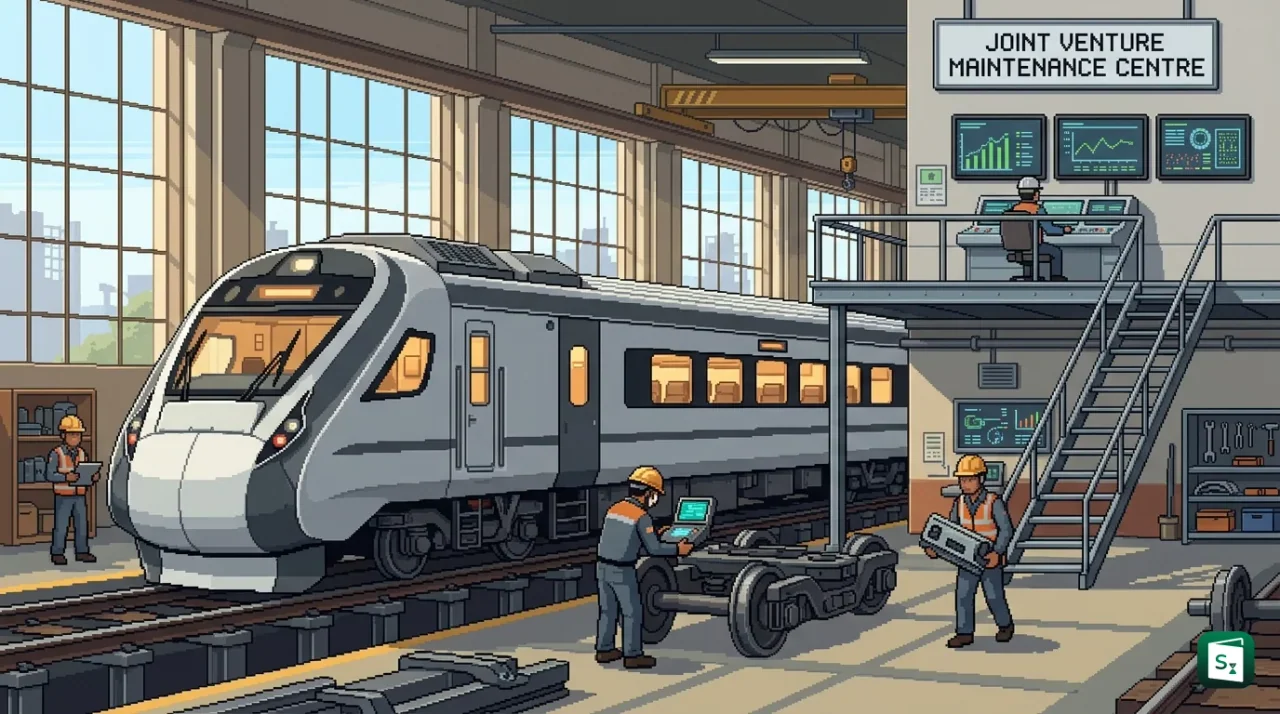
Bharat Heavy Electricals Limited and Titagarh Rail Systems Limited signed a 50:50 Joint Venture Agreement on 15 September 2026 to set up a dedicated Joint Venture Company for comprehensive maintenance of Vande Bharat Sleeper trainsets for 35 years. The Joint Venture Company, to be incorporated as a private limited company in Delhi with an initial paid up capital of ₹50 lakh, will service 80 trainsets supplied under the consortium’s nearly ₹24,000 crore contract with Indian Railways. The deal moves the partnership beyond manufacturing into long term lifecycle management and marks one of the longest maintenance commitments in Indian Railways history.
What Does the BHEL Titagarh Joint Venture Agreement Cover?
The BHEL Titagarh Joint Venture Agreement creates a dedicated 50:50 Joint Venture Company (JVC) for the comprehensive maintenance of Vande Bharat Sleeper trainsets for 35 years. The agreement was signed on 15 September 2026 and disclosed through a regulatory filing by Bharat Heavy Electricals Limited (BHEL). The filing noted that the arrangement follows an earlier intimation dated 19 March 2026.
The BHEL Titagarh Joint Venture Company is yet to be incorporated. The agreed structure is a private limited company with a registered office in Delhi and an initial paid up share capital of ₹50 lakh, contributed equally by both partners. BHEL and Titagarh Rail Systems Limited (TRSL) will each hold 50 percent equity and will each nominate two directors to the board, giving equal governance representation. BHEL has clarified that the venture is domestic in nature and does not constitute a related party transaction, and that promoters and promoter group entities have no interest in it.
The scope of the Joint Venture Company is single and focused. The company will undertake comprehensive maintenance of the supplied Vande Bharat Sleeper trainsets throughout their entire 35 year service life. BHEL stated that the Joint Venture Company will leverage the joint technical strength of both promoters to ensure operational readiness, safety and reliability of the fleet, including preventive maintenance, condition monitoring, diagnostics, component replacement and spare parts planning.
What Is a Joint Venture and a Joint Venture Company?
A joint venture is a business arrangement where two or more parties combine resources, capital and expertise to undertake a specific project or enterprise while sharing risks, returns and governance. When this collaboration is carried out through a newly incorporated company with joint ownership and joint control, it is called a Joint Venture Company (JVC). The JVC has a separate legal identity and can own assets, enter contracts and sue or be sued in its own name.
In India, there is no single standalone law for joint ventures. The structure is governed by a combination of statutes. The Companies Act, 2013 defines a joint venture under Section 2(6) Explanation (b) as a joint arrangement where parties that have joint control have rights to the net assets of the arrangement, and treats such a company as an associate company when significant influence of at least 20 percent voting power exists. The Indian Contract Act, 1872 governs the enforceability of the Joint Venture Agreement (JVA) and shareholders agreement that record ownership, funding, management rights and exit terms.
| Feature | Joint Venture Agreement (Contractual JV) | Joint Venture Company (Incorporated JV) |
|---|---|---|
| Legal status | No separate legal entity, governed by contract | Separate legal entity incorporated under Companies Act, 2013 |
| Ownership | Defined by contract, no share capital | Equity shareholding, here 50:50 between BHEL and TRSL |
| Liability | Parties may be jointly liable as per contract | Liability limited to shareholding in the company |
| Governance | Managed as per contractual terms | Board of directors, here two directors each |
| Duration | Usually for a specific project period | Can operate for long periods, here 35 years |
The BHEL TRSL structure is an incorporated Joint Venture Company rather than a short term contractual arrangement, because the maintenance obligation spans 35 years and requires dedicated manpower, depots, inventory and accountability. The JVA signed on 15 September 2026 is the contractual foundation that will be given effect through incorporation of the private limited company in Delhi.
The Larger Contract Behind the JV: 80 Vande Bharat Sleeper Trainsets and the ₹24,000 Crore Deal
The BHEL Titagarh Joint Venture Company does not stand alone. It is the lifecycle support arm of a much larger rolling stock contract awarded by Indian Railways.
In April 2023, the BHEL Titagarh Wagons Ltd (now Titagarh Rail Systems) consortium was declared L2 in one of Indian Railways’ largest tenders for manufacturing cum maintenance of 200 Vande Bharat trainsets and was awarded 80 trainsets. The consortium signed a formal contract with Indian Railways on 14 June 2023 for manufacture cum maintenance of 80 Vande Bharat Sleeper trainsets, including upgradation of government manufacturing units and trainset depots.
The contract value is reported at more than ₹23,000 crore to nearly ₹24,000 crore excluding taxes and duties. Broadly, about ₹9,600 crore to ₹10,000 crore is for supply of the trainsets and about ₹14,000 crore on a net present value basis is for the 35 year maintenance component. Final assembly is to be carried out at Indian Railways facilities in Chennai, Tamil Nadu and Latur, Maharashtra, in line with the Make in India and Aatmanirbhar Bharat approach. The consortium was noted as the only fully Indian, Aatmanirbhar bidder among the participants.
This context explains the logic of the September 2026 Joint Venture Agreement. Manufacturing 80 modern trainsets is one task, keeping them in reliable daily service for three and a half decades requires a dedicated maintenance organisation with its own depots, tooling, spares chain and technical teams. The new Joint Venture Company will provide that dedicated platform.
What Is the Vande Bharat Sleeper Train?
The Vande Bharat Sleeper is a semi high speed, long distance Electric Multiple Unit (EMU) designed for overnight travel, built as the sleeper variant of the Vande Bharat Express. Each 16 coach trainset can carry 823 passengers and is fully air conditioned with distributed traction motors for faster acceleration, automatic doors, better suspension and the indigenous Kavach automatic train protection system for safety.
The Vande Bharat platform traces back to Train 18, developed by the Integral Coach Factory (ICF), Chennai, with the first commercial Vande Bharat Express chair car service starting in February 2019 between New Delhi and Varanasi. The sleeper version was developed on the same platform but reconfigured for long distance overnight journeys. The first prototype was rolled out in September 2024, completed high speed trials under the Commissioner of Railway Safety (CRS) at up to 180 kmph, and entered commercial evaluation in January 2026.
A standard Vande Bharat Sleeper rake has 16 coaches comprising 11 AC 3 Tier, 4 AC 2 Tier and 1 AC First Class coach. The total passenger capacity is 823, split into 611 in 3AC, 188 in 2AC and 24 in First AC, with additional space for Divyangjan friendly berths and staff. Key passenger features include ergonomically designed broader berths, reading lights, USB charging points, bio vacuum toilets with odour control, sensor based lighting, public announcement and passenger information systems, modular pantries, CCTV surveillance, emergency talk back units and fully sealed gangways. The train runs on 25 kV 50 Hz AC overhead electrification through a pantograph and uses regenerative braking.
| Attribute | Vande Bharat Sleeper (16 coach rake) |
|---|---|
| Stock type | Electric Multiple Unit, self propelled |
| Design speed | 180 kmph, operational up to 160 kmph subject to track limits |
| Coaches | 16 (11 AC 3 Tier + 4 AC 2 Tier + 1 AC First Class) |
| Passenger capacity | 823 (611 + 188 + 24) |
| Traction | Distributed motors across coaches, acceleration 0.7 to 0.8 m per second square |
| Safety | Kavach automatic train protection, fire safety, CCTV, emergency talk back |
| Body | Austenitic stainless steel, aerodynamic nose, automatic plug doors |
Is Vande Bharat a Bullet Train?
No, Vande Bharat is not a bullet train. Vande Bharat is a semi high speed trainset with a design speed of 180 kmph and a sanctioned operational speed of 160 kmph, while a true bullet train such as the Mumbai Ahmedabad High Speed Rail using Japanese Shinkansen technology is designed for 320 kmph on a dedicated standard gauge viaduct and is still under construction with trial runs targeted for 2027.
Is Vande Bharat Electric?
Yes, Vande Bharat is fully electric. The Vande Bharat Sleeper is an Electric Multiple Unit that draws power from a 25 kV 50 Hz AC overhead catenary through a pantograph and distributes traction across motor coaches, which allows faster acceleration and regenerative braking without a separate diesel locomotive.
Current deployment plans illustrate why maintenance matters. The first commercial route announced is Howrah to Guwahati, with trial runs completed on sections such as Kota Nagda and Hazrat Nizamuddin to Palwal at 160 kmph with Kavach. Indicative fares shared for that corridor are about ₹2,300 for 3AC, ₹3,000 for 2AC and ₹3,600 for First AC. While searches often seek Vande Bharat Sleeper ticket price, route list and launch date, final timetables and nationwide routes are being rolled out in phases from 2026, with plans for more than 10 trainsets in 2026 and eventual scale up to 80 trainsets under the BHEL Titagarh contract.
Who Are the Partners: BHEL and Titagarh Rail Systems?
What Is BHEL Company?
Bharat Heavy Electricals Limited (BHEL) is India’s largest engineering and manufacturing enterprise in the energy and infrastructure sector and a Maharatna Public Sector Undertaking (PSU) under the Ministry of Heavy Industries. The full form of BHEL is Bharat Heavy Electricals Limited. BHEL was formally incorporated on 13 November 1964, with origins in Heavy Electricals (India) Limited set up at Bhopal in 1956 after an agreement with Associated Electrical Industries, UK. The company is headquartered at BHEL House, Siri Fort, New Delhi, and is listed on the BSE and NSE with the Government of India holding about 63 percent (as of September 2026). K. Sadashiv Murthy is the Chairman and Managing Director (as of September 2026).
BHEL manufactures power plant equipment, transmission systems, railway propulsion systems, electric locomotives, Vande Bharat traction equipment, defence and aerospace systems and emerging technologies such as battery storage. Its railway role has expanded from propulsion and electrical systems to complete trainset manufacture in consortium mode.
What Is Titagarh Rail Systems?
Titagarh Rail Systems Limited (TRSL), formerly Titagarh Wagons Limited, is a private railway rolling stock manufacturer headquartered in Kolkata, West Bengal, at Titagarh Towers, Anandapur. The company was incorporated on 3 July 1997 and began as a freight wagon maker in 1997, building on a foundry business that produced bogies and couplers since the 1980s. Founder Jagadish Prasad Chowdhary acquired the foundry division of Britannia Engineering at Titagarh and steered the group into wagons, passenger coaches, metro coaches and propulsion systems.
Titagarh is now India’s largest freight wagon manufacturer with capacity of about 12,000 wagons per year and foundry capacity of about 30,000 tonnes, holding roughly a quarter of the domestic wagon market. It became India’s first private maker of EMU and MEMU coaches in 2007, delivered more than 350 units, secured its first metro contract for Pune in 2019 with India’s first aluminium bodied metro coaches, and acquired Titagarh Firema SpA in Italy in 2015 for passenger train technology. The company also makes bridges, shipbuilding components and defence equipment, and operates facilities at Titagarh and Uttarpara in West Bengal.
How Does Vande Bharat Sleeper Compare With Rajdhani and Other Premium Trains?
The introduction of the Vande Bharat Sleeper directly overlaps with the space long held by the Rajdhani Express, introduced in 1969, which connected New Delhi with state capitals using locomotive hauled LHB coaches and offered First AC, Second AC and Third AC sleeping accommodation.
| Feature | Vande Bharat Sleeper | Rajdhani Express | Vande Bharat Chair Car (Express) |
|---|---|---|---|
| Year introduced | Prototype 2024, commercial January 2026 | 1969 (New Delhi Howrah) | February 2019 (New Delhi Varanasi) |
| Type | Self propelled EMU trainset, distributed traction | Locomotive hauled rake | Self propelled EMU trainset |
| Maximum operational speed | Up to 160 kmph, design 180 kmph | About 130 kmph | Up to 160 kmph |
| Accommodation | 16 AC sleeper coaches (823 berths) | AC 1, 2 and 3 Tier sleeper | Chair Car and Executive Chair Car, no berths |
| Journey profile | Overnight long distance, about 1,000 to 1,500 km | Overnight long distance | Daytime intercity, typically within 10 hours |
| Key amenities | Automatic doors, sealed gangways, Kavach, CCTV, bio vacuum toilets, modular pantries | Tejas upgraded rakes with similar amenities, catering included | Automatic doors, infotainment, bio vacuum toilets |
| Energy | Electric, regenerative braking | Electric hauled | Electric, regenerative braking |
Compared with a bullet train, both Vande Bharat Sleeper and Rajdhani are conventional broad gauge services. The Mumbai Ahmedabad bullet train is a separate standard gauge high speed corridor designed for 320 kmph and is not yet in commercial service. The Vande Bharat Sleeper therefore sits between Rajdhani and bullet train, offering faster acceleration, modern interiors and overnight comfort at fares lower than air travel.
Why a 35 Year Maintenance Commitment Matters for Indian Railways
A 35 year maintenance window is unusual in Indian rolling stock procurement, where supply contracts were traditionally shorter. The BHEL Titagarh 35 year commitment signals a shift from asset purchase to lifecycle management.
For Indian Railways, the Joint Venture Company provides a single accountable entity for upkeep of 80 trainsets over their full service life. This should improve punctuality and safety through scheduled preventive maintenance, faster fault diagnostics using the Train Control and Management System, and assured availability of spares for imported and indigenous components. It also upgrades the train maintenance depot ecosystem at Chennai and Latur, where final assembly and later heavy maintenance will be anchored.
For the partners, the model combines complementary strengths. BHEL contributes propulsion, electrical and traction expertise, while TRSL contributes coach manufacturing, bogies and rolling stock integration experience, including its Italian passenger coach technology. The long contract provides a recurring revenue stream over decades, with the maintenance value estimated at about ₹14,000 crore, spread across the 35 year period rather than a one time supply payment.
For passengers, lifecycle maintenance is the difference between a new train that performs well for a year and one that remains reliable for decades. Consistent suspension performance, clean interiors with disinfectant technology, and functional safety systems such as Kavach depend on continuous depot attention. The September 2026 Joint Venture Agreement creates the structure to deliver that continuity.
The Way Forward
The next step is incorporation of the Joint Venture Company as a private limited entity in Delhi and staffing of its board with two nominees from each promoter. Once incorporated, the company will set up maintenance processes aligned with the Vande Bharat maintenance manual and schedule, including condition based monitoring, periodic overhauls and depot modernisation.
Delivery of the 80 trainsets is scheduled through 2029, with production ramp up across 2026 to 2029. As each rake is commissioned and enters service on long overnight corridors such as Howrah Guwahati and future routes under planning, the Joint Venture Company will assume maintenance from day one. If execution meets timelines and reliability targets, the structure could become a template for future high speed and semi high speed rolling stock programmes and for export oriented maintenance offerings under Make in India.
Key Takeaways
- BHEL and Titagarh Rail Systems signed a 50:50 Joint Venture Agreement on 15 September 2026 to form a Joint Venture Company for 35 year comprehensive maintenance of Vande Bharat Sleeper trainsets.
- The Joint Venture Company will be a private limited company in Delhi with an initial paid up capital of ₹50 lakh and two directors nominated by each partner.
- The maintenance covers 80 Vande Bharat Sleeper trainsets supplied under the consortium’s nearly ₹24,000 crore contract with Indian Railways, with about ₹9,600 crore for supply and ₹14,000 crore for 35 year maintenance.
- A standard Vande Bharat Sleeper rake has 16 coaches (11 AC 3 Tier, 4 AC 2 Tier, 1 AC First Class) with 823 passengers capacity, a design speed of 180 kmph and Kavach automatic train protection.
- BHEL was incorporated on 13 November 1964 under the Ministry of Heavy Industries and is headquartered in New Delhi, while Titagarh Rail Systems was incorporated on 3 July 1997 and is headquartered in Kolkata.