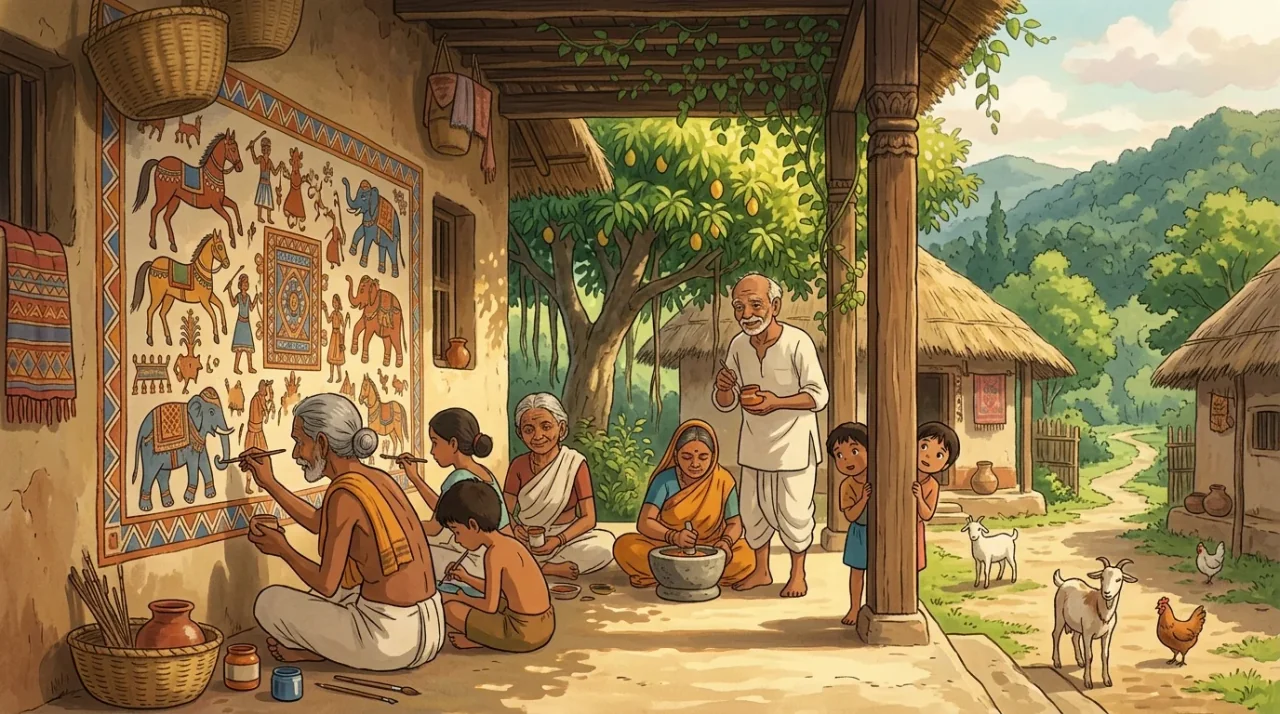
The Geographical Indications Registry (GIR) has granted the Geographical Indication (GI) tag to Pithora Painting, the centuries-old ritual wall art tradition of Gujarat’s tribal communities. The recognition, administered by the Department for Promotion of Industry and Internal Trade (DPIIT) under the Ministry of Commerce and Industry, formally protects the authenticity of this sacred art form and opens new economic avenues for the Rathwa, Bhil, Bhilala, and Nayaka artisans who have kept the tradition alive for generations.
What Is Pithora Painting?
Pithora Painting is a traditional tribal ritual wall art that originated in the hilly eastern regions of Gujarat, primarily in Chhota Udepur and Panchmahal districts. The art form is closely associated with the Rathwa tribe and is also practised by the Bhil, Bhilala, and Nayaka communities. These groups inhabit the forested and hilly terrain along the Gujarat-Madhya Pradesh border, where their cultural traditions have been shaped by deep connections with nature, agriculture, and ancestral worship.
The art is named after Pithora De (also known as Pithora Baba), the chief tribal deity of the Rathwa community. Pithora Baba is revered as a god who blesses the community with prosperity, marriage, fertility, good health, and overall well-being. The paintings are not created merely for decorative purposes. They serve as a sacred offering, a visual contract with the divine, and a collective record of the community’s myths, memories, and cultural values.
The tradition is believed to have originated from prehistoric cave paintings, with some archaeological findings tracing Pithora-style depictions back approximately 3,000 years. The art form gained wider recognition in recent decades, particularly after Padma Shri awardee Paresh Rathwa from Chhota Udepur began showcasing it on national and international platforms, including the G20 culture exhibition.
Common Motifs and Themes
Pithora paintings are characterised by their vibrant use of colour and dense, narrative compositions. The most prominent motifs include:
- Seven horses, which represent the seven hills surrounding the Gujarat-Madhya Pradesh border area
- Baba Pithora (the tribal deity) depicted as a central rider on a white horse
- Deities and ancestors shown in procession
- Animals such as elephants, birds, and cattle
- Nature elements including the sun, moon, trees, rivers, and forests
- Daily life scenes such as farming, hunting, marriages, and community gatherings
The traditional size of a Pithora painting is approximately 11 to 9 feet, and a single painting can contain as many as 165 different motifs. Each painting is unique, reflecting the specific beliefs, vows, and wishes of the family that commissions it.
Geographic Concentration
The Rathwa tribe, the primary practitioners of Pithora art, are concentrated in the eastern districts of Gujarat. According to census data, approximately 79.6% of the Rathwa population resides in the areas that now form Chhota Udepur district (bifurcated from Vadodara district in 2013), particularly in talukas such as Chhota Udepur, Naswadi, Sankheda, Pavi Jetpur, and Kawant. Smaller populations extend into Dahod and Panchmahal districts in Gujarat, as well as Alirajpur district in Madhya Pradesh, where they overlap with related Bhilala groups.
The Ritual Behind the Art
A Pithora painting is never created casually. The entire process is a deeply ritualistic affair, guided by the community’s spiritual practices and supervised by the Badwa (tribal priest or shaman).
The Vow and Its Fulfilment
The process begins when the head of a household consults the Badwa, who determines whether a Pithora painting is needed. This typically happens when the family faces a crisis, such as illness, drought, or misfortune, and makes a vow to commission a mural if their suffering is alleviated. Once the deity grants the wish, the family fulfils the vow by initiating the painting ritual.
Wall Preparation (Lipna)
The chosen wall, typically in the osari (a central room or veranda in the house), is first prepared by unmarried girls of the household. They coat the surface with a mixture of mud, cow dung, and white clay (known as Pandu Maati), which is believed to purify the space and provide a smooth, white background for the painting.
The Painting Process
Under the direction of the Badwa, the Lakharas (traditional ritual artists) begin painting. The Badwa chants and sings throughout the process, invoking deities and setting a spiritual atmosphere. The Lakharas use brushes made from bamboo shoots or bawal tree twigs, and the paints are derived entirely from natural sources such as leaves, flowers, minerals, and mahua (a flowering tree used extensively in tribal life).
The painting typically takes several days or weeks to complete. Once finished, a communal feast is held, attended by relatives, deities (invited symbolically), and the wider community.
The Ritual Context
Pithora paintings are deeply embedded in the life cycle of the Rathwa community. They are created during significant events such as marriages, the birth of children, housewarming ceremonies, and after fulfilling vows. The art serves multiple functions simultaneously: it is a form of prayer, a storytelling medium, a historical record, and a spiritual offering. This distinguishes Pithora from purely decorative folk arts.
Who Are the Lakharas?
The Lakharas (also spelled Lakhindra) are the traditional male artists who create Pithora paintings. The term “Lakhara” refers to a trained, hereditary artist who belongs to the community and has learned the craft through generations of oral transmission.
The role of the Lakhara is not simply that of a painter. They are custodians of the community’s visual language, repositories of mythological knowledge, and performers of a sacred duty. Each Lakhara develops a personal signature style within the broader framework of traditional motifs, altering colour symmetries, borders, and contemporary details to give their work individuality while preserving the ritual integrity of the form.
Among the most celebrated contemporary Lakharas is Paresh Rathwa from Chhota Udepur, who was awarded the Padma Shri in 2023 for his lifelong efforts in preserving and promoting Pithora art. He has spoken about Pithora as a 12,000-year-old art linked to the Koraj caves, and has represented India’s tribal art at the G20 culture exhibition.
Another significant figure is Bhuri Bai from Pitol village in Jhabua district, Madhya Pradesh. She broke a centuries-old gender taboo by becoming the first tribal woman to paint Pithora art on paper and canvas, moving the tradition beyond the mud walls of tribal homes. She received the Padma Shri in 2021 for her contributions. Her work has been exhibited internationally, and her painting “Story of the Jungle” was sold at a Sotheby’s auction.
Modern Adaptations
While Pithora paintings remain rooted in their ritual context, contemporary Lakharas have adapted the art form to modern mediums. Many artists now work on paper and canvas for commercial purposes, selling their work to collectors and galleries. The motifs have also evolved, with artists depicting modern elements like trousers, bikes, and trucks alongside traditional horses, gods, and forests. This adaptability has helped the art form remain relevant while preserving its spiritual core.
What Does the GI Tag Mean for Pithora Painting?
The Geographical Indication (GI) tag is a legal certification that connects a product to a specific geographical origin and acknowledges the unique qualities, methods, or reputation linked to that place. For Pithora Painting, the GI recognition carries several important implications.
Legal Protection Against Imitation
The GI tag certifies that Pithora Painting originates from specific regions of Gujarat, particularly Chhota Udepur, Panchmahal, and surrounding tribal areas. This prevents imitation and misuse of the traditional art, ensuring that only genuine artisans from the registered geographical region can market their products under the GI label. Without this protection, mass-produced imitations could flood the market, undermining the livelihoods of traditional practitioners.
Preservation of Indigenous Knowledge
The GI registration formally recognises the centuries-old knowledge system embedded in Pithora art. This includes the traditional techniques of wall preparation using cow dung and white clay, the use of natural pigments, the ritualistic process supervised by the Badwa, and the hereditary transmission of artistic knowledge through Lakharas. By providing legal backing, the GI tag helps safeguard this intangible cultural heritage from erosion.
Enhanced Market Access and Livelihoods
The GI tag improves market access for tribal artisans by creating a verified, authentic brand identity. It enables artisans to command fair prices for their work and connect with broader domestic and international markets. Organisations such as Garvi Gurjari (a Gujarat government initiative), TRIFED (Tribal Cooperative Marketing Development Federation of India), and TRTI (Tribal Research and Training Institute) have been working to connect Pithora artists with wider audiences, and the GI tag strengthens these efforts.
Boost to Cultural Tourism
Gujarat’s tribal belt, particularly the Chhota Udepur region, has been gaining attention as a destination for cultural tourism. The GI recognition enhances the visibility of Pithora art, encouraging tourists to visit tribal communities and engage with the living tradition. This creates additional economic opportunities beyond the direct sale of paintings.
India’s GI Framework: The Bigger Picture
The GI tag for Pithora Painting fits into India’s broader framework for protecting geographical indications, which has its roots in the country’s obligations as a member of the World Trade Organization (WTO).
The Geographical Indications Act, 1999
India enacted the Geographical Indications of Goods (Registration and Protection) Act, 1999 to comply with the Agreement on Trade-Related Aspects of Intellectual Property Rights (TRIPS). The Act came into force on 15 September 2003 and provides a legal framework for the registration and protection of geographical indications relating to goods.
A geographical indication is defined as an indication that identifies goods as originating from a particular territory, region, or locality, where a given quality, reputation, or other characteristic of the goods is essentially attributable to their geographical origin. GI tags in India are valid for 10 years and can be renewed indefinitely.
The Geographical Indications Registry
The Geographical Indications Registry (GIR) is located in Chennai, Tamil Nadu, under the Office of the Controller General of Patents, Designs and Trade Marks (CGPDTM). The CGPDTM functions under the Department for Promotion of Industry and Internal Trade (DPIIT), which operates under the Ministry of Commerce and Industry.
India has registered over 650 GI products as of 2026, making it one of the largest holders of geographical indication certifications in Asia. The products span categories including handicrafts, textiles, agricultural products, food items, and manufactured goods. Tamil Nadu leads all states with over 60 registered GI products, followed by Uttar Pradesh with over 70.
GI Tags and India’s Tribal Heritage
India has a rich tradition of granting GI tags to tribal art forms, recognising their cultural and economic significance. Some notable examples include Warli Painting (Maharashtra), Cheriyal Scroll Painting (Telangana), Phad Painting (Rajasthan), and Sohrai Painting (Jharkhand). The Pithora Painting GI tag adds to this growing list, reinforcing India’s commitment to preserving its indigenous artistic heritage.
Key Takeaways
- The Geographical Indications Registry (GIR), under DPIIT and the Ministry of Commerce and Industry, has granted the GI tag to Pithora Painting, a centuries-old ritual wall art tradition of Gujarat.
- Pithora Painting is primarily practised by the Rathwa, Bhil, Bhilala, and Nayaka tribal communities in the Chhota Udepur and Panchmahal districts of eastern Gujarat.
- The art is named after Pithora De (Pithora Baba), the chief tribal deity, and is created as a sacred ritual offering to seek blessings for prosperity, health, and well-being.
- Lakharas are the traditional male artists who create Pithora paintings under the guidance of the Badwa (tribal priest), using natural pigments derived from leaves, flowers, minerals, and mahua.
- The Geographical Indications Act, 1999 came into force on 15 September 2003. The GI Registry is located in Chennai, Tamil Nadu, under the CGPDTM.
- India has over 650 registered GI products as of 2026, with Tamil Nadu leading all states in GI registrations.
- Paresh Rathwa (Padma Shri, 2023) and Bhuri Bai (Padma Shri, 2021) are among the most celebrated contemporary Pithora artists who have brought the art form to national and international prominence.