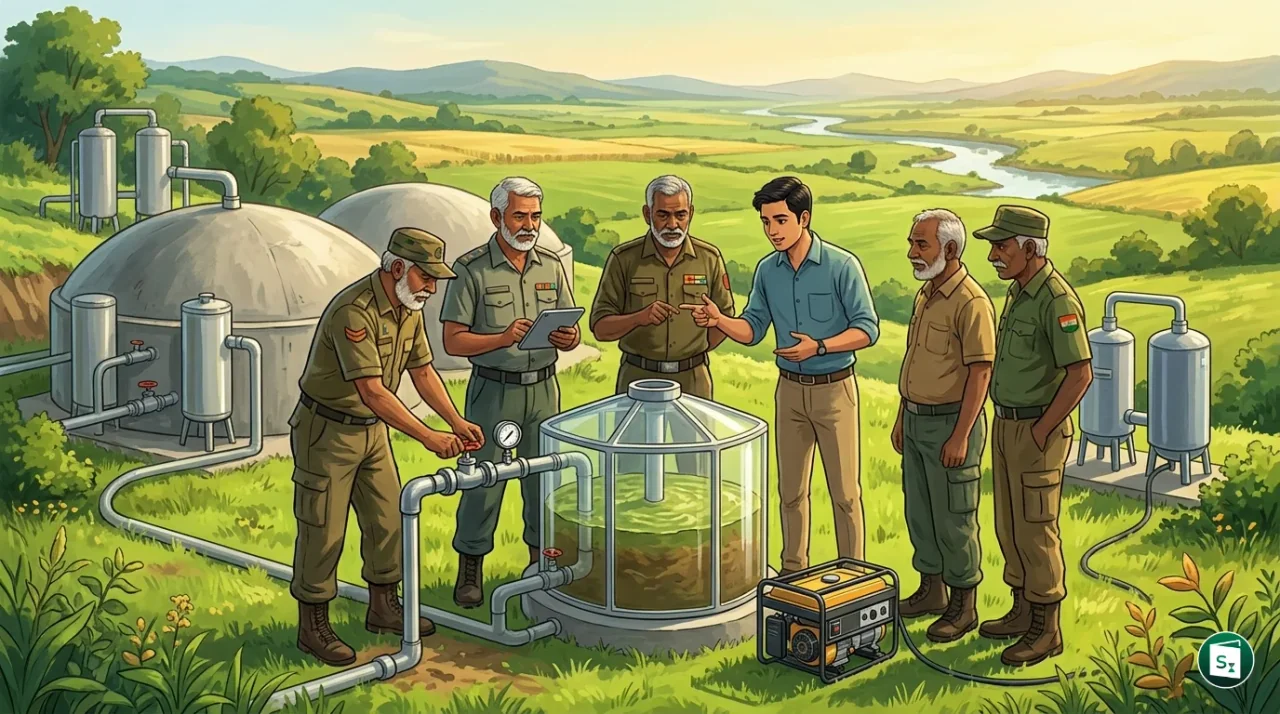
The Indian Biogas Association (IBA) has signed a tripartite Memorandum of Understanding with the Army Welfare Placement Organization (AWPO) and Reveille Energy LLP to train and employ up to 50,000 ex-servicemen in India’s rapidly growing biogas and bioenergy sector. The partnership aims to bridge the skill gap in the bioenergy ecosystem while creating sustainable career pathways for retired Army personnel. In the first phase, the initiative targets between 25,000 and 50,000 retired soldiers for skilling, reskilling, and placement across the renewable energy industry.
The Tripartite Partnership
The MoU brings together three distinct organizations, each contributing a specific set of capabilities to the initiative. The Indian Biogas Association (IBA), established in 2011 and headquartered in Gurgaon, is the apex industry body representing the biogas sector in India. It counts over 550 corporate members and a network of more than 10,000 environmental enthusiasts among its stakeholders. IBA will facilitate industry linkages, onsite training opportunities, and placement support through its extensive network of members and industry partners.
The Army Welfare Placement Organization (AWPO) is a non-profit initiative of the Indian Army established in 1999 and headquartered in New Delhi. It operates 18 regional offices and 49 placement centres across the country. AWPO will mobilise and screen suitable ex-servicemen candidates for the programme, leveraging its nationwide network and database of over 1.5 lakh registered veterans.
Reveille Energy LLP, a bio-energy consulting company founded in 2023 by Colonel Rohit Dev (Retd), will support policy advocacy, planning, and strategic coordination for the initiative. The company focuses on biomass-based bio-energy solutions and operates on a People-led Public Private Partnership (PPPP) model that centres on the rural economy.
India’s Growing Bioenergy Sector
India’s biogas industry is at an inflection point. The government has set a target of establishing 5,000 compressed biogas (CBG) plants producing 15 million tonnes of CBG annually under the SATAT (Sustainable Alternative Towards Affordable Transportation) initiative, launched by the Ministry of Petroleum and Natural Gas. As of late 2025, over 130 CBG plants had been commissioned, with many more under construction.
The sector is expected to attract investments of more than Rs 5,000 crore in 2026-27, according to IBA estimates. The market size, valued at around USD 1.6 billion in 2024, is projected to reach USD 3.5 billion by 2032 and potentially USD 5 billion by 2030. The CBG Blending Obligation (CBO), effective from FY2025-26, mandates blending of CBG in city gas distribution networks starting at 1% and rising to 5% by 2028, creating guaranteed demand for biogas producers.
The Ministry of New and Renewable Energy (MNRE) provides Central Financial Assistance (CFA) covering 15-20% of capital costs for biogas projects, along with marketing development assistance of Rs 1.50 per kg for organic fertiliser produced as a byproduct.
The Skill Gap Challenge
As the bioenergy sector expands, the demand for trained manpower is rising sharply. Biogas plants require skilled operators, technicians, and managers who understand anaerobic digestion processes, gas purification systems, compressed biogas operations, and safety protocols. The gap between the available workforce and industry requirements has been a persistent bottleneck. IBA Chairman Gaurav Kedia noted that skilled manpower will play a defining role in achieving the country’s sustainability goals, highlighting the strategic importance of this partnership in addressing the skill demand-supply gap.
Why Ex-Servicemen Are a Natural Fit
Retired Army personnel bring unique qualities that align well with the bioenergy industry. As Major General AS Chauhan (Retd), Managing Director of AWPO, pointed out, Army veterans possess leadership, integrity, and execution capabilities that every growing industry seeks. Their experience in logistics, supply chain management, engineering, maintenance, and team operations makes them well suited for roles in biogas plant operations, equipment maintenance, feedstock management, and site supervision.
The Indian Army retires approximately 1,200 officers and 50,000 personnel below officer rank (PBOR) every year. These individuals are in their prime working years, typically aged 35 to 50, and actively seek second careers. The biogas sector, with its decentralised plant locations across rural and semi-urban areas, offers employment opportunities that are geographically aligned with the backgrounds of many ex-servicemen who come from similar regions.
Key Takeaways
- The Indian Biogas Association (IBA), AWPO, and Reveille Energy LLP signed a tripartite MoU to skill 50,000 ex-servicemen for the biogas sector.
- IBA, established in 2011 and headquartered in Gurgaon, is the apex industry body representing over 550 corporate members in the biogas sector.
- AWPO, established in 1999, is a non-profit initiative of the Indian Army with 18 regional offices and 49 placement centres across India.
- The SATAT initiative aims to set up 5,000 CBG plants producing 15 million tonnes of CBG annually, with over 130 plants already commissioned.
- The biogas sector is projected to attract investments exceeding Rs 5,000 crore in 2026-27 and reach a market size of USD 5 billion by 2030.
- The CBG Blending Obligation (CBO) mandates blending of CBG in city gas networks starting at 1% in FY2025-26, rising to 5% by 2028.