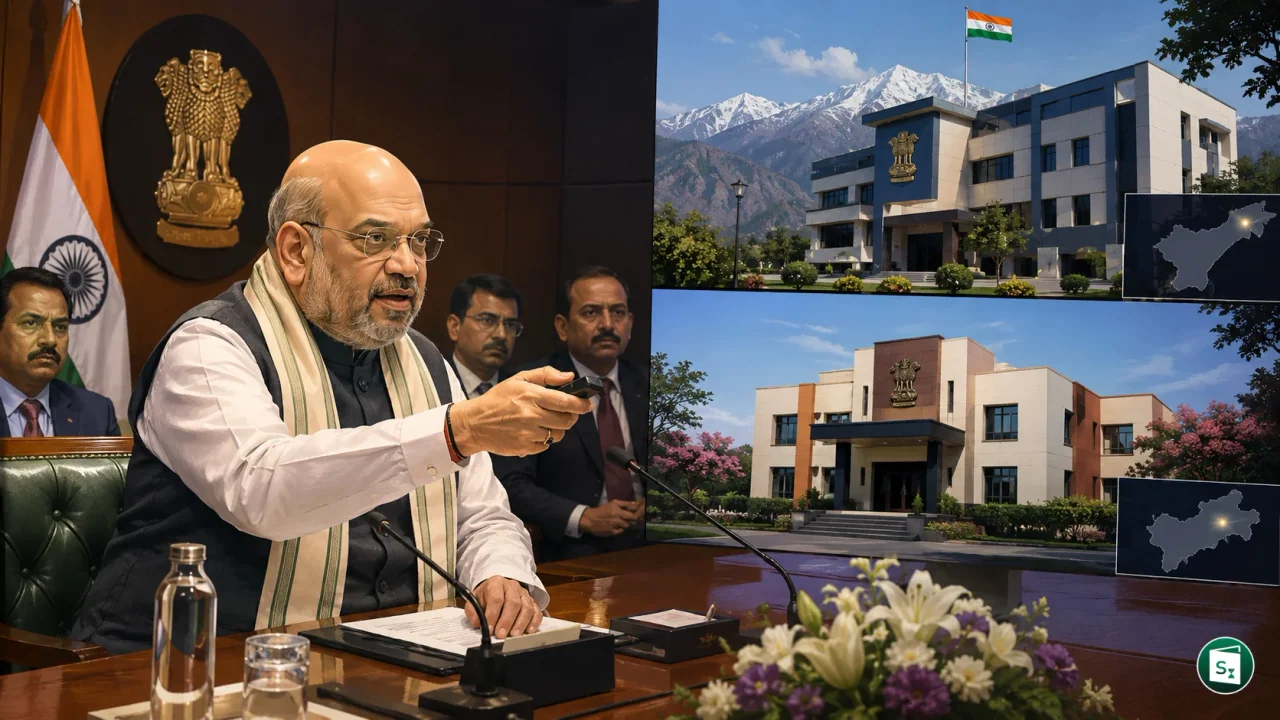
Union Home Minister Amit Shah chaired the 10th Apex-Level Meeting of the Narco-Coordination Centre (NCORD) at Vigyan Bhawan in New Delhi, bringing together 44 central ministries and 108 state-level representatives in a major review of India’s anti-drug efforts. The meeting marked the release of the Vision Document on Narcotics Control (2026-2029) , a three-year roadmap that sets measurable targets for enforcement, rehabilitation, and awareness across the country. In a significant expansion of enforcement infrastructure, Shah virtually inaugurated new Narcotics Control Bureau (NCB) zonal offices in Jammu and Guwahati, two regions critical to India’s fight against cross-border drug trafficking.
The NCORD Mechanism: A Four-Tier Coordination Framework
The Narco-Coordination Centre (NCORD) was established on 22 November 2016 under the Ministry of Home Affairs to address the need for better coordination among the many agencies involved in drug law enforcement in India. It was restructured on 29 July 2019 into a four-tier mechanism and further refined on 25 March 2022 to improve field-level coordination. The NCORD mechanism serves as the central platform for real-time intelligence sharing, joint operations, and policy coordination across central and state agencies.
The four-tier structure works as follows:
| Tier | Committee | Chairperson |
|---|---|---|
| 1 | Apex Level | Union Home Secretary |
| 2 | Executive Level | Special Secretary (Internal Security), MHA |
| 3 | State Level | Chief Secretary of the State |
| 4 | District Level | District Magistrate |
In addition to these four tiers, regular monthly NCORD meetings are chaired by the Director General of NCB, who also serves as the Member Convener of the Apex Committee. The Apex Committee includes secretaries from key ministries such as Revenue, Health, Social Justice, Chemicals and Fertilizers, and Pharmaceuticals, along with the chiefs of intelligence and enforcement agencies like the Intelligence Bureau, NIA, DRI, ED, and the Indian Navy and Coast Guard. This broad representation ensures that drug control is treated as a whole-of-government priority, not just a law enforcement issue. As of June 2026, over 15,800 district-level, 266 state-level, and seven executive-level NCORD meetings have been held since the mechanism was strengthened.
Key Outcomes of the 10th Apex-Level Meeting
The 10th NCORD meeting produced three major outcomes that will shape India’s narcotics control strategy over the coming years.
Vision Document on Narcotics Control (2026-2029)
Amit Shah released the Vision Document on Narcotics Control (2026-2029) , a comprehensive policy roadmap prepared through wide-ranging consultations with central ministries, drug law enforcement agencies, and other stakeholders. The document adopts a three-pronged approach covering demand reduction, supply reduction, and harm reduction. It defines clear responsibilities, timelines, and measurable targets for every stakeholder involved in narcotics control.
The Vision Document is built on four pillars: Enforcement, Intelligence and Operations; Precursor and Synthetic Drug Control; Demand and Harm Reduction with Rehabilitation; and Capacity Building, Coordination and Monitoring. The operational strategy is captured in three words: Detect, Disrupt and Destroy. This represents a shift from reactive seizure-based enforcement to a proactive, intelligence-driven approach that targets the entire supply chain from production to financing.
The document specifically addresses emerging challenges such as synthetic drugs, darknet-enabled trafficking, and the growing vulnerability of youth to substance abuse. It outlines strategies to expand treatment and rehabilitation centres, strengthen public awareness campaigns, and enhance institutional capacity at all levels.
New NCB Zonal Offices: Jammu and Guwahati
Shah virtually inaugurated newly constructed NCB zonal offices in Jammu and Guwahati (Assam) , significantly expanding the bureau’s operational footprint in two strategically critical regions.
Jammu is located along the India-Pakistan border, a corridor that has seen a marked rise in drone-based drug smuggling from across the border. The NCB Annual Report for 2025 revealed that Punjab accounted for 58% of India’s total heroin seizures (2,086 kg out of 3,567 kg nationally), with Jammu and Kashmir also emerging as a vulnerable transit route. The new zonal office will enable NCB to mount a more effective response to cross-border trafficking in the region.
Guwahati serves as the gateway to India’s Northeast, which shares a porous border with Myanmar, a key production hub in the Golden Triangle region. NCB’s Guwahati Zonal Unit has been active in busting transnational drug networks that use the Myanmar-Manipur-Assam corridor to traffic heroin and methamphetamine. In 2025 alone, NCB operations in the Northeast led to the seizure of over 530 kg of methamphetamine and 31 kg of heroin, valued at approximately Rs 487 crore. The new zonal office will further strengthen enforcement capacity in this region.
Online Drug Disposal Fortnight Campaign
Amit Shah launched the Online Drug Disposal Fortnight Campaign, a special drive under which approximately 2,09,500 kg of seized narcotics valued at around Rs 6,000 crore are expected to be destroyed across India in accordance with legal procedures. This is one of the largest such drug disposal exercises undertaken in the country, involving multiple central and state law enforcement agencies. The campaign reinforces the government’s commitment to ensuring that seized narcotics are safely disposed of and do not find their way back into the illegal market.
India’s Anti-Drug Framework
The fight against narcotics in India rests on a multi-layered framework of laws, institutions, and initiatives that work together to tackle both supply and demand sides of the problem.
Narcotics Control Bureau (NCB)
The Narcotics Control Bureau (NCB) is India’s premier federal law enforcement and intelligence agency for combating drug trafficking. It was established on 17 March 1986 under Section 4(3) of the NDPS Act, 1985. The NCB operates under the Ministry of Home Affairs and is headquartered in R.K. Puram, New Delhi. It is headed by a Director General, currently Anurag Garg (IPS) .
The NCB’s mandate includes coordinating actions by various central and state agencies under the NDPS Act, collecting and disseminating intelligence on drug trafficking, implementing India’s international obligations under UN drug conventions, and assisting foreign drug law enforcement agencies. The bureau maintains zonal and sub-zonal offices across major Indian cities, and the addition of Jammu and Guwahati offices is part of a broader expansion of its field presence.
The NDPS Act, 1985
The Narcotic Drugs and Psychotropic Substances (NDPS) Act, 1985 is the principal legislation governing drug control in India. It was enacted to consolidate and amend laws relating to narcotic drugs and psychotropic substances, and to give effect to India’s obligations under international treaties such as the Single Convention on Narcotic Drugs (1961) , the Convention on Psychotropic Substances (1971) , and the UN Convention Against Illicit Traffic in Narcotic Drugs and Psychotropic Substances (1988) .
The Act prohibits the production, manufacture, possession, sale, purchase, transport, storage, and consumption of narcotic drugs and psychotropic substances. Penalties under the Act are graded based on the quantity involved:
| Quantity Type | Example (Heroin) | Punishment |
|---|---|---|
| Small Quantity | Up to 5 grams | Up to 1 year imprisonment or Rs 10,000 fine or both |
| Commercial Quantity | 1 kg and above | 10 to 20 years rigorous imprisonment and fine up to Rs 2 lakh |
| Repeat Offenders | Any quantity | Up to 30 years to life imprisonment or death penalty |
Section 37 of the NDPS Act imposes strict bail conditions for offenses involving commercial quantities, requiring the court to be satisfied that the accused is not guilty and is unlikely to commit further offenses while on bail. This makes bail extremely difficult in NDPS cases.
Related Initiatives
Beyond the core enforcement framework, several initiatives have emerged from the NCORD mechanism to address demand reduction and public awareness:
The MANAS (Madak Padarth Nished Asuchna Kendra) helpline is a 24x7 toll-free national helpline (dial 1933) that provides counseling, treatment referral, and rehabilitation support to individuals affected by substance abuse. The NIDAAN (National Integrated Database on Arrested Narco-Offenders) portal serves as a centralized database for tracking repeat offenders and sharing intelligence across agencies. Mission SPANDAN partners with spiritual and community institutions to spread awareness about the dangers of drug abuse.
The Nasha Mukt Bharat Abhiyan (NMBA) , launched on 15 August 2020 by the Ministry of Social Justice and Empowerment, complements the enforcement-driven approach of NCORD by focusing on demand reduction through awareness, community outreach, and treatment. Initially launched in 272 vulnerable districts, the campaign has been expanded to cover all districts across India.
Drug Trafficking: Challenges at India’s Borders
India’s geography places it between two of the world’s largest illicit opium-producing regions, making it both a transit route and a destination market for narcotics. The Golden Crescent (Afghanistan, Pakistan, Iran) lies to the west, while the Golden Triangle (Myanmar, Laos, Thailand) lies to the east. Drug trafficking from these regions poses serious internal security challenges, with linkages to terrorist financing, money laundering, and arms smuggling.
The Western Corridor
The India-Pakistan border, particularly through Punjab and Jammu and Kashmir, has emerged as the most active corridor for heroin trafficking into India. According to the NCB Annual Report 2025, Punjab alone accounted for 2,086 kg of heroin seizures, which is 58% of the national total of 3,567 kg. A growing concern is the shift towards drone-based smuggling, as traffickers have adapted to increased ground-level checking and border fencing. The report also flagged pharmaceutical opioids such as diverted cough syrup as a dangerous second wave in Punjab, with 8,95,508 bottles seized in 2025.
Jammu and Kashmir has also witnessed increasing drug trafficking activity, with the region serving both as a transit route for heroin entering from Pakistan and as a growing consumer market. The establishment of the new NCB zonal office in Jammu is a direct response to this threat.
The Northeastern Route
The India-Myanmar border, running through four northeastern states, is a major entry point for methamphetamine and heroin produced in Myanmar’s Shan state, part of the Golden Triangle. The porous nature of the border, combined with challenging terrain and riverine routes, makes enforcement particularly difficult.
The NCB’s North Eastern Region has significantly ramped up operations since the establishment of the North Eastern Regional Headquarters in September 2023 and the creation of new zonal units in Agartala, Itanagar, and Siliguri. In 2025, NCB registered 43 NDPS cases in the Northeast, arrested 93 persons, and seized over 530 kg of methamphetamine and 31 kg of heroin valued at approximately Rs 487 crore. Mizoram accounted for 42% of the national seizure of amphetamine-type stimulants (1,477 kg out of 3,269 kg), while Manipur contributed 535 kg.
Traffickers have adapted their methods by using river systems such as the Barak River to bypass highway checkpoints. In December 2025, NCB intercepted a motorboat on the Barak River near Silchar and seized 6.149 kg of heroin packed in 530 soap cases, revealing a growing shift towards riverine trafficking routes.
Emerging Threats
The NCORD meeting focused significant attention on challenges that are reshaping the drug landscape. Amit Shah noted that between 2014 and 2026, drugs worth Rs 1.84 lakh crore (1.18 crore kg) were seized, compared to Rs 40,000 crore (26 lakh kg) during 2004-2014, reflecting a sharp increase in both enforcement intensity and the scale of trafficking. Synthetic drugs such as methamphetamine, MDMA, and LSD have seen a particularly sharp rise in seizures. The government reported that synthetic drug seizures rose from 2.6 million kg between 2004 and 2014 to 11.8 million kg between 2014 and 2026. The darknet has become a platform for anonymous drug transactions, with NCB launching Operation WIPE to curb online drug trafficking and busting the pan-India darknet network Team Kalki in March 2026. Captagon, a synthetic stimulant commonly used in Middle East conflict zones, was seized for the first time in India in May 2026 through Operation Ragepill. These developments require continuous adaptation of enforcement strategies and legal frameworks.
Way Forward
The 10th NCORD meeting reinforced the government’s zero tolerance policy against drug trafficking, a stance that Prime Minister Modi has consistently emphasized. The Vision Document (2026-2029) provides a structured roadmap with clear accountability, but its success will depend on effective implementation at the state and district levels. The expansion of NCB’s zonal network, the use of technology-driven enforcement, and the focus on both supply and demand reduction represent a comprehensive approach. However, challenges remain in addressing the evolving methods of trafficking networks, the growing synthetic drug market, and the need for stronger international cooperation, particularly with neighbouring countries to disrupt production and trafficking routes at their source.
Key Takeaways
- The 10th Apex-Level NCORD meeting was chaired by Union Home Minister Amit Shah on 26 June 2026 at Vigyan Bhawan, New Delhi, with participation from 44 central ministries and 108 state-level representatives.
- The Vision Document on Narcotics Control (2026-2029) adopts a three-pronged approach of demand reduction, supply reduction, and harm reduction with defined targets and timelines for all stakeholders.
- New NCB zonal offices were inaugurated in Jammu and Guwahati to strengthen enforcement along the Pakistan and Myanmar border corridors.
- The Online Drug Disposal Fortnight Campaign aims to destroy approximately 2,09,500 kg of seized narcotics worth Rs 6,000 crore.
- The NCORD mechanism was established in 2016 under the Ministry of Home Affairs and operates through a four-tier structure from the national to the district level.
- The NCB was established on 17 March 1986 under Section 4(3) of the NDPS Act, 1985, with headquarters in New Delhi, and functions under the Ministry of Home Affairs.