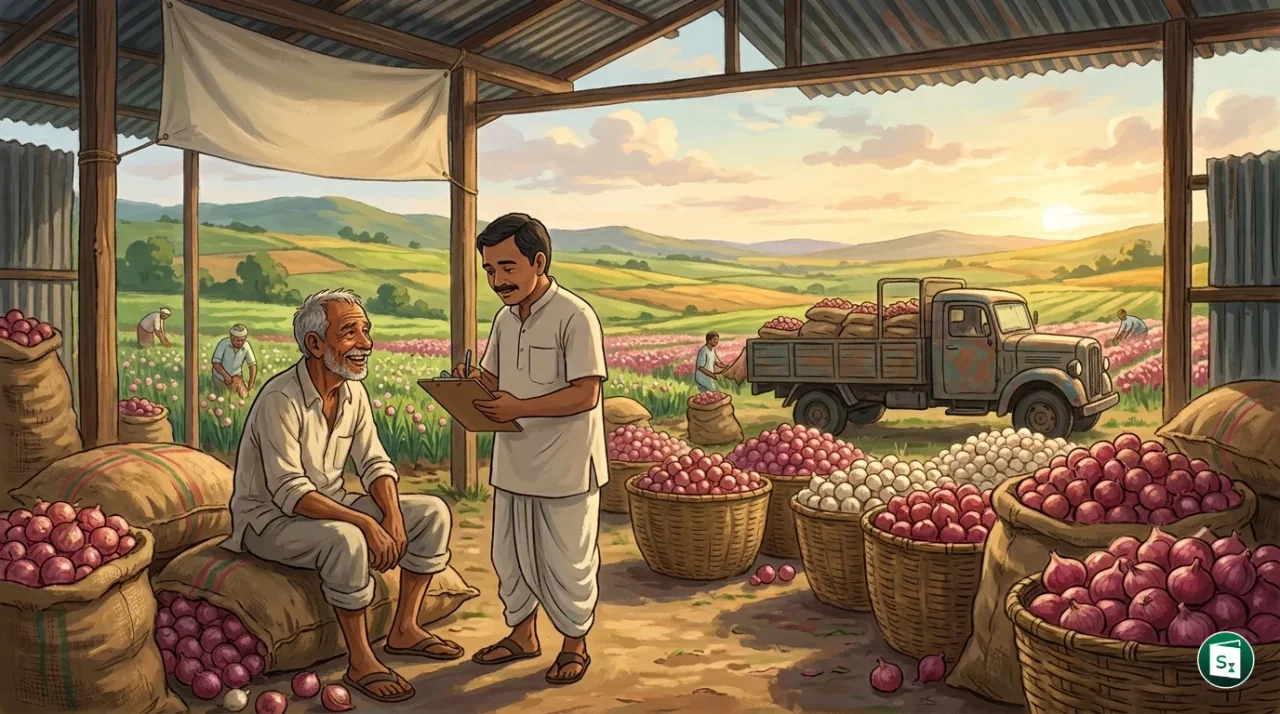
The government raised the procurement price of onions under the Price Stabilisation Buffer by 13% to ₹2,125 per quintal, effective July 4, 2026, marking the fifth upward revision this season. The move aims to accelerate buffer stock purchases after procurement agencies managed to buy only about 2,000 tonnes since the start of procurement on June 1, far short of the season’s target. Onion production for 2025-26 is estimated at 307.37 lakh metric tonnes, nearly unchanged from the previous year, indicating adequate overall supplies despite recent price firmness.
What Is the Price Stabilisation Fund?
The Price Stabilisation Fund (PSF) is a central government scheme under the Department of Consumer Affairs, which comes under the Ministry of Consumer Affairs, Food and Public Distribution. The fund was created to moderate volatility in the prices of essential agri-horticultural commodities such as onions, potatoes, and pulses.
The PSF was originally set up during 2014-15 with an initial corpus of ₹500 crore. Under the scheme, procurement agencies buy commodities directly from farmers during the surplus harvest season and build a strategic buffer stock. This stock is later released into the market during the lean season or when prices spike, helping to cool retail prices. The objective is twofold: ensure farmers get remunerative prices when there is a glut, and protect consumers from sudden price surges.
The scheme received fresh approval from the Union Cabinet in September 2024 for its continuation, ensuring sustained funding for market intervention operations.
How Buffer Stock Procurement Works
Two central agencies carry out the actual procurement. The National Agricultural Cooperative Marketing Federation of India (NAFED) and the National Cooperative Consumers’ Federation (NCCF) are the designated procuring bodies. They set up purchase centres in major onion-producing regions, primarily in Maharashtra, Madhya Pradesh, and Gujarat, the top three onion-producing states in the country.
NAFED was established in 1958 and operates under the Ministry of Agriculture and Farmers’ Welfare. NCCF was set up in 1965 as an apex cooperative organisation for consumer goods. Both agencies are also actively involved in the procurement of pulses under the same PSF framework.
For the 2026 season, the government set a buffer stock target of 2 lakh tonnes (or 2,00,000 metric tonnes) of onions, down from about 3 lakh tonnes procured in the previous year.
Five Price Revisions in One Season
The latest hike to ₹2,125 per quintal is the fifth upward revision since procurement began in mid-May 2026. The government has progressively raised the purchase price as farmers have held back their produce, waiting for better rates in the open market.
| Revision | Effective Date | Procurement Price (per quintal) | Increase |
|---|---|---|---|
| Initial | May 2026 | ₹1,270 | Baseline |
| 1st hike | May 22, 2026 | ₹1,580 | +24.4% |
| 2nd hike | June 13, 2026 | ₹1,650 | +4.4% |
| 3rd hike | June 20, 2026 | ₹1,730 | +4.8% |
| 4th hike | Late June 2026 | ₹1,875 | +8.4% |
| 5th hike | July 4, 2026 | ₹2,125 | +13.3% |
The cumulative increase from the initial price of ₹1,270 per quintal (₹12.70 per kg) to the current ₹2,125 per quintal (₹21.25 per kg) works out to a rise of about 67% over approximately seven weeks.
Why Procurement Has Been Slow
Despite repeated price increases, government agencies have managed to procure only about 2,000 tonnes by early July, which is just 1% of the 2 lakh tonne target. Several factors explain this sluggish response.
First, open market prices have remained higher than government procurement rates for most of the season. The all-India average modal price in wholesale mandis of Maharashtra stood at approximately ₹18 per kg (₹1,800 per quintal) in early July, while better-quality onions were fetching even higher prices in the open market. This gap made the earlier government rates unattractive for farmers.
Second, delayed monsoon arrival and below-normal rainfall in parts of the country triggered speculative buying by traders. Production centres such as Nashik in Maharashtra and parts of Madhya Pradesh saw speculative trading driven by expectations of future price recovery rather than genuine demand. This kept open market prices elevated and further discouraged farmers from selling to government agencies.
Third, kharif onion sowing has been delayed by about 15 days in the Nashik region of Maharashtra due to the late monsoon. In Karnataka’s Chitradurga and Challakere belt, sowing progress was estimated at only 60% of the normal level. This created uncertainty about future supplies and contributed to the cautious approach among farmers.
Supply Situation Remains Comfortable
The government has clarified that overall onion availability is not a concern despite the slow pace of buffer stock creation. Onion production for 2025-26 is estimated at 307.37 lakh metric tonnes, nearly identical to the 307.67 lakh tonnes produced in 2024-25. This means production parity with the previous year, ruling out any supply-side crisis.
Daily arrivals in wholesale mandis across the country remain robust at over 50,000 metric tonnes each day. Maharashtra alone contributes more than 30,000 metric tonnes of daily arrivals. The average modal price in Maharashtra mandis is around ₹18 per kg, while the all-India average retail price stands at ₹31 per kg.
Stocks held in the key producing states of Maharashtra, Madhya Pradesh, and Gujarat are adequate. Better-quality onions continue to remain in storage and are expected to be released into the market during the lean period, which typically runs from August to September.
Export Dynamics
Onion exports remained normal in June 2026, with about 1.50 lakh tonnes shipped overseas. However, traders expect export demand to soften in the coming months. Fresh onion supplies from Pakistan and China are becoming available at competitive rates in key export destinations, including the Gulf countries, Sri Lanka, and the Far East. This could ease some of the upward pressure on domestic prices.
Key Takeaways
- The government raised the onion procurement price under the Price Stabilisation Buffer to ₹2,125 per quintal, a 13% increase from ₹1,875 per quintal, effective July 4, 2026.
- This was the fifth upward revision in the procurement price this season, with the cumulative increase reaching about 67% from the initial ₹1,270 per quintal.
- The Price Stabilisation Fund (PSF) was created in 2014-15 under the Department of Consumer Affairs to moderate price volatility in essential agri-horticultural commodities.
- NAFED (established 1958) and NCCF (established 1965) are the designated agencies for onion procurement under the PSF framework.
- Onion production for 2025-26 is estimated at 307.37 lakh metric tonnes, nearly unchanged from 307.67 lakh tonnes in 2024-25.
- Only about 2,000 tonnes (roughly 1% of the 2 lakh tonne target) had been procured by early July 2026 due to higher open market prices and delayed monsoons.