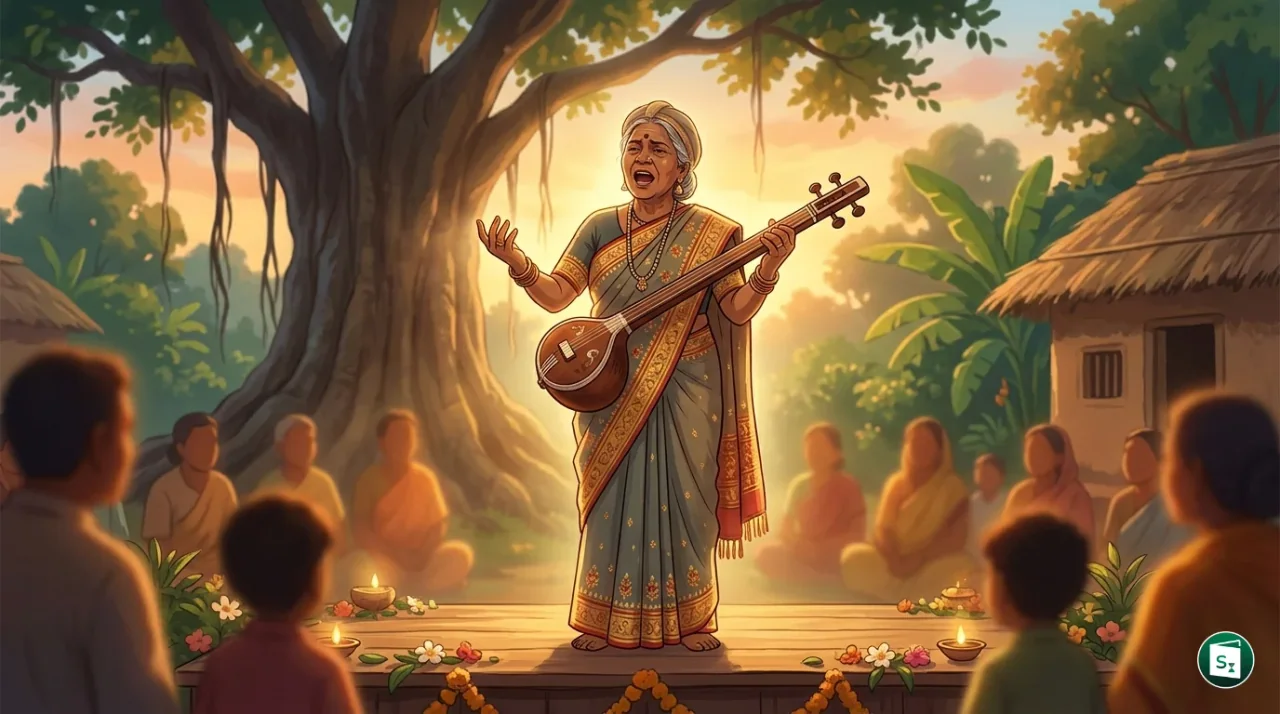
Teejan Bai, the legendary exponent of Pandavani, Chhattisgarh’s traditional folk narrative art form, passed away on 5 July 2026 at AIIMS Raipur after a prolonged illness. She was 70. The Padma Vibhushan awardee was the first woman to perform Pandavani in the Kapalik style, breaking gender barriers in a tradition that was once a male preserve.
Who Was Teejan Bai?
Teejan Bai was born on 8 August 1956 in Ganiyari village, located in the Durg district of Chhattisgarh. She belonged to the Pardhi Scheduled Tribe. Her maternal grandfather, Brijlal Pardhi, would recite the Mahabharata in the Chhattisgarhi dialect, and a young Teejan Bai absorbed these stories with remarkable ease. She soon memorised large portions of the epic and later trained informally under Umed Singh Deshmukh.
At the age of 13, she gave her first public performance in the neighbouring village of Chandrakhuri for a fee of just Rs 10. This performance was historic. She chose the Kapalik style of Pandavani, which involves standing, enacting characters, and singing with dramatic gestures. Until then, women who performed Pandavani stuck to the Vedamati style, which is a sitting, more subdued narration. By choosing to stand and perform, Teejan Bai entered what was considered a male domain.
Her big break came when the acclaimed theatre personality Habib Tanvir noticed her talent. She was soon invited to perform for then Prime Minister Indira Gandhi. Over the following decades, she became a cultural ambassador for India, performing in countries across Europe, Asia, Africa, and the Americas.
The Art of Pandavani
Pandavani is a traditional folk performing art from Chhattisgarh that involves the dramatic narration of stories from the Mahabharata, especially episodes involving the Pandava brothers. The word Pandavani literally means “stories of the Pandavas.” The lead artist, known as the narrator-singer, uses a tambura (a stringed instrument) as both a prop and a musical accompaniment, often holding it in one hand while gesturing with the other.
A Pandavani performance usually includes supporting singers and musicians playing instruments such as the harmonium, tabla, dholak, and manjira. The lead singer continuously interacts with the accompanying singers, who ask questions and provide interjections, enhancing the dramatic effect. A single performance can last several hours and covers one episode of the epic.
Two Styles of Pandavani
| Feature | Vedamati Style | Kapalik Style |
|---|---|---|
| Posture | Performed sitting down | Performed standing up |
| Style | Simple narration, text-based | Dramatic, improvised, with acting |
| Freedom | Follows the written text closely | Performer improvises freely |
| Traditional performers | Both men and women | Was a male bastion until Teejan Bai |
| Notable exponent | Jhaduram Devangan | Teejan Bai |
The Vedamati style is based on the written version of the Mahabharata by Sabbal Singh Chauhan in the Doha-Chaupal metre. The Kapalik style, which Teejan Bai mastered, gives the performer freedom to improvise, enact characters using voice modulation and facial expressions, and move around the stage. The term Kapal refers to memory or experience, meaning the performer draws on their own understanding of the epic rather than reading from a text.
Breaking Barriers: A Pioneer for Women in Folk Art
Teejan Bai’s decision to perform Pandavani was met with resistance from her own community. She was married at the age of 12, but her passion for singing led her to defy societal norms. Her community, the Pardhi tribe, expelled her for performing Pandavani as a woman. She built a small hut and lived on her own, often borrowing utensils and food from neighbours, but she never gave up her art.
By taking up the Kapalik style, she not only broke a gender barrier but also paved the way for other women to perform this dynamic form of Pandavani. Artists like Usha Barle and Shanti Bai followed in her footsteps, inspired by her courage and success. Teejan Bai also performed sequences from the Mahabharata in Shyam Benegal’s acclaimed Doordarshan television series Bharat Ek Khoj, which was based on Jawaharlal Nehru’s book The Discovery of India.
Awards and Recognition
Teejan Bai received some of India’s highest civilian honours and international awards in recognition of her contribution to Indian folk arts.
| Award | Year | Awarding Body |
|---|---|---|
| Padma Shri | 1988 | Government of India |
| Sangeet Natak Akademi Award | 1995 | Sangeet Natak Akademi |
| Padma Bhushan | 2003 | Government of India |
| Fukuoka Prize (Japan) | 2018 | Fukuoka City, Japan |
| Padma Vibhushan | 2019 | Government of India |
She was also honoured with the Sangeet Natak Akademi Fellowship and received honorary D.Litt degrees from multiple universities. The Fukuoka Prize, awarded by the city of Fukuoka in Japan, recognises individuals who have contributed to the preservation and growth of Asian culture. Teejan Bai was the only person from Chhattisgarh to have received the Padma Vibhushan.
The Legacy She Leaves Behind
Teejan Bai transformed Pandavani from a regional folk tradition confined to village courtyards into an internationally recognised art form. Her powerful voice, commanding stage presence, and expressive storytelling style captivated audiences in countries including England, France, Switzerland, Germany, Turkey, Tunisia, Malta, Cyprus, Romania, and Mauritius.
Prime Minister Narendra Modi expressed grief over her passing, saying that she gave Chhattisgarh’s folk art a unique global identity through her magnificent performances. Chhattisgarh Chief Minister Vishnu Deo Sai described her death as an irreparable loss to the entire Indian cultural world.
Her life story is also one of remarkable personal courage. From being ostracised by her community to performing on the world stage, Teejan Bai’s journey remains an enduring example of how artistic passion can overcome social barriers.
Key Takeaways
- Teejan Bai, the legendary exponent of Pandavani, passed away on 5 July 2026 at AIIMS Raipur at the age of 70.
- She was the first woman to perform Pandavani in the Kapalik style, a dramatic, standing style that was previously a male preserve.
- Pandavani is a folk narrative art form from Chhattisgarh that tells stories from the Mahabharata using singing, dramatic enactment, and musical accompaniment.
- She received the Padma Shri (1988), Sangeet Natak Akademi Award (1995), Padma Bhushan (2003), Fukuoka Prize (2018), and Padma Vibhushan (2019).
- She was honoured with the Sangeet Natak Akademi Fellowship and was the only person from Chhattisgarh to receive the Padma Vibhushan.
- She performed across the world, acting as a cultural ambassador for India in countries including England, France, Germany, Switzerland, Turkey, and Mauritius.