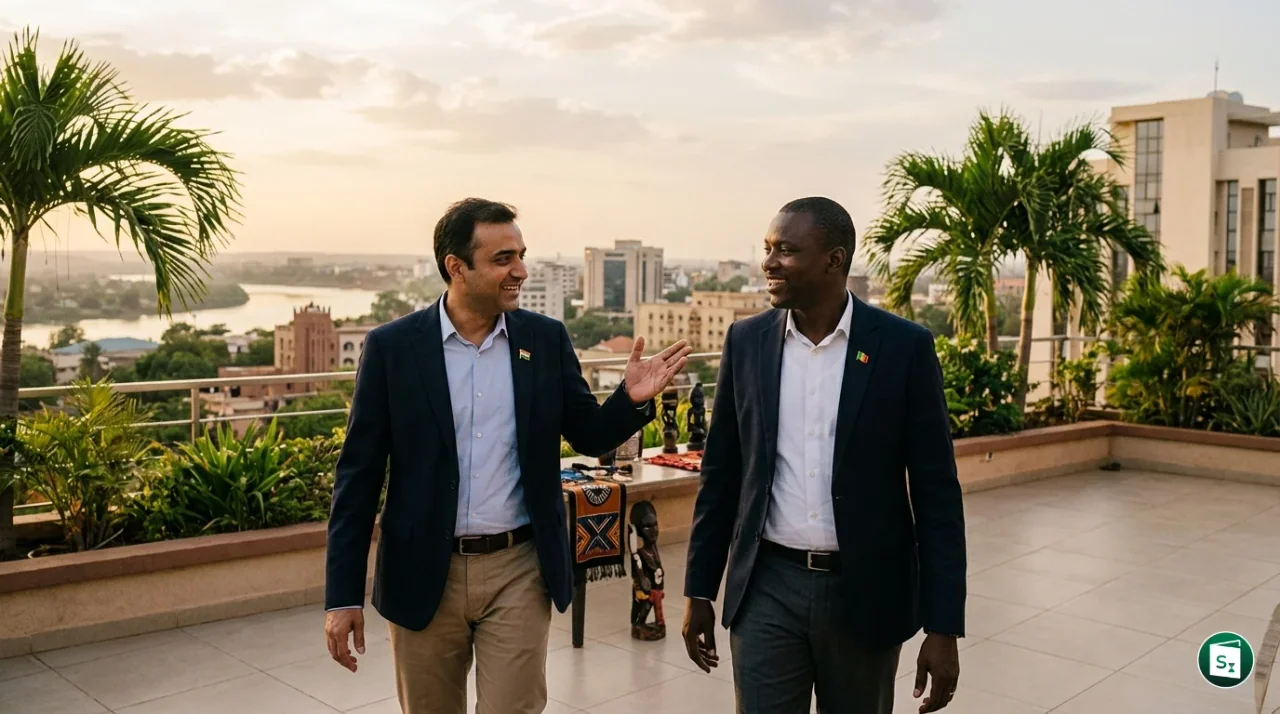
India and Mali institutionalised their growing economic partnership with the inaugural India-Mali Forum for the Promotion of Exports, held in Bamako under the theme “Reinforcing Trade and Strategic Partnerships.” The two-day forum, presided over by Mali’s Transition Prime Minister Major General Abdoulaye Maiga, brought together senior officials from both governments and around 30 Indian business leaders. The event marked a formal step in converting the recent surge in bilateral trade, which crossed $326.61 million in FY 2025-26 with a 55% year-on-year growth, into a structured long-term commercial relationship.
India-Mali Relations: A Background
India and Mali have traditionally maintained friendly relations rooted in shared values of anti-colonialism, mutual trust, and developmental solidarity. India established its Embassy in Bamako in May 2009, and Mali opened its Embassy in New Delhi in August 2009. The two countries signed a Protocol on Foreign Office Consultations and an Agreement on Political, Economic, Scientific, Technical and Cultural Cooperation in October 2009.
Mali is a landlocked country in West Africa, the eighth-largest country on the continent by area at 1.24 million square kilometres, with a population of about 25 million. Its capital, Bamako, sits on the Niger River. The country is classified as a Least Developed Country (LDC) by the United Nations and ranks among the poorest nations in the world, with agriculture and mining as its primary economic activities. Gold accounts for roughly 80% of Mali’s total exports, followed by cotton.
India has been a close development partner for Mali. It has extended seven Lines of Credit worth approximately $303.6 million for projects spanning power transmission, rural electrification, railway equipment, and agriculture. The Indian Technical and Economic Cooperation (ITEC) programme offers training slots to Malian officials in fields such as cybersecurity, drug law enforcement, and public administration. Beyond trade, cultural exchanges through ICCR scholarships, International Day of Yoga celebrations, and India-Mali film festivals have strengthened people-to-people ties.
What Happened at the Forum
The forum was jointly organised by the Ministry of Industry and Trade of Mali, the Embassy of India in Bamako, and the Malian Agency for the Promotion of Exports (APEX-Mali). The Indian delegation was led by Joint Secretary (FT-Africa) Amit Kumar from the Department of Commerce, while the Indian Embassy was represented by Ambassador Dr. N. Nandakumar.
The event featured an intensive schedule of Business-to-Business (B2B), Business-to-Government (B2G), and Government-to-Government (G2G) matchmaking meetings. Delegates visited exhibition stalls showcasing Indian and Malian products, including Sonalika tractors and vehicles from Mahindra and Tata Motors. The second day saw the Indian delegation meet Mali’s Minister of Industry and Trade, Moussa Alassane Diallo, and call on the Prime Minister.
Discussions covered five priority sectors for deeper cooperation: cotton and textiles, mining and energy, agro-industry and shea processing, pharmaceuticals, and social infrastructure covering health and education. Mali expressed strong interest in India’s support for digitising its Certificate of Origin system and for the prompt registration of approved Indian pharmaceutical products. India, on its part, sought a reconsideration of Mali’s ban on shea nut exports and reaffirmed the importance of protecting Indian nationals and investments in the country.
As a concrete follow-up, Mali announced a dedicated investment forum to be held on 3-4 December 2026, where additional bankable projects will be presented to international investors. APEX-Mali also presented “Ready-Made Business Plans” offering immediate investment opportunities across multiple sectors.
Bilateral Trade on the Rise
The most striking metric driving this new momentum is the sharp increase in bilateral trade. In FY 2025-26, trade between India and Mali surpassed $326.61 million, a 55% jump from the previous year. This growth is particularly notable because trade had remained relatively flat in the preceding years, hovering between $150 million and $210 million.
| Financial Year | India’s Exports to Mali | India’s Imports from Mali | Total Trade |
|---|---|---|---|
| 2020-21 | $186.97M | $13.97M | $200.94M |
| 2021-22 | $207.56M | $22.85M | $230.42M |
| 2022-23 | $132.49M | $20.02M | $152.51M |
| 2023-24 | $119.62M | $29.35M | $148.98M |
| 2024-25 | $128.08M | $82.52M | $210.60M |
| 2025-26 (Apr-Jan) | $101.95M | $185.66M | $287.61M |
A critical shift is visible in the balance of trade. In earlier years, India had a large trade surplus, exporting far more to Mali than it imported. In the current period, Mali’s exports to India have overtaken Indian exports, driven largely by a surge in Malian shipments of raw cotton, gum arabic, and cashew nuts.
Mali’s principal exports to India include raw cotton, finished leather, cashew nuts, lead, gum arabic, and sesame. India’s major exports to Mali comprise pharmaceuticals, cotton fabrics, two- and three-wheelers, and bicycles. Against Mali’s total global exports of approximately $4 billion, the untapped export potential in the Indian market alone is estimated at nearly $3.96 billion, indicating substantial room for further growth.
The DFTP Scheme: A Key Driver of Growth
India’s Duty-Free Tariff Preference (DFTP) Scheme has been the primary catalyst behind the surge in Malian exports to India. Announced by Prime Minister Manmohan Singh at the first India-Africa Forum Summit in April 2008 and formally introduced on 13 August 2008, India became the first developing country to offer such a facility to LDCs.
Under the DFTP Scheme, India grants duty-free access on 98.2% of its tariff lines to products originating from beneficiary LDCs. Only 1.8% of tariff lines remain subject to standard duties. Mali, classified as an LDC, is among the 48 beneficiary countries that currently avail this scheme. Key Malian exports that benefit include cotton, cashew nuts, gum arabic, and leather goods.
The scheme is rooted in the WTO Hong Kong Ministerial Declaration of 2005, which called upon developed countries and developing countries in a position to do so to extend duty-free and quota-free market access for LDC exports. India’s DFTP scheme operationalised this commitment and has since become a cornerstone of India’s South-South cooperation framework with Africa.
Strategic Significance and the Way Forward
The forum is significant for several reasons beyond the immediate trade numbers. It marks the first time India and Mali have created a dedicated institutional mechanism for export promotion, moving beyond ad-hoc business delegations to a structured annual dialogue. This aligns with India’s broader strategy of deepening engagement with West Africa, a region that has seen increased competition from China and other global powers.
For Mali, the partnership offers a vital diversification avenue. The country has faced political instability following the 2020 and 2021 military coups, and its relations with traditional Western partners and regional bodies like ECOWAS have become strained. Mali withdrew from ECOWAS in 2025 along with Niger and Burkina Faso to form the Alliance of Sahel States (AES). In this context, strengthening ties with India provides an alternative development partner that does not attach political conditionalities.
Mali has reaffirmed its commitment to positioning itself as a strategic investment hub for West Africa under its Vision Mali 2063 roadmap, a long-term development plan inspired by the African Union’s Agenda 2063. India’s expertise in pharmaceuticals, affordable healthcare, digital solutions, and small-scale manufacturing aligns well with Mali’s developmental needs.
The investment forum scheduled for December 2026 will be the next major milestone. If the momentum generated in Bamako translates into signed MoUs and concrete projects, bilateral trade could cross the half-billion-dollar mark within two to three years.
Key Takeaways
- The first India-Mali Forum for the Promotion of Exports was held in Bamako, Mali, under the theme “Reinforcing Trade and Strategic Partnerships”.
- Bilateral trade between India and Mali surpassed $326.61 million in FY 2025-26, recording a 55% year-on-year increase.
- India became the first developing country to extend duty-free market access to LDCs when it launched the DFTP Scheme in 2008, which now covers 98.2% of India’s tariff lines.
- Mali is a Least Developed Country in West Africa with a population of about 25 million and an economy heavily dependent on gold and cotton exports.
- The Indian delegation was led by Joint Secretary (FT-Africa) Amit Kumar, and the forum was presided over by Mali’s Transition Prime Minister Major General Abdoulaye Maiga.
- Mali announced a dedicated investment forum for 3-4 December 2026 and reaffirmed its Vision Mali 2063 roadmap, aligning with the African Union’s Agenda 2063.