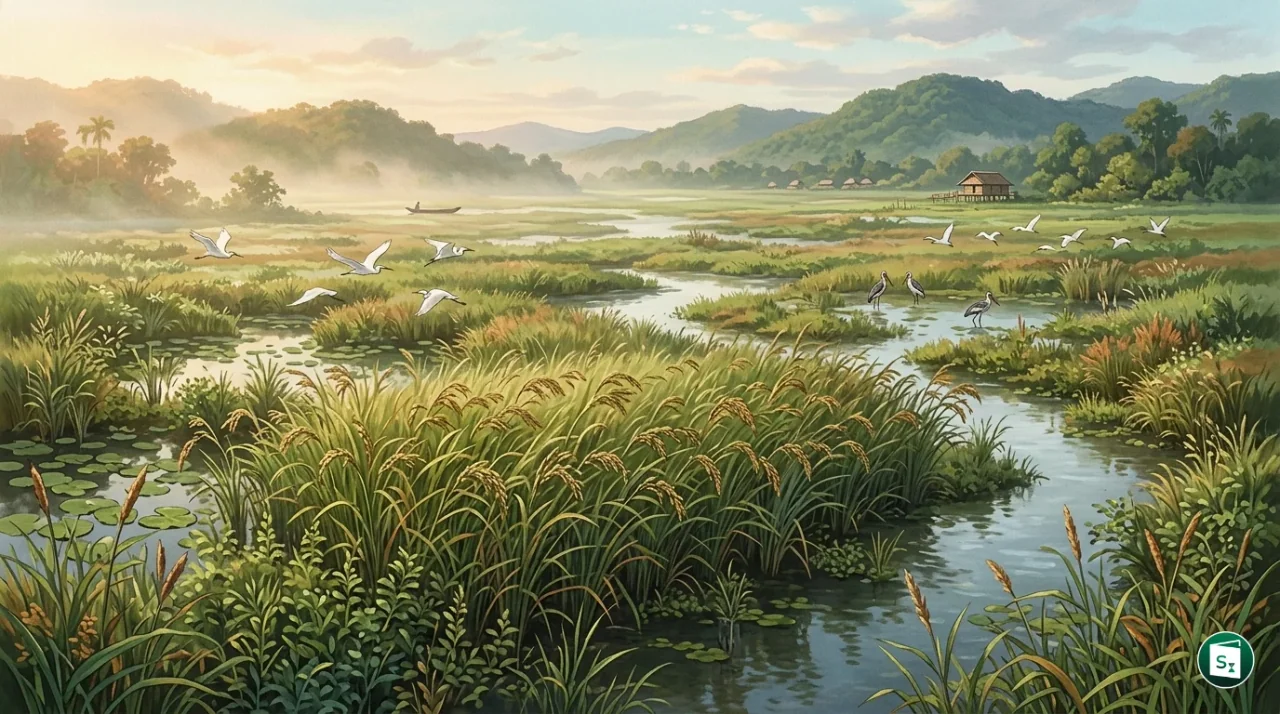
The Borjuli wetland in Sonitpur district, Assam, a tiny 0.41-hectare waterbody, has been officially notified as a Biodiversity Heritage Site for conserving Oryza rufipogon, the wild ancestral species of cultivated rice. The designation was achieved under a project funded by the National Rainfed Area Authority (NRAA) and implemented by scientists from the ICAR-National Bureau of Plant Genetic Resources (ICAR-NBPGR) since 2022. This is Assam’s second Biodiversity Heritage Site after Majuli and one of the few in the country specifically dedicated to protecting a crop wild relative.
What Is the Borjuli Biodiversity Heritage Site?
The Borjuli site, located at 26.810888 N, 92.623559 E in Borjuli village under Sonitpur district, is a freshwater wetland that hosts a viable population of Oryza rufipogon, commonly known as brownbeard rice or red rice. This perennial aquatic grass, belonging to the family Poaceae, is the direct wild progenitor of the cultivated Asian rice, Oryza sativa.
The wetland is situated on the northern bank of the Brahmaputra River in Sonitpur district, with its headquarters at Tezpur. Assam’s Brahmaputra valley has historically been a rich zone for rice diversity, and this particular wetland has managed to retain a healthy population of the wild species despite pressures from climate change and human activity.
The designation was carried out under the project titled In-situ Conservation and Management of Wild Rice (Oryza rufipogon) in Sonitpur District of Assam, which has been operational since 2022. The project is executed by the ICAR-National Bureau of Plant Genetic Resources (ICAR-NBPGR), New Delhi, in collaboration with the Assam State Biodiversity Board.
The Conservation Project and Key Players
The project is funded by the National Rainfed Area Authority (NRAA), an expert body established in 2006 under the Ministry of Agriculture and Farmers Welfare. The NRAA was set up to provide knowledge inputs for the systematic management of India’s dryland and rainfed agriculture, covering about 60% of the country’s net sown area. Its headquarters is in New Delhi.
The technical execution is led by the ICAR-National Bureau of Plant Genetic Resources (ICAR-NBPGR), headquartered at the Pusa Campus in New Delhi. The NBPGR was originally established as the National Bureau of Plant Introduction in August 1976 and was renamed the National Bureau of Plant Genetic Resources in January 1977. It operates under the Indian Council of Agricultural Research (ICAR) and serves as the nodal institution for the management of plant genetic resources in India. Its National Genebank conserves over 4.68 lakh accessions of various crop species.
Scientists from NBPGR briefed the NRAA Chief Executive Officer, Chandra Shekhar Kumar, on the project’s achievements, including the exploration, conservation and characterisation of wild rice germplasm. Kumar noted that wild rice species are an invaluable source of genes for developing climate-resilient, high-yielding and nutritionally superior rice varieties.
Understanding Oryza rufipogon: The Wild Ancestor of Rice
Oryza rufipogon is a perennial aquatic grass species native to East, Southeast and South Asia. It is considered the wild progenitor of Oryza sativa, the staple food crop that feeds more than half of the world’s population.
The species possesses several traits of immense value for rice breeding. It carries genes for disease and pest resistance, tolerance to submergence and salinity, and adaptation to acidic soils. These traits are critical for developing rice varieties that can withstand the stresses of climate change. Many modern rice varieties already derive useful genes from this wild species.
The plant is photosensitive and flowers during the short days of November and December. Its seeds shatter as soon as they mature, a natural mechanism for dispersal that distinguishes it from cultivated rice. The species is listed as Least Concern on the IUCN Red List, but its populations across Asia are increasingly fragmented due to agricultural expansion, habitat conversion and urbanisation.
In India, the Pallikaranai marshland in Tamil Nadu is another notable habitat for Oryza rufipogon, where it has been described as a precious germplasm. The Northeast, however, remains a particularly important region for wild rice diversity, and Assam’s wetlands host some of the most significant populations.
What Are Biodiversity Heritage Sites?
Biodiversity Heritage Sites (BHS) are a unique conservation category under Section 37 of the Biological Diversity Act, 2002. They are defined as well-defined areas that are unique, ecologically fragile ecosystems, which can be terrestrial, coastal, inland water or marine ecosystems with rich biodiversity.
Under the Act, the State Government, in consultation with local bodies, may notify areas of biodiversity importance as BHS. The National Biodiversity Authority (NBA) advises the State Government in the selection and management of these sites. The NBA is a statutory autonomous body headquartered in Chennai, established in 2003 under the Ministry of Environment, Forest and Climate Change.
Criteria for Designation
An area qualifies for BHS status if it possesses one or more characteristics such as richness of wild as well as domesticated species, high endemism, presence of rare and threatened species, species of evolutionary significance, fossil beds of biological significance, or significant cultural, ethical or aesthetic values. The Borjuli site qualifies primarily under the criterion of protecting wild ancestors of domesticated or cultivated species, as Oryza rufipogon is the direct progenitor of cultivated rice.
The creation of a BHS does not impose restrictions on prevailing practices of local communities. Instead, it aims to enhance the quality of life through conservation. The Biodiversity Management Committee (BMC) of the local body is responsible for preparing and implementing a management plan for the site, typically covering a period of five to ten years.
India has over 45 Biodiversity Heritage Sites notified across more than 16 states, covering diverse ecosystems from sacred groves to wetlands. Assam now has three BHS: Majuli (the largest river island district), Borjuli Wild Rice BHS, and Hajong Tortoise Lake BHS in Dima Hasao.
Significance of the Designation
The notification of Borjuli as a BHS holds multiple layers of significance, especially from the perspective of agricultural biodiversity and food security.
Protecting Crop Wild Relatives
Crop wild relatives (CWR) are wild plant species that are genetically related to cultivated crops. They are an essential reservoir of genetic diversity that breeders can tap into for developing varieties resistant to pests, diseases and climate stress. The Borjuli designation marks one of the few instances in India where a BHS has been specifically created for a crop wild relative.
Climate-Resilient Agriculture
As climate change intensifies, the need for rice varieties that can tolerate flooding, salinity and drought becomes urgent. Oryza rufipogon already carries these tolerance genes. Protecting its natural habitat ensures that these genetic resources remain available for future breeding programmes.
In-Situ vs Ex-Situ Conservation
The project uses the in-situ conservation approach, meaning the species is protected within its natural habitat rather than in a genebank (ex-situ). In-situ conservation allows the species to continue evolving and adapting to changing environmental conditions, preserving the dynamic relationship between the plant, its ecosystem, and the local climate. This is particularly important for maintaining the evolutionary potential of the species.
Boost to Assam’s Biodiversity Profile
Assam is part of the Indo-Burma biodiversity hotspot, one of the world’s most biologically rich but threatened regions. The designation reinforces the state’s importance in India’s plant genetic resource conservation efforts and adds to the growing network of protected biodiversity areas in the Northeast.
The Way Forward
The NRAA Chief Executive Officer has stressed the need to replicate similar conservation initiatives for other crop wild relatives across the country. Many wild relatives of major food crops, including wheat, millets, pulses and oilseeds, remain under-conserved in their natural habitats.
The NBPGR has already prioritised 861 crop wild relative taxa for 171 crops in India, of which 292 high-priority taxa have been identified for urgent conservation action. The Borjuli model, which combines funding from NRAA, technical expertise from ICAR-NBPGR, and implementation through state biodiversity boards, could serve as a template for scaling up in-situ conservation of crop wild relatives nationwide.
Key Takeaways
- The Borjuli wetland in Sonitpur district, Assam, a 0.41-hectare site, has been notified as a Biodiversity Heritage Site for conserving Oryza rufipogon.
- Oryza rufipogon is the wild progenitor of cultivated rice (Oryza sativa) and carries genes for disease resistance, submergence tolerance and salinity tolerance.
- The project titled In-situ Conservation and Management of Wild Rice (Oryza rufipogon) of Assam has been operational since 2022, executed by ICAR-NBPGR, New Delhi, in collaboration with the Assam State Biodiversity Board.
- The National Rainfed Area Authority (NRAA), established in 2006 under the Ministry of Agriculture and Farmers Welfare, funds the project.
- Biodiversity Heritage Sites are notified under Section 37 of the Biological Diversity Act, 2002, with the National Biodiversity Authority (NBA) advising the State Government on selection and management.
- Assam now has three Biodiversity Heritage Sites: Majuli, Borjuli Wild Rice BHS, and Hajong Tortoise Lake BHS.