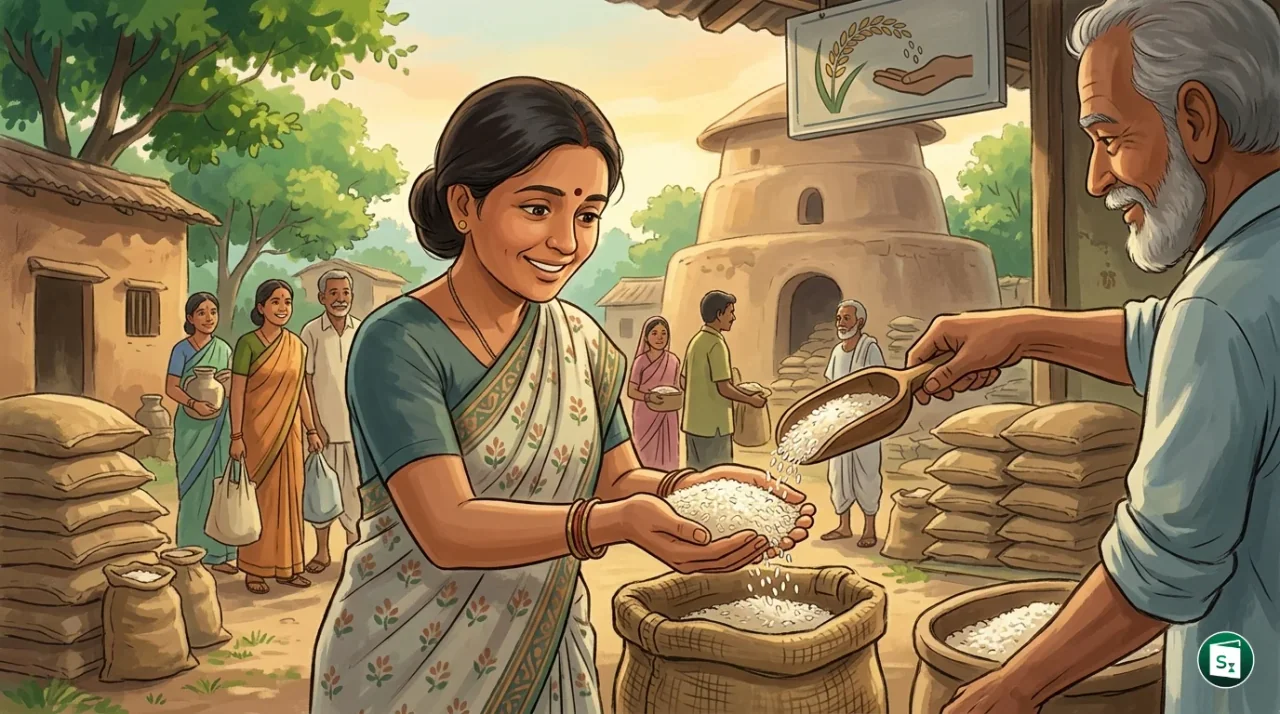
The Cabinet Committee on Economic Affairs (CCEA) has approved tighter quality standards for rice distributed under the Pradhan Mantri Garib Kalyan Anna Yojana (PMGKAY), marking the first revision of such specifications in nearly three decades. The permissible broken grain content in raw rice has been cut from 25% to 10%, while for parboiled rice it has been reduced from 16% to 5%, benefiting over 80 crore beneficiaries across the country. This reform aims to deliver better quality grain to households without reducing their existing foodgrain entitlements.
What Has the CCEA Approved?
The CCEA, chaired by the Prime Minister, approved a revision of the quality specifications for rice supplied under the Public Distribution System (PDS) for the first time in about 30 years. The new norms apply to both raw rice and parboiled rice, which are the two main forms in which rice is distributed through ration shops.
| Rice Type | Previous Broken Grain Limit | New Broken Grain Limit |
|---|---|---|
| Raw rice | Up to 25% | Up to 10% |
| Parboiled rice | Up to 16% | Up to 5% |
This means that for every 100 kilograms of raw rice, no more than 10 kilograms may consist of broken grains, down from the earlier allowance of 25 kilograms. The tighter milling parameters will ensure that beneficiaries receive whole, uniform grains rather than rice with a high proportion of broken pieces.
The improved standards will also apply to rice distributed under other welfare schemes that draw from the central pool managed by the Food Corporation of India (FCI). Beneficiaries will continue to receive their existing entitlement of 5 kg of foodgrains per person per month (or 35 kg per household per month for Antyodaya Anna Yojana families) without any reduction in quantity.
PMGKAY: The World’s Largest Food Security Programme
The Pradhan Mantri Garib Kalyan Anna Yojana (PMGKAY) was launched in March 2020 as an emergency response to the economic disruptions caused by the COVID-19 pandemic. Initially conceived as a temporary measure, the scheme was progressively extended and was eventually made permanent for a five-year period starting 1 January 2024, covering about 81.35 crore persons at an estimated cost of Rs 11.80 lakh crore.
PMGKAY operates under the broader framework of the National Food Security Act (NFSA), 2013, which provides a legal entitlement to subsidised foodgrains for up to 75% of the rural population and 50% of the urban population. The scheme is administered by the Ministry of Consumer Affairs, Food and Public Distribution, with the Food Corporation of India (FCI) acting as the nodal agency for procurement, storage, and distribution.
Under PMGKAY, eligible households receive:
- Priority Households (PHH): 5 kg of foodgrains per person per month free of cost
- Antyodaya Anna Yojana (AAY) households: 35 kg per household per month free of cost
The FCI, established in 1965 under the Food Corporations Act, 1964, procures rice and wheat from farmers at the Minimum Support Price (MSP) announced by the government. This procurement supports farmers while ensuring adequate stocks for the central pool, from which PDS and welfare schemes are supplied. Rice procurement typically happens during the Kharif Marketing Season (KMS), which runs from October to September, with the KMS 2027-28 being the deadline for full implementation of the new quality norms.
The Union Budget 2026-27 allocated Rs 2.27 lakh crore for PMGKAY, making it the single largest budgetary outlay for any welfare scheme.
Why This Reform Matters
This decision addresses a long-standing concern about the quality of grain supplied through ration shops. Beneficiaries frequently reported receiving rice with a high proportion of broken grains, which affected both the appearance and the cooking quality of the grain. By tightening the milling specifications, the government aims to restore dignity to the food security programme by ensuring that the grain reaching households is of a visibly better standard.
Cost Savings and Efficiency Gains
The reform is expected to generate annual savings of about Rs 2,161 crore through reduced logistics, storage, and packaging costs. Under the new system, broken rice will be separated at the milling stage itself and auctioned directly from millers’ premises, eliminating the need for its separate transportation and storage. The use of HDPE bags for storing broken rice instead of jute bags will further lower packaging expenses.
The revenue generated from the sale of broken rice for industrial purposes will also help reduce the overall food subsidy burden. Additionally, an estimated 8-9 million tonnes of broken rice will be freed up annually for alternative uses such as ethanol production and animal feed.
QR-Based Traceability
The reform builds on the government’s ongoing digitisation of the PDS. QR-based traceability has been integrated across the supply chain, allowing end-to-end verification of grain batches. This transparency mechanism helps prevent pilferage and ensures accountability from the point of procurement to the point of distribution at fair price shops.
The Downstream Impact: Broken Rice to Ethanol
An important consequence of the new quality norms is the productive utilisation of broken rice that will now be separated during milling. Instead of being mixed with edible rice and sent to ration shops, the broken grain will be diverted for industrial use.
India has been actively promoting the blending of ethanol with petrol under the Ethanol Blended Petrol (EBP) Programme, with a target of 20% ethanol blending (E20) by 2025-26. Broken rice, which is rich in starch, serves as a valuable feedstock for ethanol distilleries. The estimated 8-9 million tonnes of broken rice that will be freed up annually can significantly augment ethanol production, reducing the country’s dependence on imported crude oil and supporting the sugar and grain-based distillery ecosystem.
Additionally, broken rice is used in the manufacturing of animal feed and in brewing and distilling industries, ensuring that no grain procured from farmers goes to waste.
From Pilot to Nationwide Rollout
Before extending the reform nationally, the government validated the feasibility of producing improved-quality rice at scale through pilots in six states: Haryana, Andhra Pradesh, Punjab, Odisha, Telangana, and Chhattisgarh. These pilot projects demonstrated that rice millers could meet the tighter specifications without significant disruption to operations.
Procurement of rice under the new specifications will begin immediately. The rollout will be implemented across all procuring states in a phased manner, with the full transition targeted by the Kharif Marketing Season (KMS) 2027-28. Distribution of improved-quality rice to beneficiaries under PMGKAY and other welfare schemes will also be carried out in phases to ensure a smooth transition nationwide.
Rice that was already produced to the new specifications during the pilot phase will now also be supplied to beneficiaries under PMGKAY and other welfare schemes.
Key Takeaways
- The CCEA approved the first revision of PDS rice quality specifications in nearly three decades, reducing broken grain limits for raw rice to 10% and for parboiled rice to 5%.
- The reform benefits over 80 crore beneficiaries under PMGKAY, the world’s largest food security programme, without reducing their existing grain entitlements.
- The Food Corporation of India (FCI), established in 1965, is the nodal agency for procurement and distribution of rice under the PDS.
- PMGKAY was launched in March 2020 and was extended for five years from January 2024 at an estimated cost of Rs 11.80 lakh crore.
- The reform is expected to save approximately Rs 2,161 crore annually in logistics and storage costs and free up 8-9 million tonnes of broken rice for ethanol production.
- Pilots were conducted in six states Haryana, Andhra Pradesh, Punjab, Odisha, Telangana, and Chhattisgarh before nationwide rollout, which will be fully implemented by KMS 2027-28.