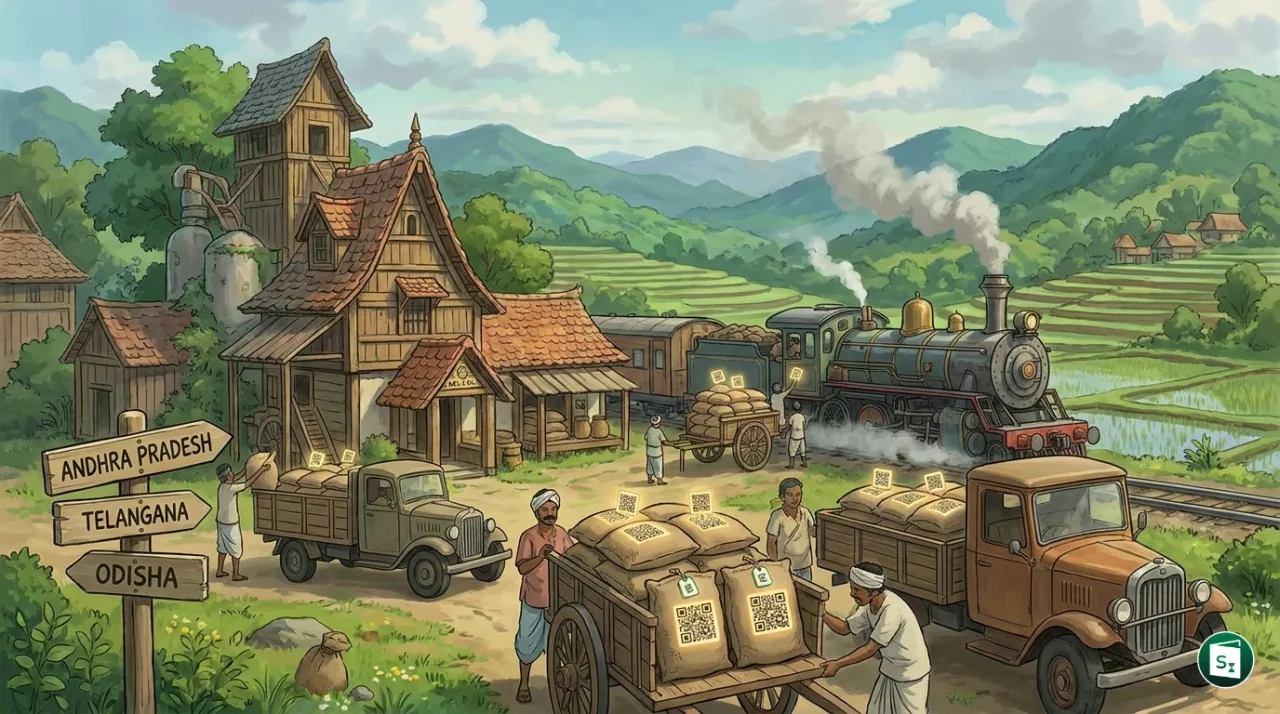
The central government has expanded the Food Corporation of India’s QR code tagging initiative for foodgrain bags to Andhra Pradesh, Telangana, and Odisha. This technological expansion targets the movement of 20 lakh tonnes of rice from milling units to distribution hubs across the three states. The digital tracking system aims to enhance supply chain transparency and eliminate the leakage of subsidized grains under the public distribution system.
Scale of the Expanded Rollout
The current expansion builds on the success of prior pilot programs. The Food Corporation of India conducted its first pilot phase for rice in Andhra Pradesh between December 2025 and January 2026. This was followed by another pilot for wheat in Punjab between April and May 2026. The positive outcomes of these initial trials paved the way for the scaled deployment across three major foodgrain-producing states.
Under the current phase, the initiative manages the allocation and movement of 20 lakh tonnes of rice. This grain is tracked during its transit from local milling units to regional distribution hubs. The state-wise breakdown of the tracked volume highlights the focus on high-procurement zones.
| State | Tracked Volume of Rice (in Lakh Tonnes) | Role in the Initiative |
|---|---|---|
| Andhra Pradesh | 10 | Host of the initial rice pilot and the largest allocation in this expansion |
| Telangana | 5 | Key southern distribution hub integrated in this phase |
| Odisha | 5 | Major eastern state participating in the expanded tracking framework |
Technology and Integration in the Supply Chain
The core of the initiative lies in assigning a unique Quick Response (QR) code to each foodgrain bag at the milling stage. This digital marker registers critical metadata, including the specific procuring agency, the local procurement centre, and the harvest season of the grain. By capturing this data at the source, the system establishes a secure identity for every bag entering the supply chain.
As the grain bags move through the distribution network, officials perform scans at key transition points. These scans take place at storage godowns run by the Food Corporation of India and subsequently at Fair Price Shops (FPS), which serve as the final distribution outlets. Using GPS-enabled mobile applications, personnel log the exact location and timestamp of each scan to create a verifiable digital trail.
At the final retail point, the QR code system integrates with electronic Point of Sale (ePoS) devices operated at fair price shops. When a dealer scans the QR code during distribution, the ePoS device verifies the grain’s authenticity and origin in real time. This technological link enables automatic generation of bills, simplifies inventory updates, and ensures accurate calculation of government food subsidies.
Curbing Pilferage and Preventing Bag Recycling
A primary focus of this digitization campaign is to combat the practice of foodgrain recycling. In this fraudulent scheme, subsidized grains distributed through the welfare network are illegally gathered, repacked in generic bags, and sold back to government agencies at the official Minimum Support Price (MSP). This practice creates artificial procurement volumes and results in substantial financial losses for the central exchequer.
The unique QR codes prevent this by establishing a digital history for each bag. When a bag is scanned at the procurement stage, the system checks its details against the active season and region. If a miller or trader attempts to present a recycled bag, the system detects the discrepancy in the harvest season or the bag’s previous distribution logs. This mechanism ensures that only fresh, legitimately procured foodgrains are paid for at the Minimum Support Price.
In addition to preventing recycling, real-time tracking curbs pilferage during transit. Historically, grain diversion occurred during the long transport routes from milling units to storage godowns. By tracking the location of the bags dynamically, the government can pinpoint exactly where transit delays or unauthorized offloadings occur.
Historical and Statutory Context of Food Distribution
The Food Corporation of India (FCI) serves as the central pillar of India’s food security system. Established on January 14, 1965, under the Food Corporations Act, 1964, the corporation was set up to implement the nation’s agricultural and food policies. Originally headquartered in Chennai, the agency later shifted its main office to New Delhi. The corporation operates under the administrative supervision of the Ministry of Consumer Affairs, Food and Public Distribution.
The operational mandate of the corporation is closely tied to the National Food Security Act (NFSA), 2013. This statutory act transformed food security from a welfare-oriented scheme into a legal right. The legislation entitles up to 75 percent of the rural population and 50 percent of the urban population to receive subsidized foodgrains. The food distribution system targets over 80 crore beneficiaries nationwide.
The grains procured by the corporation at the Minimum Support Price (MSP) are stored in central warehouses before being handed over to state governments. State agencies then distribute the foodgrains through a network of more than 5 lakh Fair Price Shops. The modernization of these shops using electronic Point of Sale (ePoS) devices has streamlined distribution and paved the way for initiatives like the One Nation One Ration Card (ONORC) scheme, which enables interstate portability of food entitlements.
Key Takeaways
- The central government expanded the Food Corporation of India (FCI) QR code tagging initiative to Andhra Pradesh, Telangana, and Odisha on June 9, 2026.
- The expanded digital tracking initiative covers a total volume of 20 lakh tonnes of rice moved from milling units to distribution hubs.
- Under this expansion, the state-wise allocations include 10 lakh tonnes in Andhra Pradesh, and 5 lakh tonnes each in Telangana and Odisha.
- The initiative follows successful pilot projects for rice in Andhra Pradesh from December 2025 to January 2026, and for wheat in Punjab from April to May 2026.
- The Food Corporation of India (FCI) is a statutory body established on January 14, 1965, under the Food Corporations Act, 1964.
- The legal mandate for foodgrain distribution is governed by the National Food Security Act (NFSA), 2013, which covers up to 75 percent of the rural and 50 percent of the urban population.