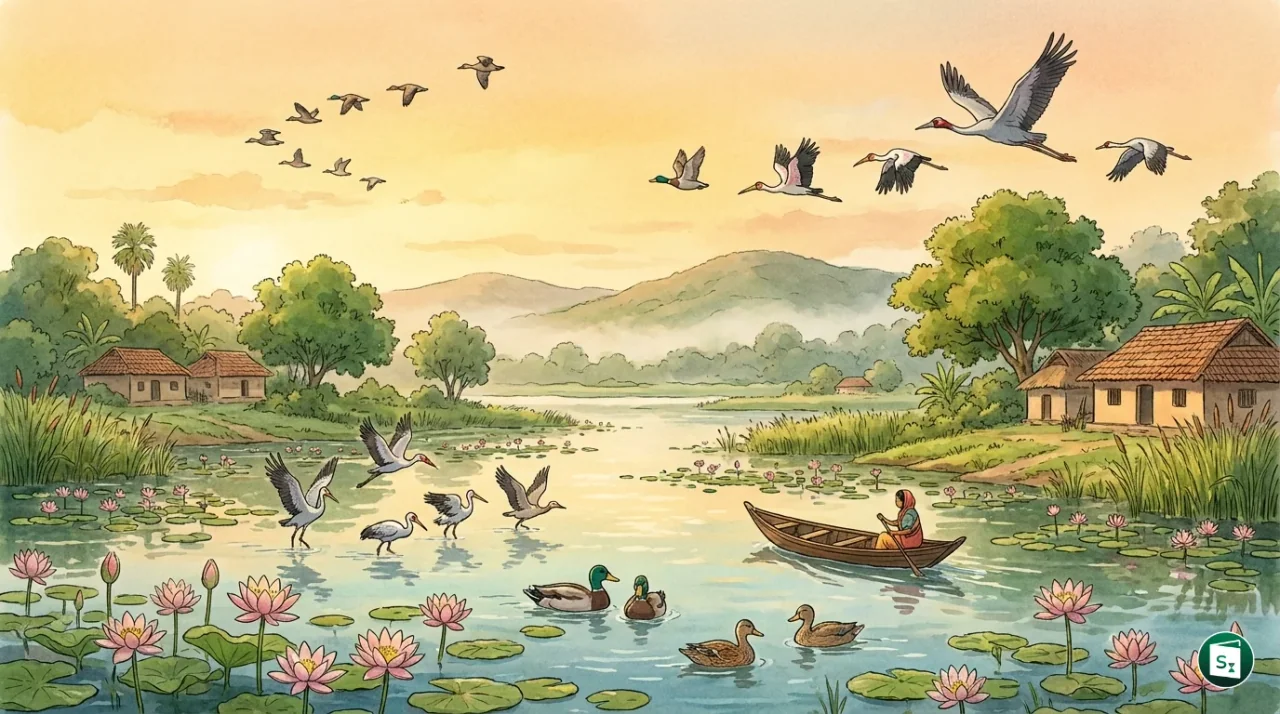
Prime Minister Narendra Modi announced the designation of the Jai Prakash Narayan Bird Sanctuary, commonly known as Surha Tal, as India’s 100th Ramsar Site on World Environment Day, June 5, 2026. Located in the Ballia district of Uttar Pradesh, this ecological milestone elevates India to the third position globally and the first in Asia for the highest number of recognized wetlands of international importance. The designation highlights the country’s growing commitment to conserving its vital aquatic ecosystems and biodiversity.
Geographic and Ecological Profile of Surha Tal
The sanctuary is situated in the middle stretch of the Ganga River basin within the Indo-Gangetic Plain. It is a large, natural, perennial oxbow lake formed by the natural meandering of the Ganga River, which shifted its course over centuries to leave a deep, horseshoe-shaped basin. The wetland covers an area of approximately 3,432 hectares, and its size expands significantly during the monsoon season to submerge the surrounding floodplains and low-lying marshes.
The hydrology of the lake is sustained by three primary seasonal inflow channels, namely the Garai River, the Budhi River, and the Madha Nala. The lake drains into the Ganga River through a 23-kilometre-long outlet channel called the Kathar Nala. During peak flood periods in the Ganga and Sarayu rivers, the water flow in the Kathar Nala reverses, causing river water to flow back into the lake. This natural cycle helps maintain the wetland’s seasonal water levels and nutrient balance.
The area was originally declared a wildlife sanctuary by the Government of Uttar Pradesh in 1991. It was subsequently renamed to honor the prominent Indian independence leader, Jai Prakash Narayan.
Biodiversity and Livelihood Value
The sanctuary acts as a critical refuge for biodiversity and is a major stopover and wintering site for migratory waterbirds travelling along the Central Asian Flyway. It supports more than 221 plant species and a diverse array of fauna. Among the bird population, the wetland is home to the vulnerable common pochard and the Indian river tern, along with species like the bar-headed goose and the sarus crane.
The aquatic environment is equally rich, hosting 66 fish species. These include vulnerable native fish species such as the Wallago attu and the Bagarius bagarius. The abundant fish population serves as a primary food source for the vulnerable fishing cat, which utilizes the dense reed beds and marshes around the lake as feeding and breeding grounds.
Beyond its ecological value, Surha Tal serves as a vital resource for local communities. The lake supports the livelihoods of approximately 45 surrounding villages by facilitating sustainable fishing, agriculture, and water extraction. The wetland also performs essential ecological services, including flood mitigation, local climate regulation, and groundwater recharge for the region.
India’s Ramsar Sites and Global Ranking
The designation of Surha Tal represents a major conservation milestone for India, bringing the national count to 100 Ramsar sites. This achievement places India first in Asia and third globally in terms of the total number of designated wetlands of international importance. Only the United Kingdom and Mexico lead India in global site designations.
| Rank | Country | Number of Ramsar Sites |
|---|---|---|
| 1 | United Kingdom | 176 |
| 2 | Mexico | 144 |
| 3 | India | 100 |
Domestically, the distribution of Ramsar sites varies across states. Tamil Nadu holds the highest number of designated wetlands in the country. Uttar Pradesh follows closely behind, with Surha Tal becoming the state’s 13th Ramsar site.
| State | Number of Ramsar Sites | Notable Sites |
|---|---|---|
| Tamil Nadu | 20 | Karikili Bird Sanctuary, Pallikaranai Marsh |
| Uttar Pradesh | 13 | Surha Tal, Bakhira Wildlife Sanctuary, Haiderpur Wetland, Upper Ganga River |
The Ramsar Convention Framework
The Ramsar Convention on Wetlands of International Importance is an intergovernmental treaty established in 1971 in the Iranian city of Ramsar. The treaty, which came into force in 1975, provides the framework for national action and international cooperation for the conservation and wise use of wetlands. India officially became a contracting party to the convention on February 1, 1982.
Key Takeaways
- Surha Tal, also known as the Jai Prakash Narayan Bird Sanctuary, in Uttar Pradesh has been designated as India’s 100th Ramsar Site.
- With this declaration, India ranks first in Asia and third globally for the highest number of Ramsar sites, behind only the United Kingdom and Mexico.
- Surha Tal is a natural perennial oxbow lake located in the Ballia district of Uttar Pradesh within the Ganga River basin.
- The wetland serves as a critical stopover and wintering site for migratory birds along the Central Asian Flyway.
- Tamil Nadu holds the highest number of Ramsar sites in India with 20 sites, while Uttar Pradesh follows with 13 sites.
- India signed the Ramsar Convention on Wetlands on February 1, 1982, which originally was established in 1971 in Ramsar, Iran.