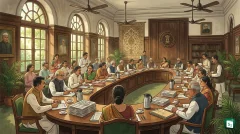
Union Minister Arjun Ram Meghwal launched the e-VSP portal on 15 July 2026 at Kartavya Bhawan-2 in New Delhi, creating a single digital gateway for Hindi legal literature. Hosted at www.vsp.gov.in, the platform makes Supreme Court and High Court judgments, legal journals, and reference books freely accessible in Hindi to lawyers, students, researchers, and citizens across the world. Developed by the National Informatics Centre (NIC) in collaboration with the Official Languages Wing, the portal brings the entire catalogue of Vidhi Sahitya Prakashan (VSP) into one online repository for the first time.
What Is the e-VSP Portal?
The e-VSP portal (electronic Vidhi Sahitya Prakashan) is a web-based platform hosted at www.vsp.gov.in that digitises the complete collection of the Vidhi Sahitya Prakashan, a wing of the Legislative Department under the Ministry of Law and Justice. It serves as a central repository for Hindi translations of reportable judgments from the Supreme Court of India and various High Courts, alongside legal journals, reference books, and other law-related publications.
The portal is designed for a wide range of users. Law students and teachers can access reference materials for study and research. Advocates and judicial officers can retrieve authoritative Hindi versions of judgments for case preparation. Researchers gain instant access to legal archives without visiting physical libraries. Ordinary citizens can read court rulings in Hindi without relying on third-party translations.
At the launch event, Legislative Department Secretary Dr. Rajiv Mani stated that the portal provides seamless digital access to VSP publications. Additional Secretary Dr. Manoj Kumar highlighted five expected outcomes: expansion of the geographic reach of Hindi legal publications, easier discovery of legal knowledge, connection with a new generation of readers, strengthening of Hindi as a language of legal discourse, and creation of a wider ecosystem for Hindi legal publishing.
Vidhi Sahitya Prakashan: A Historical Background
The origins of Vidhi Sahitya Prakashan can be traced to 1958, when the Committee of Parliament on Official Languages recommended that authorised translations of Supreme Court and High Court judgments be produced under the supervision of the Law Department. Acting on further recommendations from the Hindi Advisory Committee, the Legislative Department set up a dedicated journal wing in 1968 to promote the use of Hindi in the legal field. This wing was later named Vidhi Sahitya Prakashan.
VSP launched its first monthly Hindi publication in April 1968 under the title Uchchatama Nyayalaya Nirnaya Patrika, featuring reportable judgments of the Supreme Court translated into Hindi. A companion publication covering High Court judgments, Uchcha Nyayalaya Nirnaya Patrika, followed in January 1969. In 1987, the High Court journal was split into two separate periodicals: Uchcha Nyayalaya Civil Nirnaya Patrika and Uchcha Nyayalaya Dandik Nirnaya Patrika.
Over the decades, VSP expanded its scope to include law textbooks, reference books, digital editions of Central Acts, the Constitution of India, election manuals, and legal glossaries, all in Hindi. It also organises conferences, seminars, and book exhibitions at district courts, High Courts, and law colleges across the country to propagate Hindi in the legal domain. These activities are carried out under the mandate of Article 351 of the Constitution, which directs the Union to promote the spread and development of the Hindi language.
Key Features of the Portal
The e-VSP portal consolidates what was previously a fragmented and mostly physical collection into a single digital architecture. Before this platform, accessing official Hindi translations of court judgments required visiting physical libraries or navigating separate departmental archives. The portal changes this by integrating VSP’s entire catalogue into one searchable interface.
| Feature | Description |
|---|---|
| Centralised repository | All VSP publications, including judgments, journals, and reference books, are available from a single domain |
| Hindi language focus | Content is specifically curated in Hindi, making complex legal concepts accessible to Hindi-speaking users |
| Free and open access | No subscription or registration fees; anyone can browse and download materials |
| Official legal validity | Digital copies hosted on a government server retain the legal authority of their printed counterparts |
| Searchable interface | Users can locate specific judgments, acts, or legal texts through structured search |
| Global availability | The portal is accessible from anywhere in the world, 24 hours a day |
The portal was developed with technical assistance from the National Informatics Centre (NIC), which was established in 1976 and serves as the technology partner of the Government of India under the Ministry of Electronics and Information Technology (MeitY). NIC provided the hosting infrastructure, domain registration, and technical architecture for the platform.
Significance and Impact
The launch of the e-VSP portal carries significance on multiple fronts. First, it addresses a long-standing accessibility gap in India’s legal system. For decades, non-English-speaking citizens and legal professionals had limited access to official legal texts in Hindi. The portal removes this barrier by putting authoritative Hindi translations of court judgments and legal literature at everyone’s fingertips.
Second, the portal strengthens legal literacy among the broader population. When citizens can read court rulings in a language they understand, they are better equipped to know their rights and engage with the justice system. This directly supports the principle of access to justice, a cornerstone of the rule of law under the Constitution.
Third, the initiative aligns with the government’s Digital India vision, which seeks to transform governance through technology. The e-VSP portal follows other digital justice initiatives such as the e-Courts Project, the Tele-Law Scheme, and the UMANG app, all of which aim to make legal processes more transparent and citizen-centric.
Fourth, the portal has practical implications for legal education and practice. Hindi-medium law students, who often struggled to find quality reference materials in their preferred language, now have access to a comprehensive digital library. Independent advocates in smaller towns, who may not afford expensive subscription databases like SCC Online or Manupatra, can rely on this free government platform for authoritative legal texts.
At the event, Joint Secretary and Legislative Counsel Dr. Brijesh Singh highlighted the cooperation between the Official Languages Wing and VSP in preparing Hindi legal publications. Joint Secretary Sh. Ashvani, who is in charge of VSP, made a detailed presentation of the portal’s features alongside the NIC technical team.
Constitutional and Policy Context
The e-VSP portal operates within a well-established constitutional and legal framework concerning the official language. Article 343 of the Constitution designates Hindi in Devanagari script as the official language of the Union, while Article 348 specifies the language to be used in the Supreme Court and High Courts. Article 351 imposes a duty on the Union to promote the spread and development of the Hindi language.
The Official Languages Act, 1963, further provides for the use of Hindi for official purposes of the Union. Under section 5 of this Act, authorised Hindi translations of Central Acts, Ordinances, Orders, Rules, and Regulations are published. VSP’s work in translating court judgments and legal texts directly serves this statutory mandate.
The portal also complements the National e-Governance Plan (NeGP) and the broader push toward ease of justice, a priority area for the Ministry of Law and Justice. In recent years, the government has introduced several digital initiatives in the legal sector, including the e-Courts Integrated Mission Mode Project, which digitises court processes, and the Tele-Law programme, which provides legal advice through Common Service Centres.
Key Takeaways
- Union Minister Arjun Ram Meghwal launched the e-VSP portal on 15 July 2026 at Kartavya Bhawan-2, New Delhi.
- The portal is hosted at www.vsp.gov.in and was developed by the National Informatics Centre (NIC) in collaboration with the Official Languages Wing.
- It provides free digital access to Supreme Court and High Court judgments, legal journals, and reference books in Hindi.
- Vidhi Sahitya Prakashan (VSP) was established in 1968 as a journal wing of the Legislative Department, Ministry of Law and Justice, following recommendations from the Committee of Parliament on Official Languages (1958).
- VSP publishes Uchchatama Nyayalaya Nirnaya Patrika (Supreme Court judgments, since April 1968) and Uchcha Nyayalaya Civil/Dandik Nirnaya Patrika (High Court judgments, since January 1969).
- The initiative operates under the mandate of Article 351 of the Constitution, which directs the Union to promote the development of the Hindi language.