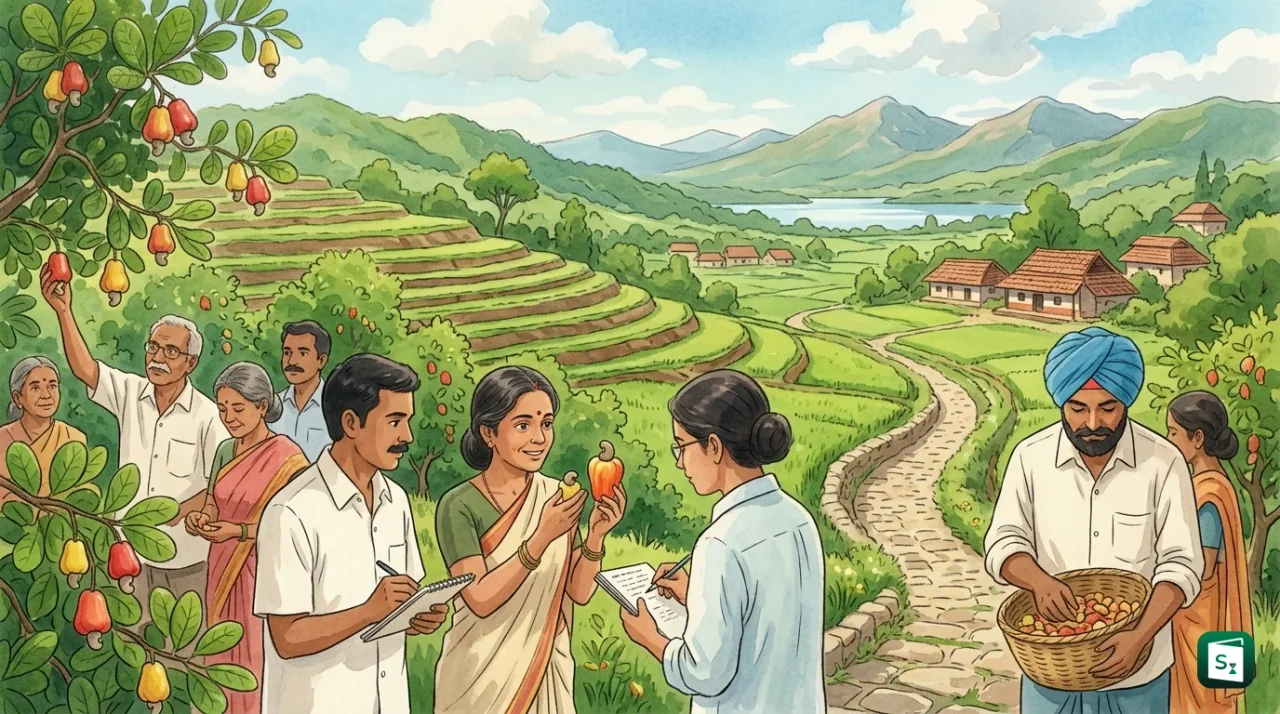
India achieved significant milestones at the 49th Session of the Codex Alimentarius Commission (CAC49) held in Geneva, Switzerland, from July 6 to 10, 2026. The Commission adopted seven Codex standards and guidelines developed under India’s chairmanship and co-chairmanship, reinforcing the country’s contribution to science-based international food standards. In another major achievement, the Commission approved India’s proposal to develop a new Codex standard for cashew kernels.
What Is the Codex Alimentarius Commission?
The Codex Alimentarius Commission (CAC) is the central part of the Joint FAO/WHO Food Standards Programme. Established in 1963 by the Food and Agriculture Organization (FAO) and the World Health Organization (WHO), it is the highest international body for food standards. The name Codex Alimentarius is Latin for “food code”.
The Commission is headquartered in Rome, Italy, at the FAO headquarters. It currently has 189 members, consisting of 188 member countries and one member organization (the European Union). The Commission’s primary mandate is to protect consumer health and ensure fair practices in the food trade.
Codex standards are developed through a science-based process by various subsidiary bodies, including General Subject Committees (which deal with horizontal issues like food hygiene, labelling, and additives) and Commodity Committees (which develop standards for specific food products). These standards serve as the global reference point in international food trade and are recognized by the World Trade Organization (WTO) under the Agreement on Sanitary and Phytosanitary Measures (SPS Agreement). Any standard adopted by the Commission becomes part of the Codex Alimentarius, a collection of internationally adopted food standards, guidelines, and codes of practice.
Seven Standards Adopted Under India’s Leadership
The Indian delegation at CAC49 was led by Rajit Punhani, Chief Executive Officer of the Food Safety and Standards Authority of India (FSSAI), along with technical experts from FSSAI and the Spices Board of India. The Commission adopted seven Codex texts that were developed under India’s chairmanship or co-chairmanship of various Codex committees.
Standards Under India’s Chairmanship
India chaired the development of two Codex commodity standards:
Codex Standard for Dried Coriander Seeds establishes internationally harmonised quality requirements for one of the world’s most widely traded spices. Coriander is a staple in cuisines across the globe, and this standard will facilitate smoother trade by providing a common reference for quality parameters.
Codex Standard for Fresh Curry Leaves provides the first internationally accepted benchmark for this regionally important culinary herb. Curry leaves hold significant cultural and commercial importance across South Asia and are increasingly used in global cuisine. This standard will help Indian exporters access international markets with greater clarity on quality expectations.
Both standards were developed under the Codex Committee on Spices and Culinary Herbs (CCSCH), which India has hosted and chaired since its establishment in July 2013. The Spices Board of India, headquartered in Kochi, Kerala, serves as the secretariat for CCSCH. The committee was created at the initiative of India to address the lack of worldwide harmonised standards for spices, which was affecting international spice trade valued at billions of dollars.
Standards Under India’s Co-Chairmanship
CAC49 also adopted five Codex texts developed under India’s co-chairmanship:
Codex Standards for Vanilla and Large Cardamom establish internationally harmonised quality requirements for these globally traded commodities. Large cardamom, also known as black cardamom, is primarily grown in India, Nepal, and Bhutan, and this standard will benefit farmers and traders in the Himalayan region.
Annexes to Guidelines for the Safe Use and Reuse of Water in Food Production and Processing promote sustainable water management while ensuring food safety. These guidelines are increasingly relevant as climate change puts pressure on freshwater resources globally.
Guidelines for the Control of Campylobacter and Salmonella in Chicken Meat strengthen measures to reduce foodborne illnesses associated with poultry. Campylobacter and Salmonella are among the leading causes of foodborne diseases worldwide.
Provisions Relevant to Joint Presentation and Multipack Formats under the General Standard for the Labelling of Prepackaged Foods provide greater clarity and consistency in food labelling requirements for products sold in combination packs, addressing a long-standing gap in international labelling rules.
New Work on a Codex Standard for Cashew Kernels
In a significant boost for India’s agricultural exports, the Commission approved India’s proposal to initiate new work for developing a Codex Standard for Cashew Kernels under the Codex Committee on Processed Fruits and Vegetables (CCPFV). The proposal received broad support from member countries, reflecting the growing need for globally harmonised quality and safety standards for one of the world’s most widely traded tree nuts.
India is the world’s largest consumer of cashew kernels and the second-largest producer globally, accounting for about 16% of global raw cashew nut production. The country also holds a 36.5% share of global processing capacity, making it a major hub for cashew processing. However, India’s share in global cashew kernel exports has declined from around 25% a decade ago to about 8%, partly due to the absence of internationally recognised quality benchmarks for Indian cashew kernels.
The new Codex standard is expected to strengthen India’s position in the international cashew market by reducing technical barriers to trade, facilitating smoother market access, and enhancing the competitiveness of Indian exports through internationally accepted quality benchmarks. The CCPFV, which was recently taken over by the Republic of Korea as its host country, will oversee the development of this standard.
India’s Expanding Role in Global Food Standards
Beyond the adoption of seven texts and the new cashew kernel standard, India secured another important leadership position at CAC49. India was elected Co-Chair of the Electronic Working Group on New Food Sources and Production Systems (NFPS). This group will review existing regulatory frameworks across member countries, identify gaps in Codex risk analysis principles, and assess the need for any future Codex guidance on emerging food technologies.
India’s growing influence in the Codex system is the result of sustained institutional engagement. The Food Safety and Standards Authority of India (FSSAI), established under the Food Safety and Standards Act, 2006, serves as India’s National Codex Contact Point and coordinates the country’s input to the Commission. FSSAI operates under the Ministry of Health and Family Welfare and is headquartered in New Delhi.
India’s flagship contribution remains the Codex Committee on Spices and Culinary Herbs (CCSCH), which it successfully proposed and has hosted since 2013. As of the 8th session of CCSCH held in Guwahati, Assam in October 2025, the committee had developed 14 international standards for 16 spices. With the addition of the dried coriander, fresh curry leaves, vanilla, and large cardamom standards at CAC49, India’s leadership in shaping global spice trade standards has been further cemented.
Key Takeaways
- The 49th Session of the Codex Alimentarius Commission (CAC49) was held in Geneva, Switzerland, from July 6 to 10, 2026.
- Seven Codex standards and guidelines developed under India’s chairmanship and co-chairmanship were adopted at CAC49.
- India chaired the development of standards for Dried Coriander Seeds and Fresh Curry Leaves through the Codex Committee on Spices and Culinary Herbs (CCSCH), which India has hosted since 2013.
- India’s proposal for a new Codex Standard for Cashew Kernels was approved, to be developed under the Codex Committee on Processed Fruits and Vegetables (CCPFV).
- India was elected Co-Chair of the Electronic Working Group on New Food Sources and Production Systems (NFPS) at CAC49.
- The Codex Alimentarius Commission was established in 1963 by FAO and WHO, is headquartered in Rome, Italy, and has 189 members.