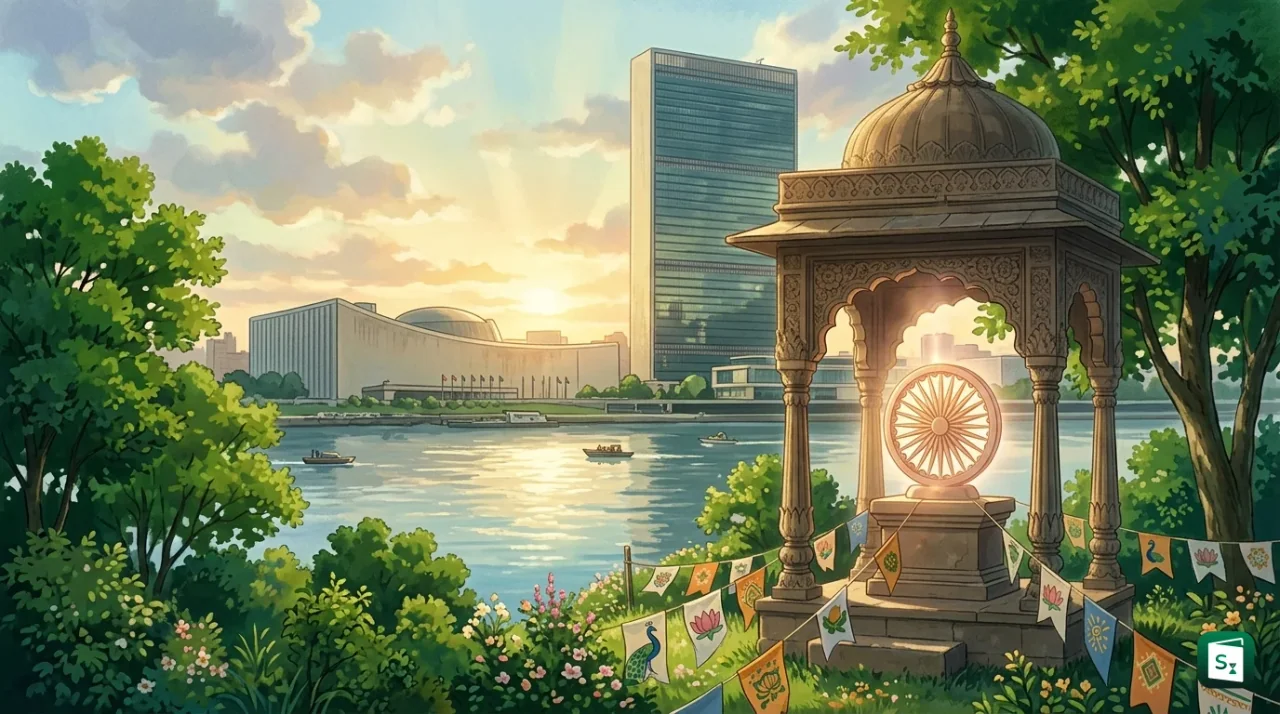
External Affairs Minister S Jaishankar formally launched India’s campaign for a non-permanent seat on the United Nations Security Council (UNSC) for the 2028-29 term at the UN Headquarters in New York on 13 July 2026. The campaign is built around the theme SHANTI, an acronym for Securing Holistic Advancement through Norms, Trust and Integrity, outlining India’s vision for a more representative and effective global order. India will contest the sole seat allocated to the Asia-Pacific Group and faces Tajikistan in the election scheduled for June 2027.
The SHANTI Vision
SHANTI stands for Securing Holistic Advancement through Norms, Trust and Integrity. Speaking at the launch event attended by UN envoys and diplomats, Jaishankar explained that peace, progress and prosperity cannot be sustained in a fragmented manner. The vision calls for a rules-based global order where norms, trust and integrity form the foundation of multilateral cooperation.
India has identified five priority areas under this framework. First, strengthening the voice of the Global South and ensuring that the concerns of developing countries are factored into global decision-making. Second, advancing reformed multilateralism to make international institutions reflect contemporary realities. Third, making UN peacekeeping ready for modern and future challenges. Fourth, promoting the responsible use of Artificial Intelligence (AI) while safeguarding against its misuse. Fifth, securing maritime trade routes and intensifying efforts against terror financing.
India’s Track Record at the UNSC
India has served as a non-permanent member of the UNSC eight times so far, totalling 16 years on the Council. Its previous terms were: 1950-51, 1967-68, 1972-73, 1977-78, 1984-85, 1991-92, 2011-12 and 2021-22. India’s most recent tenure in 2021-22 focused on counter-terrorism, maritime security, peacekeeping reforms and equitable access to technology.
India has consistently won overwhelming support in UNSC elections. For the 2021-22 term, it secured 184 out of 192 valid votes in the General Assembly. For the 2011-12 term, it received 187 of 190 votes. This broad-based support reflects India’s standing among UN member states across regions.
Beyond its elected terms, India is one of the largest and most consistent contributors to UN peacekeeping missions. It has contributed nearly 300,000 personnel to about 50 missions over the decades, making it one of the world’s leading contributors to international peace and security. India also served as a founding member of the United Nations in 1945, signing the Declaration by United Nations on 1 January 1942 and participating in the San Francisco conference that drafted the UN Charter.
How Non-Permanent Members Are Elected
The UN Security Council consists of 15 members: five permanent members (China, France, Russia, the United Kingdom and the United States) and 10 non-permanent members elected for two-year terms. The five permanent members, often referred to as the P5, hold veto power over substantive resolutions.
The 10 non-permanent seats are distributed among regional groups to ensure equitable geographical representation:
| Regional Group | Seats |
|---|---|
| African States | 3 |
| Asia-Pacific Group | 2 |
| Latin American and Caribbean States | 2 |
| Western European and Other States | 2 |
| Eastern European States | 1 |
Each year, the UN General Assembly (UNGA) elects five new non-permanent members to replace those whose terms are ending. Candidates must secure a two-thirds majority of the votes cast. Elections are conducted by secret ballot, and no nominations are made. A retiring member is not eligible for immediate re-election.
India belongs to the Asia-Pacific Group and is contesting the sole seat from this region for the 2028-29 term against Tajikistan. The election is scheduled for June 2027.
The Bigger Picture: India’s Push for UNSC Reform
India’s campaign for a non-permanent seat is closely tied to its long-standing demand for a permanent seat on the Security Council. India has argued that the UNSC, established in 1945 with 51 member states, no longer reflects contemporary geopolitical realities. The Council now serves 193 member states, yet its permanent membership has not changed in over eight decades.
India is a member of the G4, a grouping that includes Brazil, Germany and Japan, which mutually support each other’s bids for permanent seats. The G4 has proposed expanding the UNSC to 25 or 26 members, with 11 permanent seats including new ones from Asia, Africa and Latin America. India is also part of the L.69 Group, a coalition of developing countries that advocates for comprehensive UNSC reform.
Reform negotiations take place through the Inter-Governmental Negotiations (IGN) process, which was formally recognised by the UNGA in 2008. However, progress has been slow due to divergent positions among member states. The Uniting for Consensus (UfC) group, also known as the Coffee Club, opposes expanding permanent membership and has proposed creating a new category of longer-term renewable seats instead. India has rejected such proposals, calling them a ploy to delay genuine reform.
India has also cautioned that reform of the UNSC would border on failure if only the non-permanent category is expanded, as this would not fundamentally change the decision-making power structure of the P5. India’s Permanent Representative to the UN, Ambassador Harish Parvathaneni, stated that the “nothing is agreed until everything is agreed” approach must not become a tool to block progress.
Prime Minister Narendra Modi, in his address to the Parliament of Indonesia in July 2026, said that developing countries are seeking equal participation in global affairs and that reforms in the UN Security Council can no longer be delayed.
The Geopolitical Context
India’s campaign comes at a time of significant global turmoil. The world is grappling with the Ukraine war, the Gaza conflict and escalating tensions involving the US, Israel and Iran. These crises have exposed the limitations of the Security Council, where veto power has often paralysed decision-making.
India has positioned itself as a voice of the Global South, advocating for dialogue and diplomacy over confrontation. Through its SHANTI vision, India has presented itself as a candidate that can bridge divides and bring a constructive, development-oriented approach to international security challenges. The campaign’s emphasis on countering terror financing, maritime security and responsible AI governance reflects the priorities that India has consistently championed on the global stage.
Key Takeaways
- External Affairs Minister S Jaishankar launched India’s campaign for a non-permanent UNSC seat for the 2028-29 term at the UN Headquarters in New York on 13 July 2026.
- The campaign is themed SHANTI: Securing Holistic Advancement through Norms, Trust and Integrity.
- India faces Tajikistan for the sole seat in the Asia-Pacific Group, with elections scheduled for June 2027.
- India has served as a non-permanent UNSC member eight times, most recently in 2021-22.
- The UNSC has 15 members: five permanent members (P5) with veto power and 10 non-permanent members elected for two-year terms by the UN General Assembly.
- India is a member of the G4 (along with Brazil, Germany and Japan) and the L.69 Group, both pushing for expansion of the UNSC in both permanent and non-permanent categories.