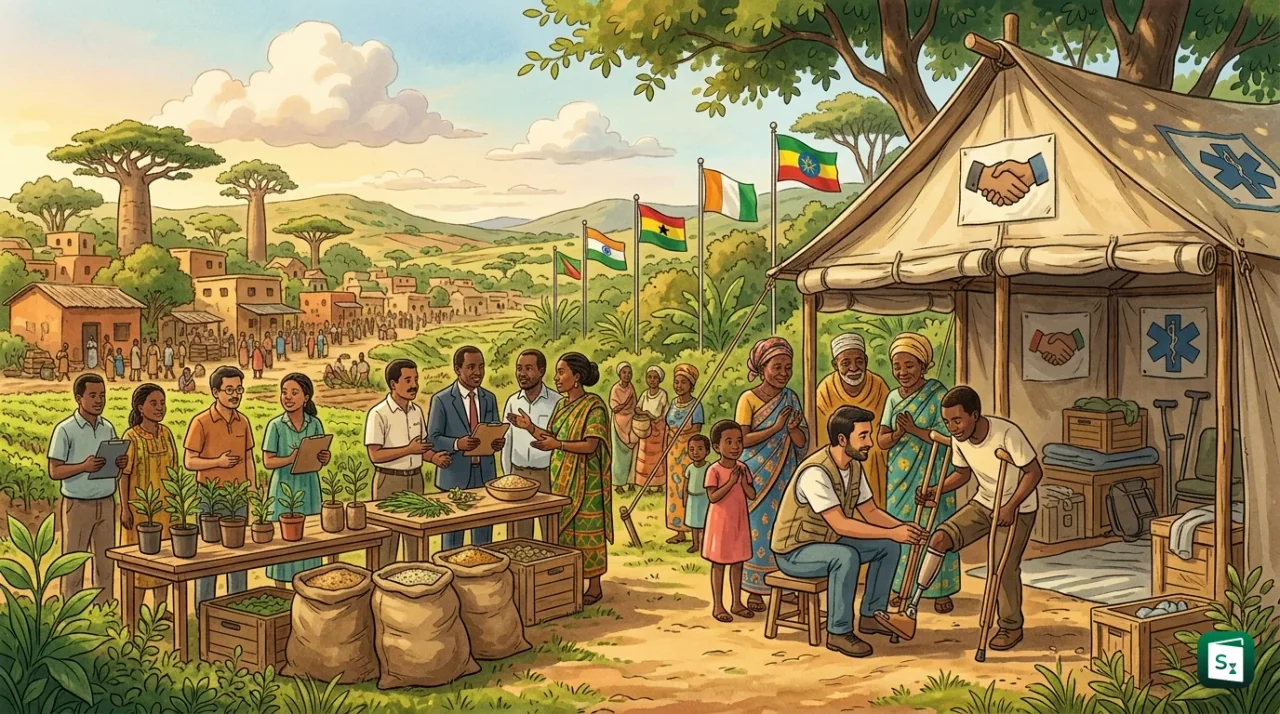
External Affairs Minister S Jaishankar travelled to three African nations, Ghana, Côte d’Ivoire and Ethiopia, from 6 to 10 October 2026 to deepen India’s bilateral ties in trade, investment and infrastructure. In Accra, India and Ghana signed two agreements covering agricultural research and zoological research, while in Abidjan Jaishankar held wide-ranging talks with Côte d’Ivoire on trade, infrastructure, agriculture and healthcare. The visit ended in Addis Ababa, where India announced a new Jaipur Artificial Limb Fitment Camp and pledged closer cooperation on the wider India-Africa partnership.
Jaishankar’s Three-Nation Africa Tour: What Happened
The External Affairs Minister’s itinerary covered one country each in West Africa and the Horn of Africa, a region where India has steadily expanded its diplomatic presence. Ghana and Côte d’Ivoire fall in West Africa, while Ethiopia hosts the headquarters of the African Union in Addis Ababa.
Across the five days, Jaishankar held bilateral meetings with his counterparts and called on the heads of state of all three nations. The Ministry of External Affairs stated that the tour reflected India’s commitment to deepen its partnership with Africa and to advance its solidarity with the Global South, a term used for developing countries across Asia, Africa and Latin America.
| Date | Country | City | Key Engagements |
|---|---|---|---|
| 6 October 2026 | Ghana | Accra | Met President John Dramani Mahama and Foreign Minister Sam Okudzeto Ablakwa; two MoUs exchanged |
| 7 October 2026 | Côte d’Ivoire | Abidjan | Talks with Minister of State for Foreign Affairs Nialé Kaba; met Vice Prime Minister and Defence Minister Tene Birahima Ouattara |
| 8 to 10 October 2026 | Ethiopia | Addis Ababa | Met Prime Minister Abiy Ahmed and Foreign Minister Gedion Timothewos; chaired Regional Heads of Mission Conference |
The choice of these three countries was deliberate. Ghana and Côte d’Ivoire are among the largest economies in West Africa, and Ethiopia is a BRICS member and the diplomatic capital of the continent. Together, they give India a foothold across a region where China, the European Union and Gulf nations are also competing for influence.
India and Ghana: Two MoUs in Agriculture and Zoological Research
Ghana was the first stop of the tour. Jaishankar called on President John Dramani Mahama and held talks with Foreign Minister Sam Okudzeto Ablakwa. The two sides reviewed the India-Ghana Comprehensive Partnership, which was elevated to that status during Prime Minister Narendra Modi’s visit to Accra in July 2025, the first by an Indian Prime Minister in three decades.
Bilateral trade between India and Ghana has crossed $3 billion, and Indian companies have invested close to $2 billion across about 900 projects. Both countries have set a target of doubling bilateral trade over the next five years. Jaishankar pointed out that Ghana’s flagship programmes, such as the Accra Reset in health, Feed Ghana in food security and the One Million Coders initiative, closely mirror India’s Ayushman Bharat, food security schemes and Digital India.
The centrepiece of the Ghana leg was the exchange of two Memoranda of Understanding. One dealt with agricultural research and education, and the other with zoological and biodiversity research.
Agricultural Research MoU Between ICAR and CSIR-CRI
The first agreement is a five-year MoU between the Indian Council of Agricultural Research (ICAR) and the CSIR-Crops Research Institute (CSIR-CRI) of Ghana. ICAR, established in 1929 and headquartered in New Delhi, is India’s apex body for coordinating agricultural research and education under the Ministry of Agriculture and Farmers Welfare.
The partnership focuses on joint agricultural research, the exchange of scientists, germplasm and breeding materials, capacity building, and the commercialisation of farm technologies. Its first phase will centre on vegetable crop research, particularly tomato development, where India will share high-yielding varieties to strengthen domestic tomato production in Ghana. The MoU also covers the processing and value addition of cassava and yam, and post-harvest management such as cold storage and refrigerated transport to reduce food losses.
A Joint Working Group of representatives from ICAR and CSIR-CRI will oversee the collaboration and will meet periodically in New Delhi and Accra.
Zoological Research MoU Between ZSI and the University of Ghana
The second agreement was signed between the Zoological Survey of India (ZSI) and the University of Ghana. ZSI, set up in 1916 and headquartered in Kolkata, functions under the Ministry of Environment, Forest and Climate Change and is India’s premier organisation for animal taxonomy and faunal research.
The MoU covers cooperation in academics, scientific research and capacity building, with priority areas including biodiversity monitoring, conservation genomics, wildlife health and One Health, an approach that links human, animal and environmental health. It builds on ZSI’s existing research in Ghana, including a project on pangolin conservation supported under the Convention on Biological Diversity.
Ghana Backs the International Big Cat Alliance
During the Accra engagements, Ghana handed over its Instrument of Acceptance for the India-led International Big Cat Alliance (IBCA). The IBCA is a multi-country coalition of big cat range countries, conservation partners and research organisations that works to protect species such as the tiger, lion, leopard, snow leopard, cheetah, jaguar and puma. Ghana’s formal accession expands the alliance’s membership in Africa, home to the lion, leopard and cheetah.
India and Côte d’Ivoire: Trade, Infrastructure and Defence Cooperation
From Ghana, Jaishankar travelled to Côte d’Ivoire, a Francophone nation whose economic capital is Abidjan and whose political capital is Yamoussoukro. India established its embassy in Abidjan in 1979, and the two countries have built steady ties across trade and development cooperation.
In Abidjan, Jaishankar held comprehensive talks with Côte d’Ivoire’s Minister of State for Foreign Affairs and International Cooperation Nialé Kaba. He described the country as one of India’s key partners in Western Africa and stressed that India’s cooperation would be people-centric and driven by Côte d’Ivoire’s own priorities.
The discussions covered trade, investment, infrastructure, agriculture, healthcare and people-to-people ties. Jaishankar also met Vice Prime Minister and Defence Minister Tene Birahima Ouattara, where talks covered the growing defence partnership and opportunities to expand cooperation in anti-terrorism, including through training and institutional exchanges.
Côte d’Ivoire is the ninth-largest economy in Africa and the largest economy in the eight-member West African Economic and Monetary Union (WAEMU), contributing about 40% of the bloc’s total GDP. Bilateral trade between India and Côte d’Ivoire stands at roughly $1.5 billion. India imports cashew, natural rubber, cotton and teak wood from Côte d’Ivoire, while exporting rice, vehicles, machinery and medicines.
Capacity building remains a pillar of the relationship. Around 800 ITEC slots have been used by Côte d’Ivoire over the last twelve years, along with 123 defence slots and 100 civilian slots. The Indian Technical and Economic Cooperation (ITEC) programme offers training in areas such as ICT, public administration, banking, agriculture and counter-terrorism. Jaishankar also interacted with ITEC alumni and members of the Indian community, which numbers about 6,000 people in the country.
India and Ethiopia: Jaipur Foot Camp and a Strategic Partnership
Ethiopia was the final leg of the tour. In Addis Ababa, Jaishankar met Prime Minister Abiy Ahmed Ali and handed over a personal message from Prime Minister Modi, while congratulating him on his re-election. He also held talks with Foreign Minister Gedion Timothewos, reviewing cooperation in trade, investment, agriculture, renewable energy, health, education, skill development, defence, mining, artificial intelligence and digital public infrastructure.
India and Ethiopia elevated their ties to a Strategic Partnership during PM Modi’s visit to Addis Ababa in December 2025. Ethiopia is a BRICS member and hosts the headquarters of the African Union, making it central to India’s Africa outreach. Bilateral trade stood at $550.19 million in FY 2024-25, and Indian companies have invested over $5 billion, with more than 675 Indian firms registered in Ethiopia, creating tens of thousands of local jobs.
India announced that it will organise the next Jaipur Artificial Limb Fitment Camp in Ethiopia. This follows an earlier camp held in the Afar region in 2024 that provided prosthetic limbs to around 450 beneficiaries. India also offered specialised training for Ethiopian officials in forensic sciences, women and child development, and media governance.
Later, Jaishankar chaired a Regional Heads of Mission Conference in Addis Ababa, attended by Indian ambassadors and high commissioners from across Africa. Speaking at the Adwa Memorial Museum, he said that partnerships of the future must create capabilities rather than dependencies, and called for a reformed UN Security Council with fair representation for Africa.
What Is the Jaipur Artificial Limb Fitment Camp?
The Jaipur Foot is a low-cost prosthetic limb developed in Jaipur that allows amputees to walk, run, climb and squat without shoes, and it can be fitted within a day. It uses a polymer socket made of high-density polyethylene, with a special knee joint, the Jaipur-Knee, developed in partnership with Stanford University.
The camps are run by the Bhagwan Mahaveer Viklang Sahayata Samiti (BMVSS), a Jaipur-based society registered in 1975 and recognised as the world’s largest organisation for the rehabilitation of lower-limb amputees. The overseas camps are funded under the India for Humanity initiative, launched by the Ministry of External Affairs on 9 October 2018 to mark the 150th birth anniversary of Mahatma Gandhi. BMVSS has so far held camps in more than 40 countries. These camps provide limbs free of cost and serve as a visible example of India’s development partnership and soft power in the Global South.
Why Is Africa Important for India?
Africa matters to India as a source of energy and critical minerals, a fast-growing market for Indian goods and services, and a diplomatic partner in the Global South. The continent provides crude oil, natural gas, coal and precious stones, while buying Indian pharmaceuticals, vehicles, machinery and petroleum products.
In FY 2024-25, India-Africa trade touched $81.99 billion, with Indian exports worth $42.6 billion and imports worth $39.2 billion. India is currently Africa’s fourth-largest trading partner and among its top five investors. India’s cumulative investment in Africa reached approximately $80 billion between 1996 and 2025.
A large share of India’s imports from Africa consists of crude oil, natural gas, coal, fertilizers, pulses and precious stones, which feed directly into India’s energy, food and industrial security. In return, India exports petroleum products, pharmaceuticals, automobiles, engineering goods, food grains, chemicals and textiles. This complementarity is why both sides have set an ambitious target of $200 billion in trade by 2030.
India also supports African economies through the Duty-Free Tariff Preference (DFTP) scheme, which gives duty-free access to 98.2% of India’s tariff lines for Least Developed Countries and benefits 33 African nations. The African Continental Free Trade Area (AfCFTA), the world’s largest free trade area by number of member countries, has further expanded opportunities for Indian businesses. Critical minerals for the clean energy transition, such as cobalt, lithium and graphite, have emerged as a new area of strategic interest for India across the continent.
The India-Africa Forum Summit and the Wider Partnership Framework
India-Africa relations are anchored in the India-Africa Forum Summit (IAFS), established in 2008 as the highest institutional platform for dialogue and cooperation between India and African countries. The first three summits were held in New Delhi (2008), Addis Ababa (2011) and New Delhi (2015).
The fourth summit, IAFS-IV, was held in New Delhi from 28 to 31 May 2026, the first such meeting in eleven years. Its theme was “IA SPIRIT”, standing for India Africa Strategic Partnership for Innovation, Resilience and Inclusive Transformation. The summit’s logo featured the lion, an animal native to both India and Africa.
India’s Africa outreach rests on several enduring pillars. The African Union became a permanent member of the G20 during India’s presidency of the grouping in 2023, a step that gave Africa a seat at the table of the world’s major economies. India has also expanded its diplomatic footprint to 46 of the 54 African countries, opening 17 new missions since 2018.
The broad principles of India’s engagement were set out by Prime Minister Modi in the Ugandan Parliament in July 2018, emphasising African priorities, local ownership and demand-driven development. India has supported more than 220 development projects across Africa in areas such as power generation, water supply, railways, healthcare and public infrastructure. A diaspora of around three million people across the continent serves as a living bridge between the two regions.
Jaishankar’s October tour fits into this larger framework by translating summit-level commitments into concrete, country-specific agreements, whether in agricultural research with Ghana, defence and anti-terror cooperation with Côte d’Ivoire, or healthcare outreach in Ethiopia.
Key Takeaways
- External Affairs Minister S Jaishankar visited Ghana, Côte d’Ivoire and Ethiopia from 6 to 10 October 2026 to deepen India’s bilateral ties with Africa.
- India and Ghana exchanged two MoUs: one between ICAR and the CSIR-Crops Research Institute on agricultural research, and one between the Zoological Survey of India and the University of Ghana on biodiversity and zoological research.
- The Zoological Survey of India, established in 1916 and headquartered in Kolkata, works under the Ministry of Environment, Forest and Climate Change.
- Ghana handed over its Instrument of Acceptance for the India-led International Big Cat Alliance (IBCA).
- In Abidjan, Jaishankar held talks with Côte d’Ivoire’s Minister of State for Foreign Affairs Nialé Kaba, covering trade, infrastructure, agriculture, healthcare and defence, with bilateral trade at roughly $1.5 billion.
- India announced the next Jaipur Artificial Limb Fitment Camp in Ethiopia, following a 2024 camp in the Afar region that helped around 450 beneficiaries.
- The Jaipur Foot camps are run by the BMVSS, with overseas camps funded under the India for Humanity initiative launched on 9 October 2018.
- IAFS-IV, the fourth India-Africa Forum Summit, was held in New Delhi from 28 to 31 May 2026 with the theme “IA SPIRIT”; the African Union became a G20 permanent member during India’s 2023 presidency.