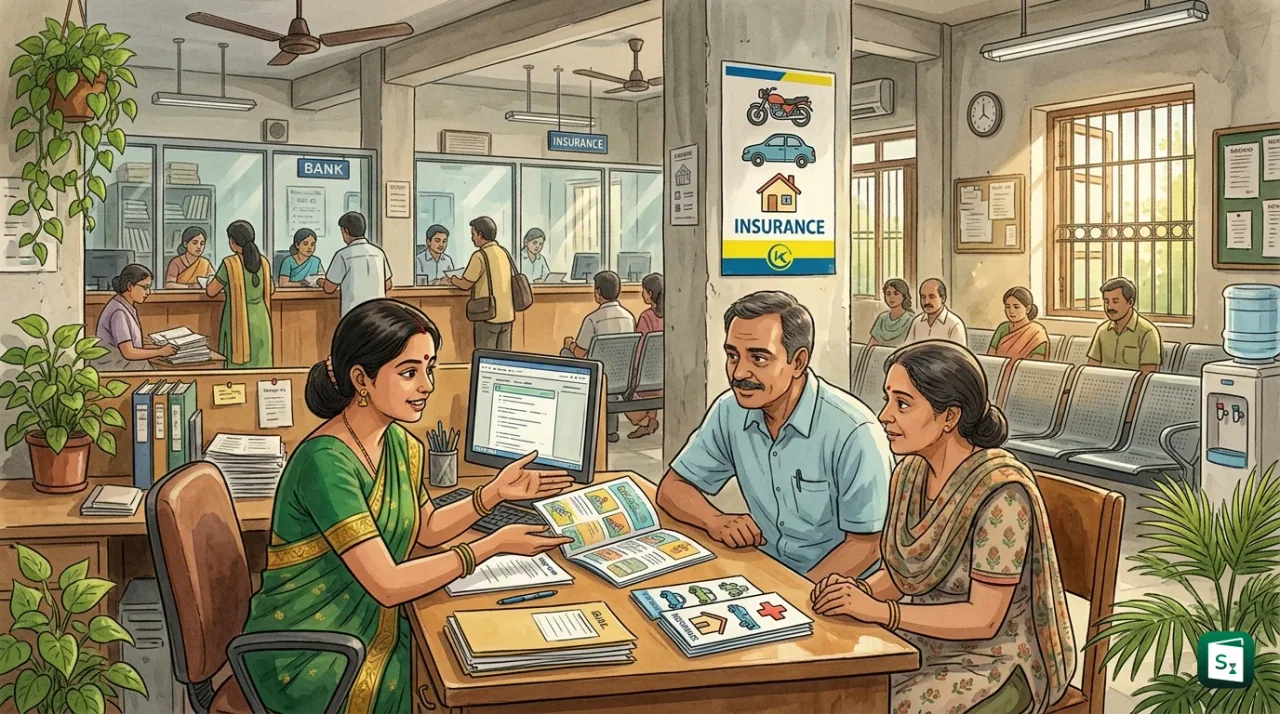
Karur Vysya Bank has signed a bancassurance agreement with Zurich Kotak General Insurance Company (India) Limited to sell the insurer’s general insurance products through its branches. The bank disclosed the arrangement to the stock exchanges on 12 October 2026, stating that it forms part of its regular bancassurance and customer service activities. The tie-up widens the range of non-life insurance options available to the bank’s customers and adds a fee-based income stream for the lender.
What Is Bancassurance and How Does It Work?
Bancassurance is a distribution arrangement in which a bank sells insurance policies of one or more insurance companies through its own branches and digital channels, earning a commission for each policy it helps to place. The bank does not carry the insurance risk itself; the insurer continues to underwrite the policy and settle claims.
The model rests on a simple idea. Banks already have millions of customers, verified identities, and a network of branches that reaches deep into cities, towns, and villages. Insurers, on the other hand, often find it expensive to build such a reach on their own. Bancassurance connects the two, letting the insurer use the bank’s existing customer relationships to sell protection products.
In India, a bank usually operates as a corporate agent for the insurer. This is a formal registration granted by the Insurance Regulatory and Development Authority of India (IRDAI), under which the bank is permitted to solicit, procure, and service insurance policies on the insurer’s behalf. The bank earns commission, the insurer gains distribution, and the customer gets a convenient place to buy cover.
The arrangement suits customers because insurance becomes a routine counter service, much like opening a fixed deposit. For the bank, it earns fee income without lending money or taking on credit risk. For the insurer, it is a low-cost route to scale. This is why bancassurance has become one of the largest distribution channels in Indian insurance.
Karur Vysya Bank Ties Up with Zurich Kotak General Insurance
What Exactly Was Announced
Karur Vysya Bank intimated the stock exchanges on 12 October 2026 that it had entered into an agreement with M/s Zurich Kotak General Insurance Co. Ltd for the distribution of general insurance products to meet the requirements of its customers. The bank stated clearly that the arrangement was made in the ordinary course of its business and forms part of its regular bancassurance and customer service activities.
Because Karur Vysya Bank is listed on the National Stock Exchange and the BSE, it was required to disclose the agreement under Regulation 30 of the SEBI (Listing Obligations and Disclosure Requirements) Regulations, 2015. Regulation 30 requires a listed company to inform the exchanges of any event that could materially affect its operations, and the intimation was signed by the bank’s Company Secretary and Compliance Officer.
The disclosure did not spell out individual insurance products or revenue targets. It simply recorded that the bank would now distribute the insurer’s general insurance products through its banking channels, which include its branch network and digital platforms.
The Business Logic for the Bank
The partnership fits a clear strategy. Karur Vysya Bank already distributes non-life insurance for partners such as Bajaj Allianz General Insurance, ICICI Lombard, Go Digit General Insurance, and Kshema General Insurance. Adding Zurich Kotak General Insurance widens the shelf of products it can offer, particularly motor, health, and home cover.
Bancassurance is attractive to banks because it generates fee-based income that does not require deploying capital as a loan would. A bank earns commission on policies it sells, so the revenue comes with no credit risk. For a mid-sized lender with a large presence in semi-urban and rural markets, this is a meaningful way to deepen the relationship with existing customers and improve per-customer profitability.
The market response was muted but positive. Karur Vysya Bank shares closed at ₹342.90 on the NSE on the day of the disclosure. The announcement came just days before the bank reported a 37 per cent rise in net profit to ₹788 crore for the September 2026 quarter (Q2 FY27), underlining the lender’s healthy financial position.
What Is General Insurance and How Does It Differ from Life Insurance?
General insurance, also called non-life insurance, protects against financial loss from events other than death, such as accidents, illness, fire, theft, or damage to property. It covers motor, health, home, marine, crop, and travel risks, and usually compensates the policyholder on an indemnity basis, meaning it pays for the actual loss suffered rather than a fixed sum.
The distinction between the two main types of insurance matters for understanding what this partnership adds. Life insurance deals with risks linked to human life, such as death, disability, or retirement. General insurance deals with everything else, from a damaged car to a hospital bill to a burnt warehouse.
A key difference lies in how claims are paid. A life insurance policy typically pays a fixed sum assured on the happening of an insured event, such as death or maturity. A general insurance policy usually reimburses the actual loss, and the payout cannot exceed the value of what was insured. This principle is called indemnity.
| Feature | Life Insurance | General (Non-Life) Insurance |
|---|---|---|
| What it covers | Death, disability, retirement, survival | Motor, health, home, fire, marine, crop, travel |
| Claim basis | Fixed sum assured | Indemnity (actual loss) |
| Typical duration | Long term, often decades | Short term, usually one year |
| Premium nature | Investment plus protection | Pure risk protection |
| India’s share of premium (FY25) | Around 74 per cent | Around 26 per cent |
Within general insurance, health insurance has become the largest segment, contributing about 41 per cent of gross domestic premium and overtaking motor insurance. Motor cover remains the second-largest line. Together, health and motor make up roughly seven out of every ten rupees of general insurance business in India.
About Zurich Kotak General Insurance Company (India) Limited
A 70:30 Joint Venture Between Zurich and Kotak
Zurich Kotak General Insurance Company (India) Limited is a 70:30 joint venture between the Switzerland-based Zurich Insurance Group and Kotak Mahindra Bank. Its registered office is in Mumbai, Maharashtra. The company sells non-life insurance products including motor, health, home, and commercial cover.
The insurer began life in 2015 as Kotak General Insurance, set up by the Kotak group to serve India’s growing non-life market. In June 2024, Zurich acquired a 70 per cent stake in the business for ₹5,560 crore, a deal valued at about $670 million. Following that acquisition, the company adopted its present name, Zurich Kotak General Insurance Company (India) Limited, in August 2024.
That transaction holds wider significance. It was the largest foreign investment ever made in India’s general insurance market, and the first by a foreign insurer after the government raised the foreign direct investment (FDI) limit in insurance from 49 per cent to 74 per cent in 2021. The deal cleared regulatory scrutiny from the Reserve Bank of India, IRDAI, and the Competition Commission of India.
The Global and Indian Parents
Zurich Insurance Group was founded more than 150 years ago and is headquartered in Zurich, Switzerland. It serves more than 82 million customers across over 200 countries and territories and is one of the world’s leading multi-line insurers. Its entry into India reflects the group’s push into fast-growing Asian markets.
Kotak Mahindra Bank, the Indian partner, was established in 1985 as part of the Kotak Mahindra Group, one of India’s largest financial services conglomerates. In February 2003, Kotak Mahindra Finance Limited became the first non-banking financial company in India to receive a banking licence from the RBI and convert into a bank. It retained a 30 per cent stake in the insurance venture after Zurich’s investment.
Karur Vysya Bank: A Century-Old Private Sector Lender
Karur Vysya Bank is a private sector bank headquartered in Karur, Tamil Nadu. It was founded in 1916 by two textile-town businessmen, M. A. Venkatarama Chettiar and Athi Krishna Chettiar, who pooled an initial capital of ₹1 lakh to serve traders and farmers around Karur. The bank began commercial operations in the town that still gives it its name.
Because it is a private bank and not a public sector undertaking, its ownership and management differ from banks such as SBI or Canara Bank. Its day-to-day operations are headed by a professional management team, with B. Ramesh Babu serving as Managing Director and Chief Executive Officer and Dr Meena Hemchandra as the non-executive part-time Chairperson (as of October 2026). The bank is listed on the NSE and BSE under the scrip symbol KARURVYSYA.
Over more than a century, Karur Vysya Bank has grown well beyond its Tamil Nadu roots. It now operates more than 900 branches across around 22 states and union territories, supported by over 2,250 ATMs and cash recyclers. Its strength lies in semi-urban and rural India, a market that gives it a natural advantage in selling insurance to customers who have fewer options nearby.
| Parameter | Detail |
|---|---|
| Established | 1916, in Karur, Tamil Nadu |
| Type | Private sector bank |
| Registered and Central Office | Karur, Tamil Nadu |
| Branch network | More than 900 branches across about 22 states and union territories |
| ATM and cash recyclers | Over 2,250 |
| Managing Director and CEO | B. Ramesh Babu |
| Total business | ₹1,86,569 crore (FY 2024-25) |
The bank’s existing relationships in smaller towns make it an ideal distribution partner for an insurer. A customer who trusts the bank for a savings account or a gold loan is more likely to consider buying motor or health cover from the same counter.
The Regulatory Framework Governing Bancassurance in India
Bancassurance in India operates under a clear two-regulator structure. IRDAI governs the insurance side, while the Reserve Bank of India oversees the banking side. Any bank that wants to sell insurance must satisfy both.
On the insurance side, the key rules are the IRDAI (Registration of Corporate Agents) Regulations, 2015, which came into force on 1 April 2016. These rules are framed under the Insurance Act, 1938, and the IRDAI Act, 1999. They created four categories of corporate agents: life, general, health, and composite, and require every agent to register with IRDAI before soliciting business.
A December 2022 amendment significantly expanded the reach of this channel. A Corporate Agent (General) may now tie up with a maximum of nine general insurers, up from the earlier limit of three. A Corporate Agent (Composite) may partner with up to nine insurers each in the life, general, and health categories, subject to an overall ceiling of 27 arrangements. This is why a single bank such as Karur Vysya Bank can offer products from several insurers at once.
The rules also protect customers. A bank acting as a general corporate agent may sell retail lines and commercial lines where the total sum insured does not exceed ₹5 crore per risk. Every distribution arrangement must be disclosed to IRDAI within 30 days, and the minimum term of such an arrangement is one year.
On the banking side, the RBI’s guidelines of January 2015 allow banks to take up insurance distribution either as a corporate agent or as a broker, departmentally or through a subsidiary. Only one entity in a banking group may undertake insurance distribution, and insurers are barred from paying any cash or non-cash incentive directly to bank staff. The bank must also maintain a Board-approved policy on insurance distribution, assess whether a product suits the customer, and follow know-your-customer norms.
Why Bancassurance Matters for India’s Insurance Push
India is one of the world’s largest insurance markets by size, but a large share of its population remains uninsured. The country was the 10th largest insurance market globally by premium volume, with a global market share of about 1.8 per cent, according to the Swiss Re Institute. Its total insurance penetration stood at just 3.7 per cent of GDP in FY 2024-25, with life insurance at 2.7 per cent and non-life at only 1 per cent.
The gap with the rest of the world is stark. India’s insurance density, which is the average premium spent per person, was close to $97 a year, against a global average of more than $500. Non-life penetration of 1 per cent is far below the global average of around 4.3 per cent. In simple terms, most Indians still do not hold general insurance cover, even as medical costs and vehicle ownership rise.
Bancassurance is one of the most practical tools to close this gap. Banks already reach customers in areas where insurers have no office. Turning a bank branch into an insurance counter lowers the cost of selling a policy and removes the need for the customer to travel to an agent. The country’s overall insurance distribution network, including agents and institutional partners, grew from about 48 lakh in FY 2021 to nearly 83 lakh by FY 2025, and banks are a growing part of that network.
The policy environment has also turned favourable. The government’s Sabka Bima Sabki Raksha (Amendment of Insurance Laws) Act, 2025 raised the FDI limit in insurance to 100 per cent and introduced reforms to deepen coverage. IRDAI’s long-term goal of “Insurance for All by 2047” relies heavily on expanding distribution, and the Bima Sugam digital platform is being built as a unified marketplace for insurance. Non-life premiums grew about 9.3 per cent to ₹3.36 lakh crore in FY 2025-26, aided by a cut in the goods and services tax on health and life policies. Partnerships such as the one between Karur Vysya Bank and Zurich Kotak General Insurance feed directly into this national push.
Consumer Protection and Grievance Redressal
When a bank sells an insurance policy, the customer has a clear route to raise complaints if something goes wrong. The Insurance Ombudsman Rules, 2017 created a free and impartial system to resolve disputes between policyholders and insurers, their agents, and intermediaries. These rules were framed under the IRDAI Act, 1999 and replaced the older Redressal of Public Grievances Rules, 1998.
The offices of the Insurance Ombudsman function under the Council for Insurance Ombudsmen. There are 17 Insurance Ombudsman centres across the country, located in cities including Ahmedabad, Bengaluru, Chennai, Delhi, Mumbai, Kolkata, Hyderabad, and Guwahati. The system covers personal lines of insurance, group policies, and policies issued to sole proprietorships and micro enterprises.
The Ombudsman can take up complaints about delayed claim settlement, partial or total rejection of a claim, disputes over premiums, misrepresentation of policy terms, and problems with policy servicing. A complaint must normally be filed within one year of the insurer’s response or silence, and the Ombudsman is expected to pass an award within three months of receiving all the required documents. The insurer must comply with the award within 30 days, and the award is binding on the insurer. Compensation can go up to ₹50 lakh.
For banking-related complaints, customers can approach the Reserve Bank - Integrated Ombudsman Scheme, a single-window grievance system that came into force as RB-IOS, 2026 from 1 July 2026. Taken together, these mechanisms mean that a customer buying insurance at a bank counter is protected on both sides, by the insurance regulator and by the banking regulator.
The Way Forward
The Karur Vysya Bank and Zurich Kotak General Insurance partnership is small in scale but points to a larger trend. Banks are increasingly becoming the default shop for insurance in semi-urban and rural India, where agents and insurer offices are scarce. As more lenders add general insurance to their product shelves, the share of Indians with motor, health, and home cover should rise.
For Karur Vysya Bank, the next steps will be to train branch staff, integrate the insurer’s products into its digital channels, and build the fee income that partnerships like this are meant to deliver. The bank has been expanding its network and pushing digital banking, and insurance fits neatly into that plan. Zurich Kotak General Insurance, backed by Zurich’s global expertise and Kotak’s local reach, is positioning itself as a fast-growing non-life insurer in a market that is still underpenetrated.
The bigger picture is about access. India’s insurance penetration has stayed near 3.7 per cent of GDP for several years, and non-life cover remains the weakest link. Regulatory reforms, a higher FDI ceiling, and digital marketplaces such as Bima Sugam can help, but the last mile is built by branches and counters. Each tie-up like this one moves a general insurance policy a little closer to the millions of customers who need it.
Key Takeaways
- Karur Vysya Bank signed a bancassurance agreement with Zurich Kotak General Insurance Company (India) Limited on 12 October 2026 to distribute general insurance products through its branches.
- Bancassurance is a model in which a bank sells an insurer’s policies through its own branches and digital channels, earning commission without carrying the insurance risk.
- Zurich Kotak General Insurance is a 70:30 joint venture between Zurich Insurance Group and Kotak Mahindra Bank, renamed in August 2024 after Zurich acquired its 70 per cent stake for ₹5,560 crore.
- Karur Vysya Bank is a private sector bank founded in 1916 in Karur, Tamil Nadu, operating more than 900 branches across about 22 states and union territories.
- India’s insurance penetration stood at 3.7 per cent of GDP in FY 2024-25, with non-life insurance at only 1 per cent and insurance density near $97 per person.
- The Sabka Bima Sabki Raksha (Amendment of Insurance Laws) Act, 2025 raised the FDI limit in insurance to 100 per cent to deepen coverage under IRDAI’s “Insurance for All by 2047” vision.