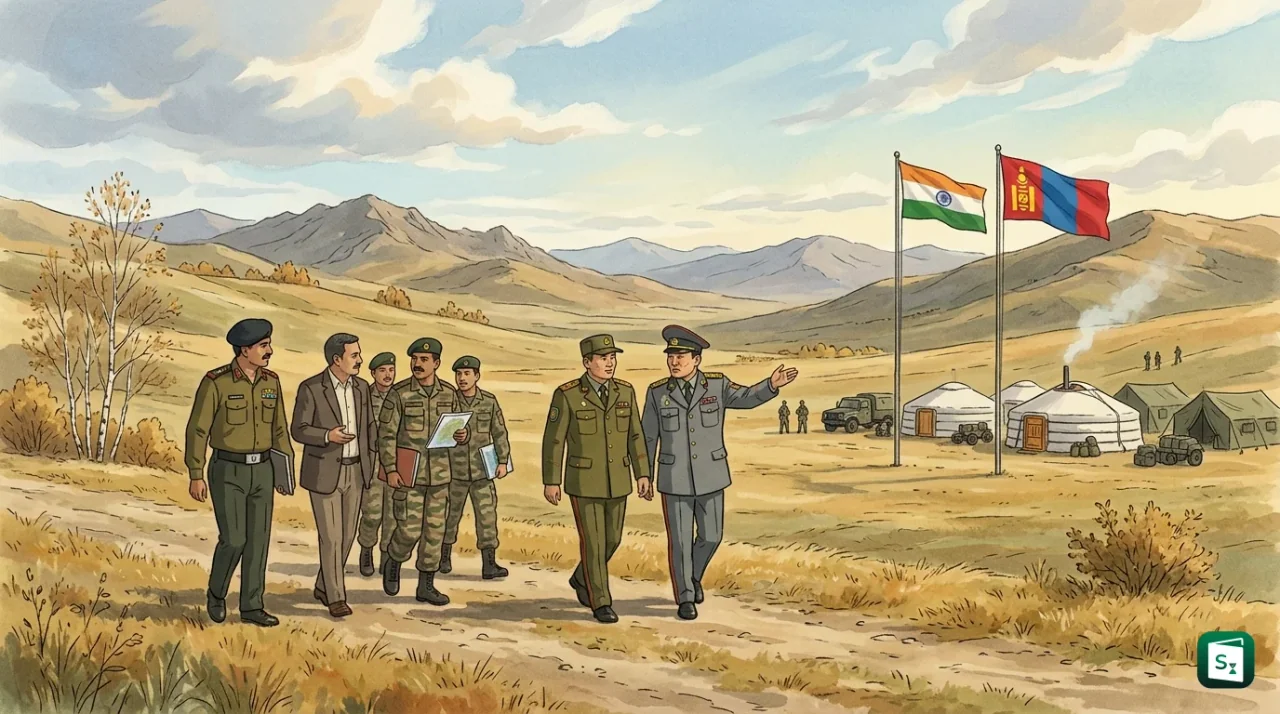
The 14th Joint Working Group meeting between the Defence Ministries of India and Mongolia was held in Ulaanbaatar on 16 October 2026, with both sides reviewing their ongoing military cooperation and agreeing to widen it. The Indian delegation was led by Joint Secretary in the Ministry of Defence Dr Ishita Ganguli Tripathy, while Mongolia was represented by Deputy State Secretary of Defence Brigadier General Gansukh E. The meeting reaffirmed the India-Mongolia Strategic Partnership and appreciated the recent conclusion of the two armies’ annual Exercise Nomadic Elephant.
What Happened at the 14th India-Mongolia Joint Working Group Meeting
The 14th Joint Working Group meeting was held in Ulaanbaatar, Mongolia, on 16 October 2026 to review India-Mongolia bilateral defence cooperation. The Indian side was led by Dr Ishita Ganguli Tripathy, Joint Secretary in the Ministry of Defence, and the Mongolian side by Brigadier General Gansukh E, Deputy State Secretary of Defence.
Both delegations carried out a comprehensive review of ongoing defence activities and assessed the progress of existing initiatives. They discussed measures to expand cooperation in areas both countries have jointly identified, and exchanged views on regional and international developments. The aim was to chart a forward-looking agenda for the India-Mongolia Strategic Partnership.
Two specific outcomes stood out. First, the two sides appreciated the successful conclusion of Exercise Nomadic Elephant, the annual joint army exercise between the two countries. Second, the Mongolian side acknowledged India’s continued support in building the capacity of the Mongolian Armed Forces and in training its personnel.
On the sidelines, Dr Tripathy met Major General Usukhbayar J, Deputy Chief of the General Staff of the Mongolian Armed Forces, and the two sides noted the progress of cooperation between the two defence forces. The Indian delegation also visited the National Defence University in Ulaanbaatar to review the functioning of a Cyber Security Training Centre established there with Indian assistance. Mongolia thanked India for its support in language training and cyber security, both of which feed directly into the partnership.
What Is the India-Mongolia Joint Working Group on Defence?
The Joint Working Group on Defence Cooperation is the institutional mechanism that plans, coordinates and reviews defence engagement between India and Mongolia. It meets every year, alternately in the two countries, and is the primary platform through which joint exercises, training programmes and capacity-building projects are agreed upon.
The group is a working-level body rather than a leadership summit. On the Indian side it is co-chaired by a Joint Secretary in the Ministry of Defence, and on the Mongolian side by the State Secretary or Deputy State Secretary of Defence. Importantly, this defence group is separate from the India-Mongolia Joint Committee on Cooperation (IMJCC), which handles the overall relationship and is co-chaired at the political level by India’s External Affairs Minister and Mongolia’s Chief Cabinet Secretary.
The two channels differ in focus. The table below sets out the distinction.
| Mechanism | Indian Chair | Mongolian Chair | Main Focus |
|---|---|---|---|
| India-Mongolia Joint Committee on Cooperation (IMJCC) | External Affairs Minister | Chief Cabinet Secretary | Overall bilateral relations across all sectors |
| Joint Working Group on Defence Cooperation | Joint Secretary, Ministry of Defence | State Secretary of Defence | Defence and military cooperation |
The group has met regularly since India and Mongolia signed a formal defence cooperation agreement in 2001 during Mongolian President Natsagiin Bagabandi’s visit to India. The 11th meeting was held in New Delhi in February 2023, and the 12th in Ulaanbaatar in May 2024. The 14th meeting in October 2026 continued this steady rhythm of annual dialogue.
India-Mongolia Defence Ties: A Partnership Rooted in History
India and Mongolia established diplomatic relations on 24 December 1955, and India was the first country outside the Soviet bloc to open ties with Mongolia. The Indian resident mission in Ulaanbaatar began functioning in 1971. The relationship rests on ancient cultural and spiritual links, as both countries share a long Buddhist heritage and describe each other as “spiritual neighbours”.
Bilateral ties were formalised through several agreements over the decades. A Joint Declaration was signed in 1973, followed by a Treaty of Friendly Relations and Cooperation in 1994. In 2001, the two countries signed a defence cooperation agreement. In 2009, India signed a civil nuclear agreement with Mongolia for the supply of uranium, making Mongolia one of the few countries with which India has such a pact.
The biggest shift came in May 2015, when Prime Minister Narendra Modi visited Mongolia, the first ever visit by an Indian Prime Minister. The two countries elevated their ties to a Strategic Partnership, and India declared Mongolia a key component of its Act East Policy. In October 2025, India and Mongolia marked 70 years of diplomatic relations and a decade of the Strategic Partnership, with Mongolian President Ukhnaagiin Khurelsukh visiting India (as of October 2026).
These high-level engagements have translated into practical defence measures. India has appointed a resident Defence Attaché and set up a Defence Wing at its embassy in Ulaanbaatar, and it has launched a capacity-building programme for Mongolia’s border security forces. This growing institutional presence is what the annual Joint Working Group meeting now anchors.
Exercise Nomadic Elephant: The Bedrock of Military Cooperation
Exercise Nomadic Elephant is the annual joint military exercise between the Indian Army and the Mongolian Armed Forces. It is a platoon-level field training exercise held alternately in India and Mongolia, and it is the single most visible symbol of defence cooperation between the two countries.
The exercise was first held in 2004 at Ulaanbaatar. Its stated aim is to build interoperability between the two armies so they can operate together in counter-insurgency and counter-terrorism operations in semi-urban and mountainous terrain, under a United Nations mandate. Over the years, its curriculum has widened to include cyber warfare, drone and counter-drone operations, and special heliborne drills.
The 18th edition, which closed shortly before the 14th Joint Working Group meeting, was held at the Foreign Training Node in Pithoragarh, Uttarakhand, from 21 September to 3 October 2026. Both sides fielded 45 personnel each, and the training covered cordon and search operations, room intervention, special heliborne operations and cyber security. Earlier editions have followed a similar pattern, as the table shows.
| Edition | Year | Venue |
|---|---|---|
| 15th | 2023 | Ulaanbaatar, Mongolia |
| 16th | 2024 | Umroi, Meghalaya, India |
| 17th | 2025 | Ulaanbaatar, Mongolia |
| 18th | 2026 | Pithoragarh, Uttarakhand, India |
The alternating host arrangement matters for both sides. For India, it brings Mongolian troops to Indian training nodes and exposes them to Indian operational methods. For Mongolia, which maintains a small military and relies heavily on partnerships, the exercise offers professional training that its own forces could not otherwise sustain.
Khaan Quest and Mongolia’s Peacekeeping Tradition
India and Mongolia also train together outside their bilateral exercise, most notably through Exercise Khaan Quest, a multilateral peacekeeping exercise hosted by Mongolia. Khaan Quest began in 2003 as a bilateral exercise between the United States and the Mongolian Defence Forces and became multilateral from 2006. It is conducted to enhance interoperability in peace support operations under Chapter VII of the United Nations Charter, which allows the use of force to maintain or restore international peace and security.
The 23rd edition of Khaan Quest was held at the Five Hills Training Area, Ulaanbaatar, from 20 June to 3 July 2026, marking its 20th anniversary. More than 1,000 troops from 18 countries took part. The Indian Army sent a contingent of 40 personnel, drawn mainly from a battalion of the JAT Regiment, to take part in joint peacekeeping drills.
Mongolia’s enthusiasm for peacekeeping is central to its military identity. Since it deployed its first peacekeepers in 2002, Mongolia has sent close to 21,000 Blue Helmets, the UN’s term for peacekeeping personnel, to about 15 missions. It ranks among the world’s leading troop contributors on a per-capita basis, and its peacekeeping role gives the country an international standing far larger than its small defence budget would suggest.
Mongolia’s security posture is also shaped by its geography. Landlocked between Russia and China, it declared itself a single-state nuclear-weapon-free zone in 1992 and follows a policy of neutrality. Peacekeeping and partnerships with countries such as India are, for Ulaanbaatar, a way to secure its sovereignty without joining any military bloc.
Why Mongolia Matters to India: The Third Neighbour Policy
Mongolia’s central foreign policy challenge is geography. Squeezed between two large powers, Russia and China, it follows a “Third Neighbour Policy” that seeks close ties with democratic partners beyond its two immediate neighbours. Under this policy Mongolia builds political, economic and defence relations with countries such as India, the United States, Japan, South Korea and members of the European Union, so that it is not dependent on any single power.
India occupies a special place in this framework. Mongolia calls India its “spiritual neighbour” because of shared Buddhist heritage, and a reliable “third neighbour” because of shared democratic values. India, for its part, treats Mongolia as an important element of its Act East Policy and its vision of a multipolar Asia. Despite the close language of partnership, the two countries do not share a land border, a point worth remembering when tracing their geography.
The relationship is often summarised through what has been described as the “3D” approach: Democracy, Dharma and Development. Democracy reflects support for shared democratic institutions, Dharma refers to the Buddhist cultural and spiritual connection, and Development covers India’s role as a major partner in Mongolia’s infrastructure and energy projects.
That development role is substantial. India has extended a $1.7 billion line of credit for Mongolia’s first oil refinery, the Mongol Refinery Project, at Altanshiree in Dornogobi province. It is India’s largest development partnership project anywhere in the world. The plant is designed to process 1.5 million tonnes of crude oil a year, and India is also supporting projects such as the Atal Bihari Vajpayee Centre of Excellence for IT and the India-Mongolia Friendship School. This economic weight is what gives the defence partnership its strategic depth.
Mongolia’s Armed Forces at a Glance
| Parameter | Detail |
|---|---|
| Active personnel | About 35,000 |
| Reserve personnel | About 230,000 |
| Defence budget | About $130 million, roughly 0.8% of GDP |
| Main components | Ground Force, Air Force, Construction and Engineering Forces, Cyber Security Forces, Special Forces |
| Nuclear posture | Single-state nuclear-weapon-free zone since 1992 |
| Peacekeeping record | Close to 21,000 personnel deployed since 2002 |
India’s Capacity Building Support to Mongolia’s Armed Forces
Training and capacity building form the steady, less visible layer of India-Mongolia defence cooperation, and they came up repeatedly during the 14th Joint Working Group meeting. The Indian delegation reviewed a Cyber Security Training Centre at Mongolia’s National Defence University, which was established with Indian assistance. Mongolia acknowledged this support alongside India’s help in language training for its personnel.
Much of this flows through the Indian Technical and Economic Cooperation (ITEC) Programme, which the Indian Cabinet instituted on 15 September 1964. ITEC is a fully government-funded programme of assistance for partner countries, and its defence component trains officers from friendly nations at Indian institutions such as the National Defence College and the Defence Services Staff College. Mongolia is one of the countries that uses this channel, sending officers each year for courses in infantry, signals and logistics.
India has also launched a dedicated capacity-building programme for Mongolia’s border security forces, complementing the training of its regular armed forces. Together with the recruitment of a resident Defence Attaché and the annual exercises, these programmes give the partnership a practical, people-level anchor that survives changes in the wider geopolitical weather.
The 14th Joint Working Group meeting fits into this larger design. It is not a one-off event but the annual checkpoint of a relationship that India and Mongolia have steadily institutionalised since 1955, expanding it from cultural and spiritual affinity into training, exercises, cyber security and shared views on regional security.
Key Takeaways
- The 14th India-Mongolia Joint Working Group on Defence Cooperation met in Ulaanbaatar on 16 October 2026.
- The meeting was co-chaired by Dr Ishita Ganguli Tripathy, Joint Secretary in India’s Ministry of Defence, and Brigadier General Gansukh E, Deputy State Secretary of Defence, Mongolia.
- Both sides appreciated the 18th edition of Exercise Nomadic Elephant, held at the Foreign Training Node, Pithoragarh, Uttarakhand, from 21 September to 3 October 2026.
- The Indian delegation reviewed a Cyber Security Training Centre at Mongolia’s National Defence University, established with Indian assistance.
- India and Mongolia established diplomatic relations on 24 December 1955, and upgraded their ties to a Strategic Partnership in 2015 during Prime Minister Narendra Modi’s visit.
- Exercise Khaan Quest, hosted by Mongolia, began in 2003 as a bilateral exercise with the United States and became multilateral in 2006.
- Mongolia declared itself a single-state nuclear-weapon-free zone in 1992 and is a leading per-capita contributor to UN peacekeeping.
- India’s $1.7 billion line of credit for Mongolia’s first oil refinery, the Mongol Refinery Project, is its largest development partnership project globally.