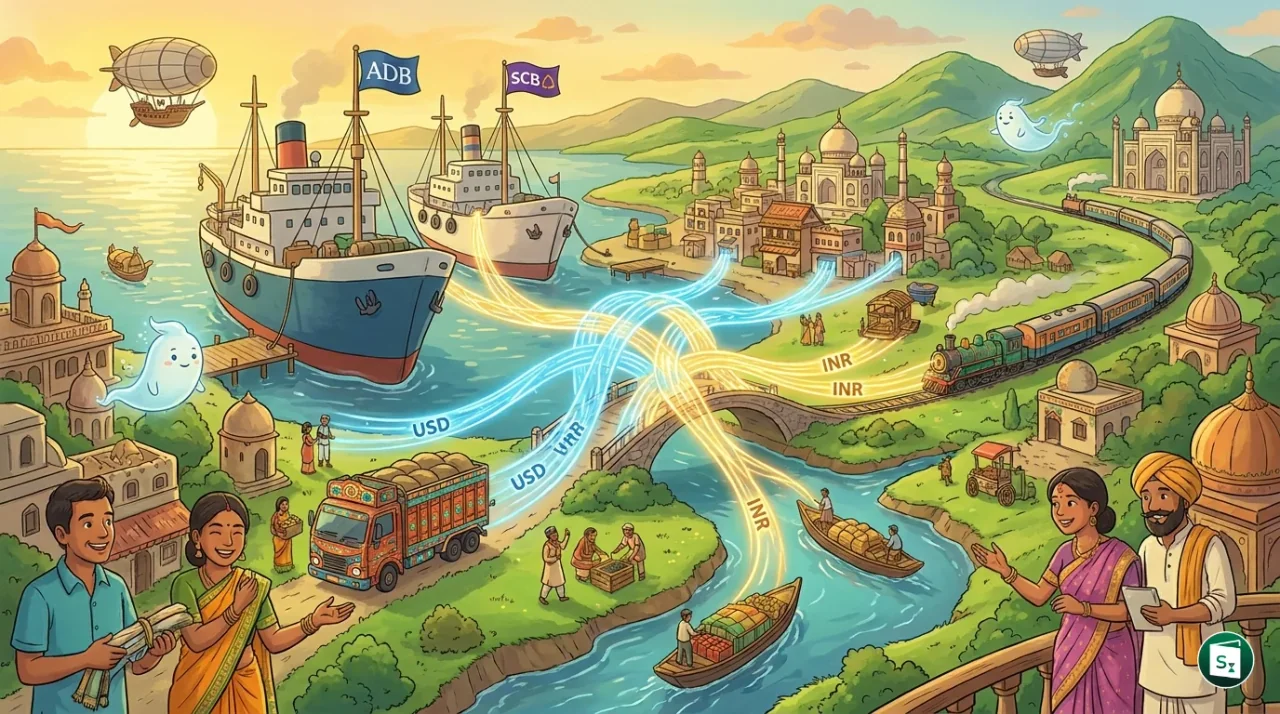
The Asian Development Bank and Standard Chartered Bank signed a landmark partnership agreement on June 9, 2026, in Mumbai to expand supply chain finance solutions in India. By establishing dual-currency risk-sharing arrangements, the collaboration will facilitate credit flows in both US Dollars and Indian Rupees to support trade operations. This initiative is designed to address critical working capital deficits for distributors and small businesses across the country.
Enhancing Supply Chain Finance in India
The agreement was signed by the Vice-President of the Asian Development Bank, Bhargav Dasgupta, and the Chief Executive Officer of Standard Chartered Bank India and South Asia, P.D. Singh. This initiative operates under the Trade and Supply Chain Finance Program of the multilateral development bank. This framework helps commercial banks provide liquid cash and credit guarantees to businesses in developing member nations.
A key highlight of this partnership is its focus on distributor financing, representing the first such engagement by the multilateral institution in the Indian market. Supply chain finance helps companies optimize their cash flow by allowing them to unlock funds tied up in unpaid invoices and trade receivables. Through distributor financing, small distributors can get short-term loans or credit lines to purchase goods from large corporate manufacturers. This mechanism ensures that goods keep moving through the supply chain without getting stuck due to cash shortages.
Structure of the Risk-Sharing Arrangements
To expand credit access, the collaboration sets up distinct facilities for offshore and onshore transactions. A risk-sharing arrangement allows both institutions to share the risk of loan defaults. This reduces the risk exposure for individual commercial lenders and encourages higher credit volume.
Gujarat International Finance Tec-City (GIFT City) Framework
The US Dollar transactions will run through the Gujarat International Finance Tec-City, commonly known as GIFT City, located in Gandhinagar, Gujarat. This facility operates under the International Financial Services Centre rules. This special zone acts as an offshore financial hub within India, allowing companies to access international financial services and foreign currencies without leaving the country. Standard Chartered will use this hub to execute risk participation agreements in US Dollars for cross-border trade transactions.
Onshore Rupee-Denominated Transactions
For domestic trade, the institutions signed a Partial Guarantee Facility Agreement to cover transactions in Indian Rupees. Under this onshore arrangement, the multilateral development bank guarantees a specific percentage of the trade loans extended by Standard Chartered to local businesses. This guarantee protects the commercial bank against defaults by small domestic buyers and distributors, making it easier for them to secure credit.
| Arrangement Feature | Offshore USD Facility | Onshore INR Facility |
|---|---|---|
| Transaction Currency | US Dollar | Indian Rupee |
| Agreement Type | Risk Participation Arrangement | Partial Guarantee Facility Agreement |
| Operational Hub | GIFT City IFSC (Gandhinagar, Gujarat) | Onshore domestic market |
| Primary Target | Cross-border trade finance | Domestic supply chain transactions |
Strategic Importance and MSME Credit Gap
This partnership addresses a major issue in the Indian economy. Micro, Small, and Medium Enterprises face a massive formal credit deficit. Reports estimate this credit gap to be between ₹20 lakh crore and ₹28 lakh crore. Traditional banks often require physical property or land as collateral before extending business loans. This requirement excludes many small distributors and retailers who do not own such assets. Supply chain finance resolves this issue by using trade invoices and receivables as security, shifting the focus from physical collateral to cash flow stability.
By supporting distributor financing, this agreement helps the lower layers of the business ecosystem. Small distributors can get credit to purchase goods from large manufacturers, ensuring that supply chains remain unbroken.
To understand the institutional backing, it is helpful to look at the history of the participating organisations. The Asian Development Bank was established in 1966 to promote economic growth in Asia and the Pacific. Headquartered in Mandaluyong, Metro Manila, Philippines, the bank has 69 member countries and is currently led by President Masato Kanda. On the other side of this agreement, Standard Chartered Bank is a global banking group founded in 1853 and headquartered in London, United Kingdom. The bank began operating in India in 1858, making it one of the oldest foreign banks in the country.
Key Takeaways
- The Asian Development Bank and Standard Chartered Bank signed risk-sharing agreements on June 9, 2026, in Mumbai to expand supply chain finance in India.
- The partnership utilizes a risk participation structure in GIFT City to support trade transactions denominated in US Dollars.
- A Partial Guarantee Facility Agreement has been established to cover domestic supply chain transactions in Indian Rupees.
- This agreement marks the first time that the Asian Development Bank has supported distributor financing within the Indian market.
- The Asian Development Bank was established in 1966 in Mandaluyong, Metro Manila, Philippines, and currently has 69 member nations.
- The credit gap for the Micro, Small, and Medium Enterprises sector in India is estimated to be between ₹20 lakh crore and ₹28 lakh crore.