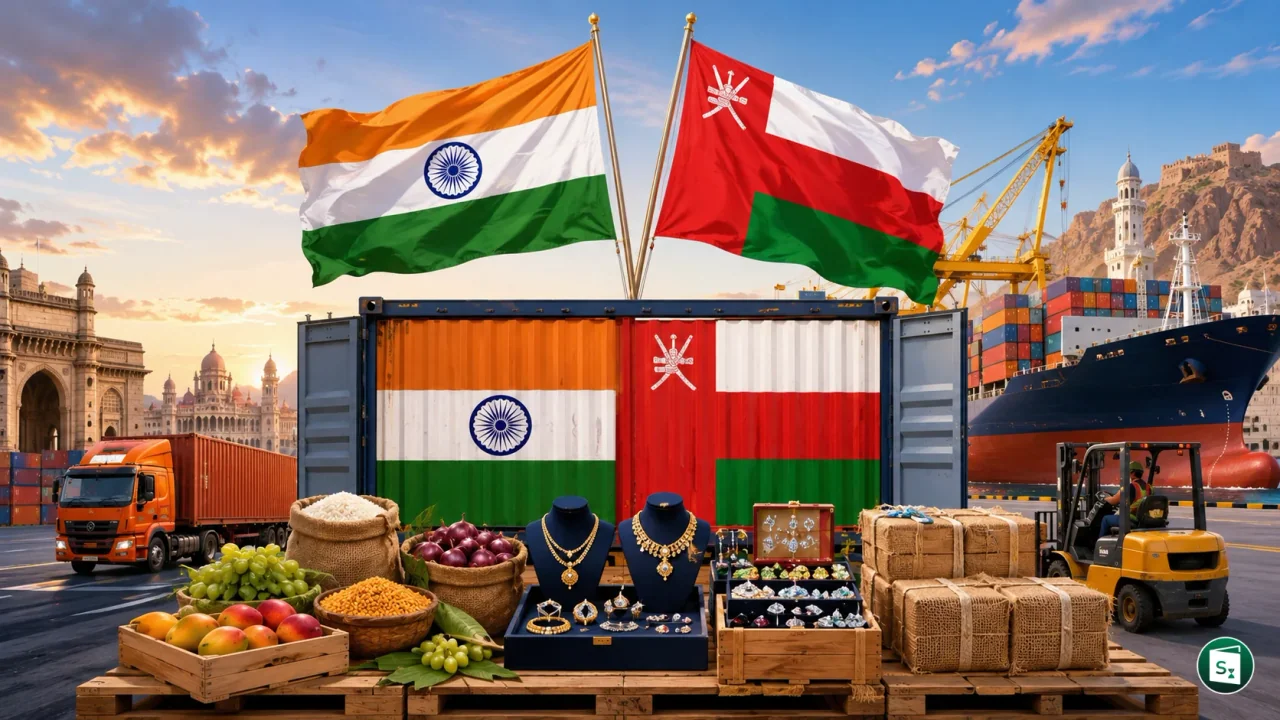
The Comprehensive Economic Partnership Agreement between India and Oman officially entered into force on June 1, 2026, marking a new milestone in bilateral trade relations. To initiate the operationalisation of the pact, Union Minister of Commerce and Industry Piyush Goyal flagged off the first commercial consignments from Mumbai, Kolkata, and Chennai. This historic agreement aims to bolster economic cooperation by eliminating tariffs on almost all bilateral trade lines.
Core Provisions and Tariff Concessions
The Comprehensive Economic Partnership Agreement (CEPA) is a bilateral treaty that aims to lower or eliminate customs duties on a wide array of goods and services, fostering smoother trade flows between signatory nations. Under the new agreement, Oman provides immediate duty-free access on 98.08% of its tariff lines, which corresponds to 99.38% of India’s exports by value. This represents a massive shift from the earlier Most Favoured Nation (MFN) framework. Most Favoured Nation is a status given by one country to another under the guidelines of the World Trade Organization, ensuring equal treatment without discrimination. Under the previous MFN regime, only 15.33% of Indian exports enjoyed duty-free entry into Oman.
The sudden drop in tariff barriers is expected to give a massive competitive edge to Indian exporters. To highlight the scale of the change, the following table compares the market access under the previous and current trade regimes:
| Aspect | Most Favoured Nation (MFN) Regime | CEPA Regime (Effective June 2026) |
|---|---|---|
| Duty-Free Export Access (Tariff Lines) | Extremely limited access | 98.08% of tariff lines |
| Value of Indian Exports Covered | 15.33% | 99.38% |
| Key Sectors Benefiting | Subject to high standard tariffs | Agriculture, gems and jewellery, pharmaceuticals, textiles |
To commemorate the operationalisation of the treaty, the first commercial shipments were flagged off simultaneously from major Indian maritime hubs. These initial shipments included agricultural goods, gems, and jewellery originating from Mumbai, Kolkata, and Chennai, showcasing the broad geographic distribution of sectors that will benefit from day one.
Bilateral Trade and Strategic Importance of Oman’s Ports
Bilateral trade between India and Oman has shown robust growth, reaching US$ 11.187 billion in the fiscal year 2025 to 2026, compared to US$ 10.613 billion in the preceding fiscal year. India primarily exports engineering goods, agricultural items, gems, jewellery, and textiles to Oman, while importing crucial energy commodities like crude oil, petroleum products, liquefied natural gas, and fertilizers. The CEPA is expected to further accelerate this trade volume, providing a solid foundation for regional economic stability.
Beyond the immediate tariff benefits, the agreement holds deep geopolitical and maritime significance. Oman’s key logistics hubs and ports, namely Duqm, Sohar, and Salalah, serve as strategic access points for India. Critically, these ports are situated outside the Strait of Hormuz, a narrow water body that connects the Persian Gulf with the Gulf of Oman and the Arabian Sea, serving as one of the world’s most sensitive maritime chokepoints. By securing preferential logistics access to Omani ports, India gains a crucial buffer against potential disruptions in the Strait of Hormuz, thereby safeguarding its energy imports and trade routes to the Gulf Cooperation Council, North Africa, and East Africa.
Services, Rules of Origin, and Investment Chapters
The India-Oman CEPA is a comprehensive pact that extends beyond merchandise trade to incorporate services, investment, and regulatory cooperation. In the services sector, the agreement covers 127 service sub-sectors, enhancing reciprocal commitments in healthcare, education, professional services, computer services, and information technology. To facilitate the movement of skilled professionals, the agreement raises the ceiling for intra-corporate transferees from 20% to 50%, simplifying the process for managers and technical experts to work between the two jurisdictions.
To ensure that only genuine goods from the signatory nations benefit from tariff cuts, the agreement incorporates strict Rules of Origin. Rules of Origin are the criteria used to determine the national source of a product, preventing third-party countries from routing their goods through a treaty member to claim duty benefits. India’s Ministry of Finance notified these guidelines under Notification No. 48/2026-Customs, requiring goods to meet specific value-addition thresholds or undergo a change in tariff classification. Additionally, the pact introduces bilateral cumulation, which permits manufacturers in one country to count materials sourced from the other country as domestic content.
Furthermore, the investment chapter aims to build a modern, predictable legal framework that encourages capital flows and technology transfer. The chapter aligns closely with Oman’s Vision 2040, a national development roadmap focused on diversifying Oman’s economy away from oil dependency. By providing a transparent legal framework and simplified customs, the agreement facilitates Indian businesses looking to set up manufacturing and warehousing bases in Omani free zones.
Timeline and Background of India-Oman CEPA
The road to the operationalisation of this agreement began in November 2023, when both nations formally launched negotiations. The discussion rounds progressed rapidly, culminating in the signing of the CEPA on December 18, 2025, in Muscat. The signing ceremony occurred during a high-profile state visit by Sultan Haitham bin Tarik Al Said, in the presence of Prime Minister Narendra Modi.
Following the signing, both countries initiated their respective domestic ratification processes, including the formal notification of customs rules by India’s Ministry of Finance. These processes were completed by late May, paving the way for the agreement to officially come into force on June 1, 2026. The swift conclusion of the negotiations and implementation timeline underscores the high degree of political trust and economic synergy between New Delhi and Muscat.
Key Takeaways
- The India-Oman Comprehensive Economic Partnership Agreement (CEPA) officially entered into force on June 1, 2026.
- The agreement provides duty-free export access on 98.08% of tariff lines, covering 99.38% of India’s exports to Oman by value.
- Prior to the implementation of the CEPA, only 15.33% of India’s exports entered Oman duty-free under the Most Favoured Nation (MFN) regime.
- Bilateral trade between the two nations reached US$ 11.187 billion during the fiscal year 2025 to 2026.
- The Rules of Origin for the pact were formally notified by the Ministry of Finance under Notification No. 48/2026-Customs.
- To ease professional mobility, the ceiling for intra-corporate transferees was raised from 20% to 50% under the services chapter.