Union Home Minister Amit Shah launched the VINIMAY Land Port Management System (LPMS) on June 9, 2026, in New Delhi, marking a significant leap in India’s border infrastructure. Developed by the Land Ports Authority of India (LPAI), this centralized digital platform is designed to modernize cargo and passenger processing at India’s land borders. By bringing land ports to the same digital standards as advanced airports and seaports, the system aims to bolster national security while drastically reducing trade bottlenecks.
What is the VINIMAY Land Port Management System?
The Land Port Management System (LPMS), branded as VINIMAY (a term meaning ‘exchange’ or ‘barter’), is a unified software platform that integrates all operations at India’s land-based international gateways. It acts as a single-window interface for various stakeholders, including traders, logistics operators, and government agencies. By digitizing the entire cargo and passenger lifecycle, the system eliminates the traditional, fragmented approach where different departments used disconnected databases.
This initiative is a critical component of the “Smart Border” strategy, which seeks to secure India’s boundaries through technology rather than physical barriers alone. Currently, the system is operational across 15 land ports (Integrated Check Posts) in India. The government plans to expand this coverage to 11 more ports within the next three years, ensuring a uniform digital standard across all international land borders with neighbors like Bangladesh, Nepal, and Bhutan.
Key Features and Digital Integration
The VINIMAY platform is designed to be a comprehensive digital hub that connects several national and security databases. It provides an end-to-end digital workflow, starting from online slot booking for cargo to the final exit approval at the gate.
Strategic Platform Connectivity
The system bridges previously isolated databases to ensure real-time data sharing:
- ICEGATE and CBIC: Integrated for seamless customs e-filing and financial compliance.
- Unified Logistics Interface Platform (ULIP): Connected to provide complete visibility of the logistics supply chain.
- UIDAI (Aadhaar): Used for robust identity verification of passengers and truck drivers.
- Motor Vehicle System: Tracks commercial vehicle registrations and permits automatically.
- Border Security Force (BSF): Allows security personnel to access real-time cargo and passenger data for enhanced surveillance.
Automated Operations
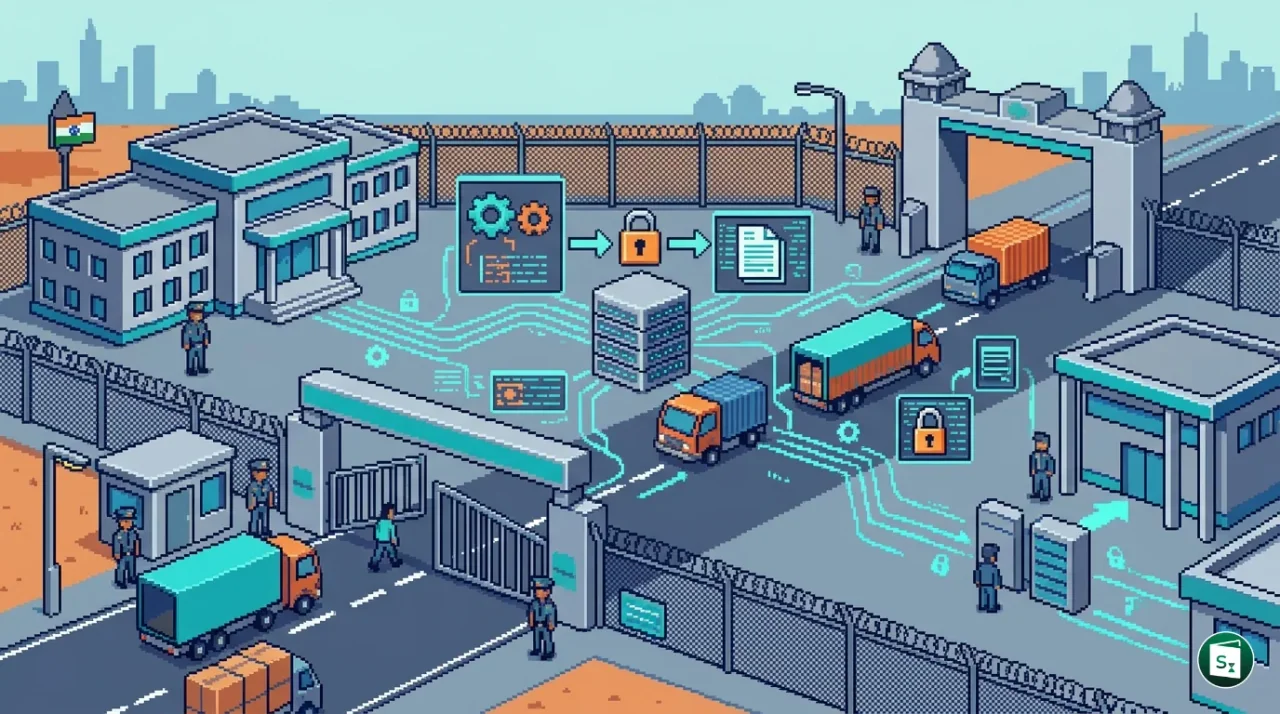
To minimize human intervention and speed up movement, VINIMAY employs Automatic Number Plate Recognition (ANPR) technology. High-tech cameras capture vehicle data at entry and exit gates, matching it with pre-booked slots. This automation, combined with electronic boom barriers, ensures that only verified vehicles can pass through the port, significantly reducing the scope for manual errors or unauthorized crossings.
Transforming Border Trade: The Economic and Security Impact
The implementation of VINIMAY addresses long-standing logistical challenges at India’s land borders. Historically, land ports were hampered by excessive paperwork and manual inspections, leading to long queues of trucks. The new digital system is expected to deliver substantial improvements in operational speed and efficiency.
| Metric | Expected Improvement |
|---|---|
| Physical Paperwork | 90% reduction |
| Truck Waiting Time | 40% to 60% reduction |
| Gate Processing Time | 22% to 35% reduction |
Boosting Regional Commerce
During the launch, it was highlighted that trade through India’s land ports has grown exponentially over the last decade. Total trade value surged from approximately ₹5,000 crore in 2014 to over ₹83,000 crore by early 2026. By converting informal trade into legitimate, digitally-tracked channels, VINIMAY will further boost economic activity in border regions while ensuring that every transaction is transparent and traceable.
Strengthening National Security
Beyond trade, VINIMAY is a pillar of India’s national security framework. By creating a “Data Moat,” it provides security agencies with real-time surveillance capabilities. The integration of advanced security tools, such as Full Body Truck Scanners and Radiation Detection Equipment (RDE), into the digital workflow allows for thorough security checks without causing delays. This technology-driven approach ensures that India’s borders remain “smart”—highly secure yet facilitating seamless movement for legitimate commerce and people.
About the Land Ports Authority of India (LPAI)
The Land Ports Authority of India (LPAI) is the statutory body responsible for creating, upgrading, maintaining, and managing border infrastructure in India. It functions as the nodal agency for the development of Integrated Check Posts (ICPs), which are unified hubs providing all necessary facilities for customs, immigration, and border security under one roof.
Established on March 1, 2012, under the Land Ports Authority of India Act, 2010, the organization operates under the Ministry of Home Affairs (MHA). It is headquartered in New Delhi at Lok Nayak Bhawan. The current Chairman of LPAI is Jayant Singh, an IRTS officer who assumed the role in early 2025.
The primary mission of the LPAI is to facilitate the seamless movement of passengers and cargo across international land borders while ensuring that security is never compromised. One of its most prominent projects is the Petrapole land port in West Bengal, which is currently the largest and busiest land port in South Asia. By implementing systems like VINIMAY, the LPAI is playing a pivotal role in realizing the national vision of “Viksit Bharat 2047” through modern, technology-enabled border governance.
Key Takeaways
- Union Minister Amit Shah launched the VINIMAY Land Port Management System (LPMS) in New Delhi on June 9, 2026.
- The system was developed by the Land Ports Authority of India (LPAI), which functions under the Ministry of Home Affairs.
- VINIMAY is currently operational across 15 land ports in India, with plans to expand to 11 more in the next three years.
- The platform is expected to reduce truck waiting times by 40% to 60% and eliminate nearly 90% of paperwork.
- The Land Ports Authority of India (LPAI) was established in 2012 under the LPAI Act, 2010, and is headquartered in New Delhi.
- Trade through India’s land ports has increased from ₹5,000 crore in 2014 to over ₹83,000 crore by 2026.