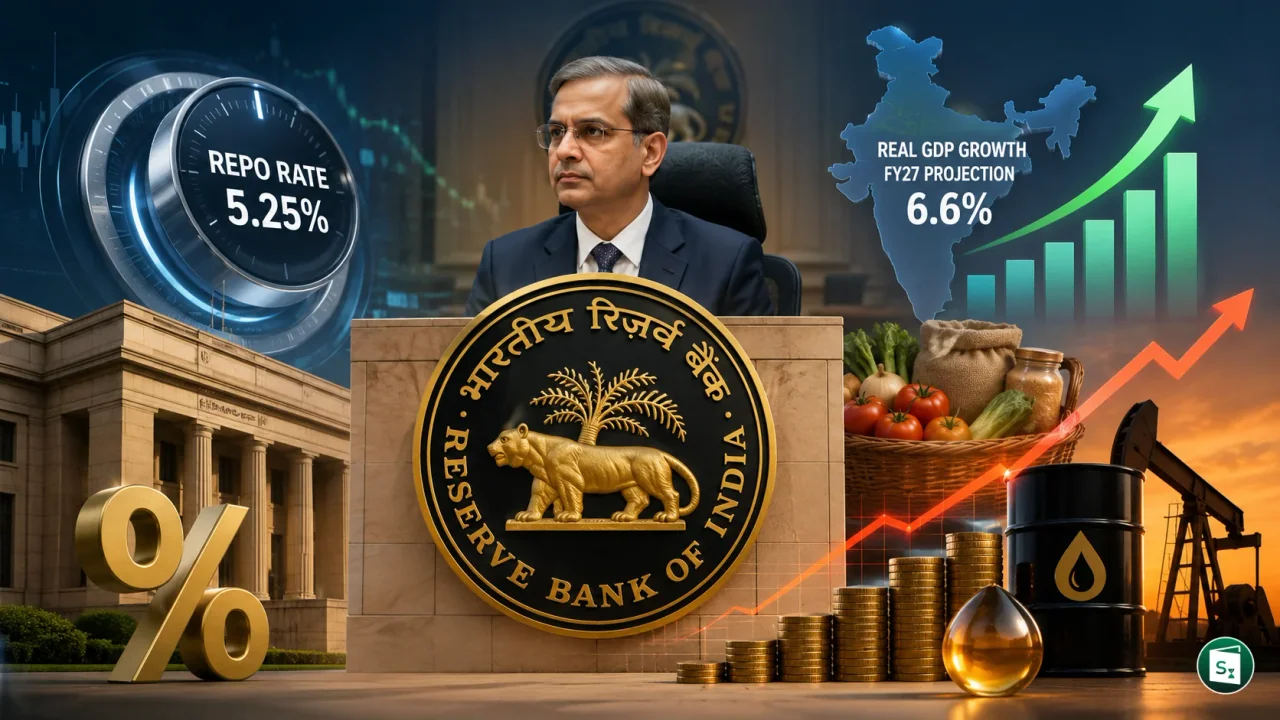
The Reserve Bank of India (RBI) decided to keep the policy repo rate unchanged at 5.25% during its second bi-monthly monetary policy review of the 2026-27 fiscal year on June 13, 2026. Led by Governor Sanjay Malhotra, the Monetary Policy Committee (MPC) maintained a neutral stance while lowering India’s growth forecast and raising inflation projections due to rising global crude oil prices. This decision reflects a cautious approach as the central bank navigates external shocks and domestic supply pressures.
Highlights of the June 2026 Monetary Policy
The Monetary Policy Committee, comprising six members, voted unanimously to keep the repo rate steady. This marks the third consecutive meeting where the rates have been held at 5.25%, following a period of easing in 2025. The decision was primarily driven by the need to ensure that inflation aligns with the target while supporting the post-conflict economic recovery.
The committee also chose to retain its neutral policy stance. This stance gives the RBI the flexibility to move interest rates in either direction based on emerging economic data. By staying neutral, the central bank signals that it is neither aggressively tightening nor further loosening the monetary supply at this stage.
In addition to the repo rate, several other key interest and reserve rates were maintained to ensure stability in the financial markets:
| Policy Rate | Current Value |
|---|---|
| Repo Rate | 5.25% |
| Standing Deposit Facility (SDF) | 5.00% |
| Marginal Standing Facility (MSF) | 5.50% |
| Bank Rate | 5.50% |
| Cash Reserve Ratio (CRR) | 3.00% |
| Statutory Liquidity Ratio (SLR) | 18.00% |
Why Did the RBI Maintain a Neutral Stance?
The decision to stay neutral comes at a time of significant global uncertainty. The primary concern for the RBI is the sharp rise in global crude oil prices, which have been revised upward to $95 per barrel from the previous estimate of $85 per barrel. This spike is a direct consequence of the ongoing conflict in West Asia, which has disrupted supply chains and increased energy costs globally.
For India, which imports more than 85% of its crude oil requirements, such price volatility act as a major supply-side shock. Higher oil prices lead to increased transportation and logistics costs, which eventually trickle down to retail prices. By maintaining a neutral stance, the RBI is waiting to see how these external pressures impact the domestic inflation trajectory before committing to any further rate adjustments.
Analogy · The Neutral Stance and the Traffic Signal Expand analogy
Imagine you are driving a car and approach a yellow traffic light. You don’t slam on the brakes (rate hike) nor do you accelerate (rate cut). Instead, you keep your foot ready on either pedal, observing the cross-traffic and the countdown timer. This “wait and watch” approach is exactly what the RBI’s neutral stance represents in the face of unpredictable global events.
Revision in Growth and Inflation Projections
Due to the evolving global landscape, the RBI has revised its key economic forecasts for the 2026-27 financial year (FY27). The real GDP growth projection for India has been lowered to 6.6%, down from the previous estimate of 6.9%. This moderation reflects the potential impact of higher input costs on industrial activity and private consumption.
The quarterly growth trajectory for FY27 is projected as follows:
| Quarter | Projected GDP Growth |
|---|---|
| Q1 (April-June) | 6.6% |
| Q2 (July-September) | 6.3% |
| Q3 (October-December) | 6.5% |
| Q4 (January-March) | 6.8% |
On the inflation front, the central bank has raised its projections for the Consumer Price Index (CPI). The headline inflation target for FY27 is now set at 5.1%, up from the earlier forecast of 4.6%. Similarly, core inflation, which excludes volatile food and energy components, has been revised to 4.7% from 4.4%. These revisions indicate that inflationary pressures are becoming more broad-based, necessitating a vigilant approach from the monetary authority.
Understanding the Key Policy Rates
It is essential to understand the various instruments the RBI uses to manage the economy. The Monetary Policy Committee (MPC) was established in 2016 under the RBI Act, 1934, to bring transparency to the rate-setting process. It consists of six members: three from the RBI and three external members appointed by the Central Government.
The Policy Corridor
The RBI uses a “corridor” of interest rates to manage liquidity in the banking system. At the center is the Repo Rate, which is the rate at which the RBI lends money to commercial banks against government securities. This is the primary tool used to control inflation and stimulate growth.
- Standing Deposit Facility (SDF): Introduced in 2022, the SDF replaced the Fixed Reverse Repo as the floor of the corridor. It is the rate at which the RBI absorbs excess liquidity from banks without providing any collateral.
- Marginal Standing Facility (MSF): This is the upper end of the corridor. It is a window for banks to borrow from the RBI in an emergency when interbank liquidity dries up, usually at a rate higher than the repo rate.
- Bank Rate: This is the rate at which the RBI is prepared to buy or rediscount bills of exchange or other commercial papers. It is generally aligned with the MSF rate.
Reserve Requirements
Apart from interest rates, the RBI also uses reserve ratios to control the money supply:
- Cash Reserve Ratio (CRR): This is the percentage of a bank’s total deposits (Net Demand and Time Liabilities or NDTL) that must be kept with the RBI in cash. The current rate is 3%.
- Statutory Liquidity Ratio (SLR): This is the portion of NDTL that banks must maintain in the form of liquid assets like gold, cash, or government-approved securities. The current rate is 18%.
The Road Ahead: Challenges for the Malhotra Era
The current policy highlights the delicate balancing act Governor Sanjay Malhotra must perform. While the Indian economy remains resilient, the “imported inflation” from high energy prices and the potential for a volatile monsoon in 2026 pose significant risks. The shift from the high-growth “Goldilocks” period of 2024 toward a more defensive posture in 2026 suggests that the RBI is prioritizing stability over rapid expansion.
As the financial year progresses, all eyes will be on the monsoon’s performance and the resolution of global geopolitical conflicts. If inflation begins to exceed the upper tolerance band of 6%, the MPC may be forced to pivot from its neutral stance toward a more hawkish position. Conversely, if global oil prices stabilize and domestic demand remains robust, the possibility of rate cuts later in the year could once again be on the table.
Key Takeaways
- The Monetary Policy Committee (MPC) maintained the policy repo rate at 5.25% and retained a neutral stance in its June 2026 meeting.
- India’s real GDP growth projection for FY27 has been revised downward to 6.6% from the earlier estimate of 6.9%.
- The headline CPI inflation projection for FY27 has been increased to 5.1%, while core inflation is projected at 4.7%.
- The baseline crude oil price estimate was revised upward to $95 per barrel due to ongoing geopolitical tensions in West Asia.
- The Cash Reserve Ratio (CRR) and Statutory Liquidity Ratio (SLR) remain unchanged at 3% and 18%, respectively.
- Governor Sanjay Malhotra chaired the meeting, which saw a unanimous vote from all six committee members to maintain the status quo.