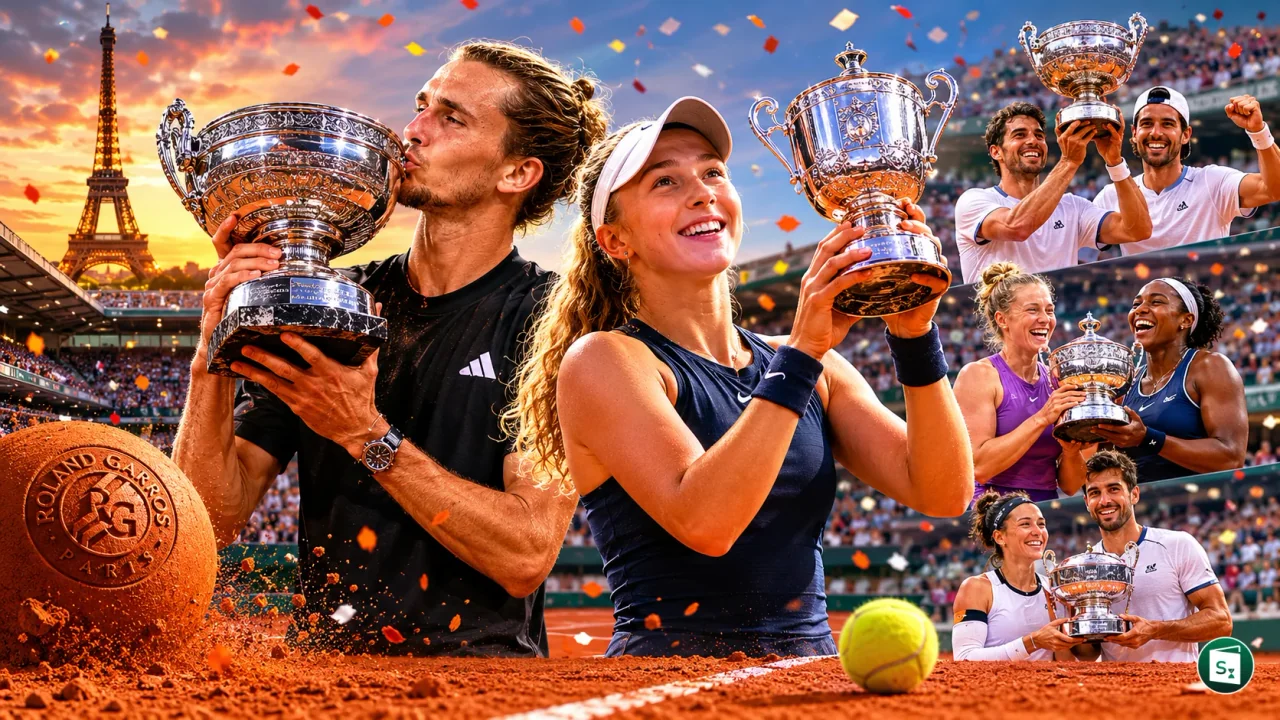
The 2026 French Open concluded at the iconic Stade Roland Garros in Paris, witnessing historic first-time Grand Slam victories for Germany’s Alexander Zverev and Russia’s Mirra Andreeva. Zverev triumphed in a thrilling men’s singles final, while the 19-year-old Andreeva dominated the women’s draw to claim her maiden major title. This 125th edition of the tournament marked a significant shift in the tennis landscape as new champions emerged on the legendary red clay courts.
Alexander Zverev’s Long-Awaited Grand Slam Glory
Germany’s Alexander Zverev finally secured his maiden Grand Slam title by defeating Italy’s Flavio Cobolli in a dramatic five-set encounter. The final, which lasted nearly four hours, ended with a scoreline of 6,1, 4,6, 6,4, 6,7, 6,1. This victory marked the culmination of a decade-long pursuit for Zverev, who had previously reached multiple major finals only to fall short. By lifting the Coupe des Mousquetaires (Musketeers’ Cup), Zverev became the first German man to win the French Open singles title since Henner Henkel in 1937.
The win also carries broader national significance, as Zverev is the first German male player to win any Grand Slam singles title since Boris Becker triumphed at the Australian Open in 1996. His path to the 2026 title was characterized by defensive resilience and a dominant first serve, traits that proved decisive against the rising Italian star Cobolli. The German champion walked away with a winner’s check of €2.8 million, the highest prize money ever awarded at the tournament.
Mirra Andreeva: The Teen Phenomenon Claims the Clay
The women’s singles draw saw the rise of a new superstar as 19-year-old Mirra Andreeva claimed her first Grand Slam trophy. Andreeva defeated Poland’s Maja Chwalinska with a convincing 6,3, 6,2 victory in the final. By securing the Coupe Suzanne Lenglen, she became the youngest women’s champion at Roland Garros since Monica Seles achieved the feat in 1992. Andreeva’s run through the tournament was nearly flawless, as she dropped only one set during the entire two-week event.
This victory also marked the first time a Russian woman has won a Grand Slam singles title since Maria Sharapova won the French Open in 2014. Andreeva, coached by former Wimbledon champion Conchita Martinez, showed tactical maturity far beyond her years, utilizing heavy topspin and exceptional court coverage to dismantle her opponents. Her triumph confirms her status as the World Number One in the latest WTA rankings, a position she reached shortly after her victory in Paris.
Doubles Success and Retained Titles
The 2026 edition also featured high-intensity competition across the doubles categories. In the men’s doubles final, the veteran duo of Marcel Granollers (Spain) and Horacio Zeballos (Argentina) successfully defended their title, lifting the Coupe Jacques-Brugnon. They defeated their opponents in straight sets to remain the dominant force on clay. This win further solidified their partnership as one of the most successful in modern tennis history.
The women’s doubles title, the Coupe Simonne-Mathieu, was won by the team of Katerina Siniakova (Czechia) and Taylor Townsend (USA). Their victory marked a successful first-time partnership at a major, showcasing a blend of Siniakova’s clinical net play and Townsend’s powerful baseline game. Meanwhile, the mixed doubles final saw an all-Italian triumph as Sara Errani and Andrea Vavassori claimed the Coupe Marcel-Bernard, adding to Italy’s strong presence in the 2026 tournament.
Roland Garros: The Prestige of the Red Dirt
The French Open, one of the four prestigious Grand Slam tournaments, has been held at Stade Roland Garros since 1928. The stadium was originally built for France to defend its Davis Cup title, led by the legendary Four Musketeers: René Lacoste, Jean Borotra, Henri Cochet, and Jacques Brugnon. The venue is named after Roland Garros, a French aviation pioneer and World War I hero who was the first to fly across the Mediterranean Sea.
What sets the French Open apart is its unique red clay surface, which is considered the slowest in professional tennis. The court is actually a complex five-layered structure approximately 80 centimeters deep. It consists of a drainage layer at the bottom, followed by crushed gravel, clinker (coal residue), and crushed white limestone. The iconic ochre color comes from the final top layer, which is a thin 1-2 millimeter coating of red brick dust. This surface produces a high bounce and rewards players with high physical endurance and exceptional defensive skills.
Prize Money and Economic Impact
The 2026 French Open featured a record-breaking total prize pool of €61,723,000, representing a nearly 10 percent increase from the previous year. Both the men’s and women’s singles champions were awarded €2.8 million each, while the runners-up received €1.4 million. The tournament organizers emphasized a significant boost in earnings for players in the early rounds and qualifying stages, aiming to provide better financial stability for lower-ranked professionals.
This financial growth reflects the increasing global commercial appeal of tennis and the French Open’s status as a premier international sporting event. As the 125th edition, the 2026 tournament saw record attendance at the gates and unprecedented digital viewership worldwide. The tournament remains the only Grand Slam played on clay, maintaining its unique identity in the global sporting calendar and continuing to be a major economic driver for the city of Paris.
Key Takeaways
- Alexander Zverev (Germany) and Mirra Andreeva (Russia) captured their first Grand Slam singles titles at the French Open 2026.
- At 19 years old, Mirra Andreeva became the youngest women’s champion at Roland Garros since Monica Seles in 1992.
- Alexander Zverev is the first German man to win the French Open singles title since Henner Henkel in 1937.
- The men’s singles winner receives the Coupe des Mousquetaires, while the women’s singles winner is awarded the Coupe Suzanne Lenglen.
- The French Open is the only Grand Slam played on red clay, which consists of a complex five-layer structure including a top layer of brick dust.
- The 2026 tournament featured a record total prize pool of over €61.7 million, with singles champions earning €2.8 million each.