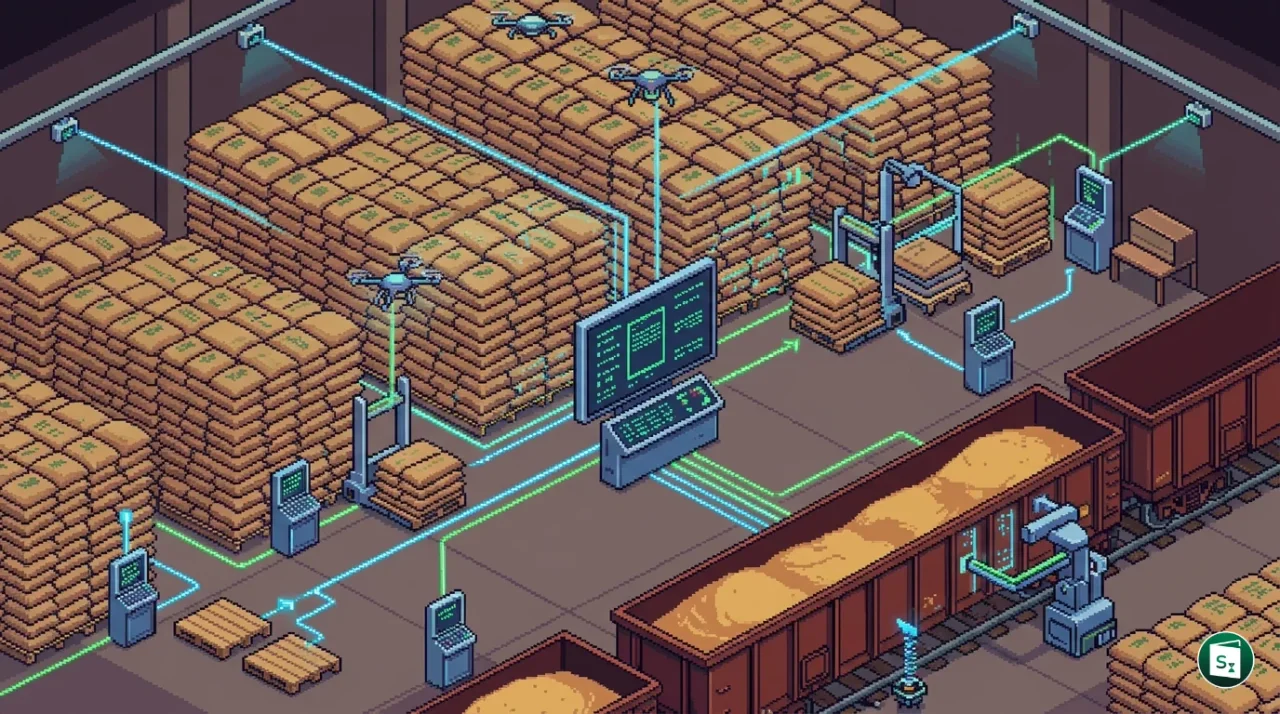
Union Minister for Consumer Affairs, Food and Public Distribution, Pralhad Joshi, launched the Smart Warehousing System on 18 June 2026 at Bharat Mandapam in New Delhi. This system is being called the world’s largest deployment of Artificial Intelligence (AI) and Internet of Things (IoT) based technologies in public-sector foodgrain warehousing. The initiative marks a decisive shift from manual, paper-based warehouse management to a fully integrated digital ecosystem designed to protect India’s grain reserves and strengthen the Public Distribution System (PDS).
Why India Needs Smart Warehousing
India produces more than 350 million tonnes of foodgrains every year, making it one of the world’s largest agricultural producers. A significant portion of this output is procured by the government at Minimum Support Price (MSP) and stored in warehouses managed by the Food Corporation of India (FCI) and the Central Warehousing Corporation (CWC) before being distributed to over 80 crore beneficiaries under the National Food Security Act (NFSA), 2013.
However, post-harvest losses have been a persistent challenge. According to a NABCONS study, India loses agricultural produce worth approximately ₹1.53 lakh crore every year due to inefficiencies in storage, handling, and transportation. Traditional warehouse operations have relied on manual record-keeping, physical inspections, and outdated surveillance methods. These practices have led to problems such as grain diversion, rodent infestation, undetected fungal growth, pilferage, and delays in vehicle turnaround at warehouse gates.
The Smart Warehousing System directly addresses these vulnerabilities by replacing human-dependent processes with automated, sensor-driven monitoring and real-time data analytics.
What the Smart Warehousing System Offers
The system integrates a comprehensive suite of advanced technologies across every stage of warehouse operations. It brings together hardware sensors, AI-powered software, and enterprise resource planning (ERP) integration to create an end-to-end digital management platform.
Technologies Deployed Across Warehouses
| Technology | Function |
|---|---|
| FASTag and ANPR based gate automation | Automatic vehicle identification and entry using RFID and number plate recognition, integrated with VAHAN and SARATHI databases |
| Geo-tagged smart locks | Digital access control with location verification to prevent unauthorised entry into godowns |
| AI-based bag counting | Computer vision systems that automatically count grain bags during loading and unloading, eliminating manual tally errors |
| Face recognition systems | Biometric verification for authorised quality inspectors and warehouse personnel |
| IoT gas sensors | Real-time monitoring of carbon dioxide (CO2) and Phosphine (PH3) levels to detect early signs of grain infestation and fumigation safety |
| AI-powered surveillance | Intelligent cameras for fire, smoke, and rodent detection with automated alert generation |
| Ambient sensors | Continuous tracking of temperature and relative humidity inside storage areas |
All these devices feed data into an integrated Enterprise Resource Planning (ERP) platform that generates automated records, sends real-time alerts, and provides multi-level operational dashboards accessible from the warehouse floor to the ministry level.
CWC and FCI: The Two Pillars of Implementation
The smart system is being rolled out in phases across India’s public-sector warehousing network. The Central Warehousing Corporation (CWC) has already implemented it across 216 of its bag-based foodgrain warehouses, completing the first and largest phase of the deployment.
CWC is a statutory body established in 1957 under the Warehousing Corporations Act, 1962. It operates under the Ministry of Consumer Affairs, Food and Public Distribution and is headquartered in New Delhi. With a network of over 730 warehouses across the country and a storage capacity exceeding 10 million tonnes, CWC is one of India’s largest public warehouse operators. It was conferred Navratna status in April 2024.
The Food Corporation of India (FCI) is the next agency scheduled to come on board. FCI was established in 1965 under the Food Corporations Act, 1964 and is the primary agency responsible for procurement, storage, and distribution of foodgrains under the PDS. The corporation manages over 2,500 warehouses with a total storage capacity of more than 48 million tonnes. According to Food Secretary Sanjeev Chopra, FCI will transition 150 of its warehouses to the smart system by October 2026.
Depot Darpan: Building on a Digital Foundation
The Smart Warehousing System builds directly on Depot Darpan, a digital assessment and performance-monitoring framework launched by the Department of Food and Public Distribution (DFPD) in May 2025. Depot Darpan is a web portal and mobile application that evaluates warehouses on two main axes: infrastructural aspects (structural safety, ventilation, fire safety, technology adoption) and operational efficiency (stock turnover, space utilisation, manpower expenses, profitability). Each warehouse receives a composite star rating based on its performance.
During the Smart Warehousing System launch event, the department felicitated the 20 Best Performing Warehouses of CWC and FCI identified through the Depot Darpan framework. The event also saw the release of several knowledge publications, including a Practical Guide for Safe Grain Storage at Mandis, a Pocket Handbook for FPS Dealers, a book titled 12 Years of Ensuring Food Security, and the Smart Warehousing Manual containing Standard Operating Procedures for operating IoT-enabled systems.
The Broader Digital Ecosystem
The Smart Warehousing System is part of a larger digital transformation underway in India’s foodgrain management infrastructure. Over the past few years, the DFPD has introduced a suite of AI and machine learning-driven platforms:
| Initiative | Purpose |
|---|---|
| SMART PDS | End-to-end digitisation of the Public Distribution System for transparent ration distribution |
| Anna Chakra | Optimisation of foodgrain logistics and supply chain routing using AI |
| ASHA | Automated system for monitoring and reporting of foodgrain movement |
| SCAN | Supply chain analytics platform for real-time decision support |
| Anna Darpan | Digital dashboard for public transparency on PDS operations |
These platforms, together with the Smart Warehousing System, create a connected digital backbone that spans procurement, storage, logistics, and distribution. The initiative aligns with the government’s broader vision under Digital India, the IndiaAI Mission, PM GatiShakti, and Atmanirbhar Bharat.
Significance for India’s Food Security
The Smart Warehousing System is expected to deliver multiple benefits across the foodgrain supply chain. By automating gate and weighbridge operations, vehicle turnaround time will be significantly reduced, allowing more trucks to be serviced each day. AI-based bag counting eliminates manual tally errors and reduces opportunities for diversion of grain meant for the PDS. IoT sensors provide early warning of gas leaks, fire, rodent activity, and grain spoilage, enabling timely intervention that cuts post-harvest losses.
The system also strengthens compliance monitoring and governance. With real-time dashboards accessible to senior officials, warehouse-level data can now be reviewed from the ministry without physical inspections. This creates a transparent audit trail for every transaction, from grain arrival to dispatch.
Speaking at the launch, Minister Pralhad Joshi described smart warehousing as a food security initiative rather than just a technology project. He noted that the government has already identified and removed over 2.43 crore ineligible ration cards through digital reforms, ensuring that food subsidies reach only genuine beneficiaries. Together, these measures are designed to protect the interests of farmers who sell their produce at MSP, warehouse operators who manage the stock, and the over 80 crore citizens who depend on the PDS for subsidised foodgrains.
Key Takeaways
- Union Minister Pralhad Joshi launched the Smart Warehousing System on 18 June 2026 at Bharat Mandapam, New Delhi, described as the world’s largest AI and IoT deployment in public-sector foodgrain warehousing.
- The system is currently operational across 216 warehouses of the Central Warehousing Corporation (CWC), with FCI set to bring 150 more warehouses under the system by October 2026.
- CWC was established in 1957 under the Warehousing Corporations Act, 1962, and was conferred Navratna status in 2024. FCI was established in 1965 under the Food Corporations Act, 1964.
- Key technologies deployed include FASTag and ANPR gate automation, geo-tagged smart locks, AI-based bag counting, face recognition for quality inspections, IoT gas sensors (CO2 and Phosphine), and AI-powered surveillance for fire, smoke, and rodent detection.
- The system integrates with an Enterprise Resource Planning (ERP) platform for automated records, real-time alerts, and multi-level operational dashboards.
- The initiative builds on Depot Darpan, a digital warehouse assessment framework launched in May 2025, which covers over 2,200 warehouses and provides star ratings based on infrastructure and operational efficiency.