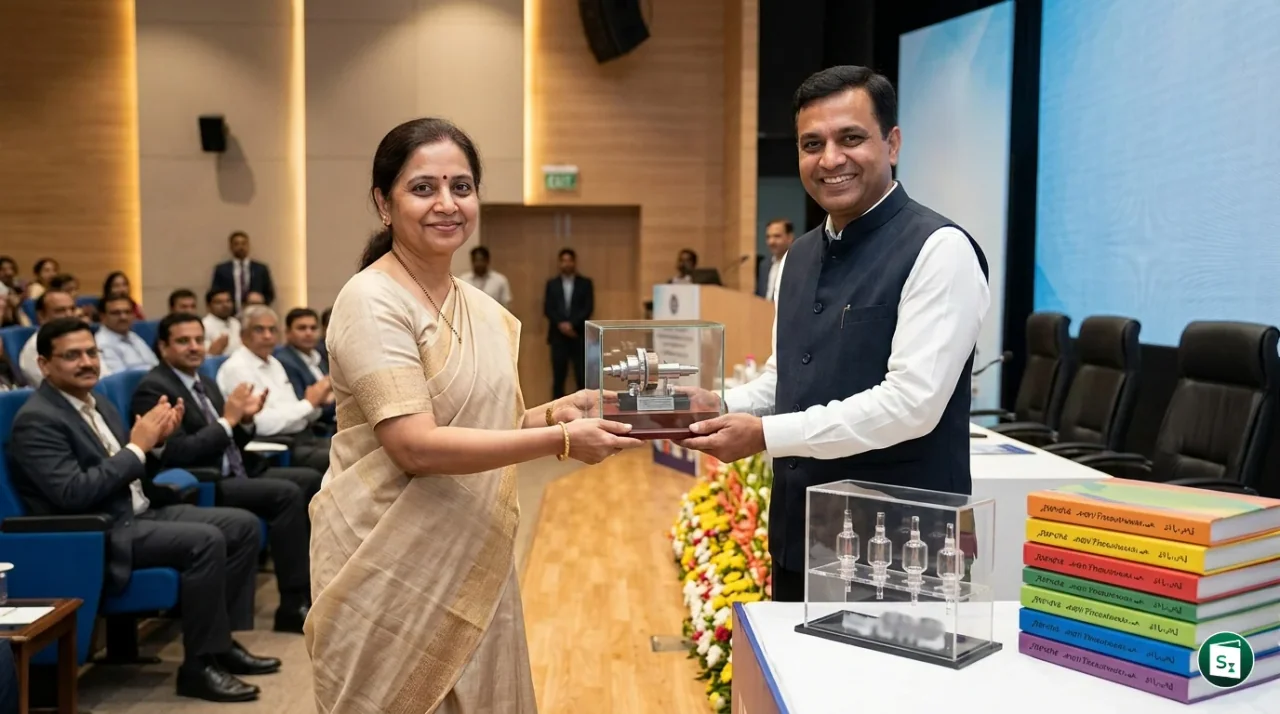
CSIR organised a Technology Transfer and Bharatiya Nirdeshak Dravya Release Function at its headquarters in New Delhi, bringing together scientists, industry partners, and strategic stakeholders. Seven indigenous technologies developed by CSIR-NPL and CSIR-CRRI were licensed to industry for commercial deployment, while ten new certified reference materials were released to strengthen India’s quality infrastructure. In a significant move for strategic technology, five specialised vapor cells for quantum sensing applications were handed over to DRDO’s Solid-State Physics Laboratory.
The Organisations Behind the Event
The Council of Scientific and Industrial Research (CSIR) was established in 1942 and is among the largest publicly funded research and development organisations in the world. Headquartered in New Delhi, CSIR operates a network of 37 national laboratories and 39 outreach centres across the country. Dr. N. Kalaiselvi serves as its Director General and also as Secretary of the Department of Scientific and Industrial Research (DSIR). The Prime Minister of India is the President of CSIR.
CSIR-National Physical Laboratory (CSIR-NPL), founded on 4 January 1947, is the National Metrology Institute (NMI) of India. It is the custodian of national measurement standards and is responsible for maintaining the Indian Standard Time (IST). Located in New Delhi, CSIR-NPL ensures that all measurements in the country are traceable to the International System of Units (SI). Prof. Venu Gopal Achanta is the Director of CSIR-NPL.
CSIR-Central Road Research Institute (CSIR-CRRI), established in 1952, is a premier national laboratory focused on research and development in road construction, design, maintenance, traffic engineering, and transportation planning. Located on Mathura Road in New Delhi, CRRI provides technical and consultancy services to agencies such as NHAI, state PWDs, and the Ministry of Road Transport and Highways. Prof. Manoranjan Parida is the Director of CSIR-CRRI.
The event was jointly organised by CSIR-NPL and CSIR-CRRI, reflecting the growing collaboration between CSIR laboratories and industry.
Seven Technologies Licensed to Industry
The core of the event was the transfer of seven indigenously developed technologies to industry partners for commercialisation. Three technologies came from CSIR-NPL and four from CSIR-CRRI.
Technologies from CSIR-NPL
| Technology | Transferred To | Application |
|---|---|---|
| Rydberg Systems Based Broad Band E-Field Sensing Technology | M/s Nostradamus Technologies Private Limited, Hyderabad | Quantum-based sensing of electromagnetic fields from MHz to 40 GHz |
| High-Volume PM2.5 Impactor Sampler Technology | M/s Engineering and Environmental Solutions Private Limited, Aligarh | Air quality monitoring as per National Ambient Air Quality Standards |
| Environment Friendly and Scalable Process for Recycling of Pharmaceutical Blisters | M/s GM Industries, New Delhi | Recovery of aluminium and polymers from medical packaging waste |
The Rydberg atom-based electric field sensor is a breakthrough in quantum measurement technology. It uses rubidium atoms excited to high-energy Rydberg states inside a vapour cell to detect radio frequency electric fields with extreme precision. Unlike conventional antennas, this sensor is self-calibrating because the atomic properties provide direct traceability to fundamental constants. It can detect fields as weak as 1 microvolt per centimetre across a frequency range from 50 MHz to 40 GHz, making it a truly broadband sensing platform.
The High-Volume PM2.5 Impactor Sampler is India’s first indigenously designed impactor-based sampler for measuring fine particulate matter. It segregates particles larger than 2.5 micrometres and collects the remaining finer particles on a filter at a high flow rate of 1.13 cubic metres per minute. The technology is critical for monitoring air quality under the National Clean Air Programme (NCAP).
The pharmaceutical blister recycling technology provides an environmentally friendly chemical process to separate and recover aluminium and plastic polymers from waste medical blister packaging. Each year, India generates thousands of tonnes of pharmaceutical blister waste that typically ends up in landfills or incinerators. This process recovers both metallic and polymeric fractions for reuse as value-added products.
Technologies from CSIR-CRRI
| Technology | Transferred To | Application |
|---|---|---|
| VInSD-VAIU: Drone-Based Non-Destructive Testing System for Bridges | M/s Dronix Technologies Private Limited (Aero360), Chennai | Structural health monitoring of bridges and tunnels using drones |
| PAVE-SEAL: Air-Cleaning Nano Photocatalytic Pavement Sealing Emulsion | M/s Ashita Renewables, Muzaffarnagar, Uttar Pradesh | Road sealing material that breaks down air pollutants |
| PATCHFILL: Pothole Repair Machine | M/s Petrochem Specialities, Muzaffarnagar, Uttar Pradesh | Rapid and durable pothole repair for road maintenance |
| CLARIVISOR: Glare Mitigation Device | M/s Intelligent Diagnosis LLP, Gurugram, Haryana | Device to reduce glare and improve road safety |
The VInSD-VAIU system combines a Vibro Integrity Sensing Device with an Aerial Inspection Unit mounted on a drone. It performs non-destructive testing of concrete structures such as bridges and flyovers using ultrasonic pulse velocity measurements and accelerometer-based structural health monitoring. This technology is especially useful for inspecting inaccessible components of ageing infrastructure.
PAVE-SEAL is a nano-photocatalytic road sealing emulsion that uses sunlight to break down nitrogen oxides and other air pollutants on road surfaces. It turns road pavements into passive air-cleaning infrastructure that can reduce local pollution levels.
PATCHFILL is a dedicated pothole repair machine that enables rapid, durable, and cost-effective filling of potholes. It uses a cold-mix technology that works across diverse climatic conditions, making it suitable for India’s vast road network.
CLARIVISOR is a wearable glare measurement and mitigation device that provides real-time glare and light level monitoring. It helps improve road safety by enabling accurate assessment of glare from vehicle headlights and street lighting.
Bharatiya Nirdeshak Dravyas: India’s Certified Reference Materials
A major highlight of the event was the release of 10 new Bharatiya Nirdeshak Dravyas (BNDs). These are India’s indigenous certified reference materials that ensure accuracy and traceability in testing and calibration.
The newly released BNDs cover:
| Category | Number Released |
|---|---|
| Phytochemical reference materials | 8 |
| Precious metal reference material | 1 |
| Propane gas reference material | 1 |
What Are BNDs?
Bharatiya Nirdeshak Dravya (BND) is the trademarked name for India’s certified reference material programme, led by CSIR-NPL. The programme was relaunched in 2017 to produce Indian reference materials that are traceable to SI units (the International System of Units). BNDs are created by CSIR-NPL in collaboration with authorised Reference Material Producers (RMPs).
Reference materials act as measurement benchmarks. They are used by testing laboratories, industries, and regulatory agencies to calibrate instruments, validate test methods, and ensure the accuracy of results. For example, a phytochemical BND allows a pharmaceutical lab to verify the purity and concentration of an active ingredient in a herbal medicine with confidence.
India’s BND programme has grown significantly since its relaunch. More than 142 certified reference materials are now available on the domestic and international markets, covering areas such as cement and building materials, petroleum products, water testing, high-purity chemicals, precious metals, pharmaceuticals, and phytochemicals. CSIR-NPL has also listed its BNDs on the international COMAR database, making them globally accessible.
The release of phytochemical BNDs is particularly significant for India’s AYUSH sector and herbal medicine industry. India is a major producer of medicinal plants, but the lack of certified reference standards has historically limited the global acceptance of its herbal products. These new phytochemical BNDs will help Indian manufacturers meet international quality standards and access export markets.
By expanding the BND repository, India is reducing its dependence on imported reference materials and strengthening what is called measurement sovereignty - the ability to independently ensure the accuracy of measurements within the country.
Quantum Sensing Components Handed Over to DRDO
The event also marked an important milestone in India’s quantum technology programme with the handover of five specialised vapor cells developed by CSIR-NPL to the Solid-State Physics Laboratory (SSPL) of DRDO. These vapor cells are critical components for quantum sensing applications.
What Are Vapor Cells and Why Do They Matter?
A vapor cell is a small glass container filled with alkali atoms such as rubidium or caesium in vapour form. When laser light is passed through the cell, the atoms become polarised and can detect extremely small changes in magnetic fields, electric fields, rotation, and time. This is the principle behind atomic magnetometers and atomic clocks.
Unlike conventional sensors that rely on solid-state electronics, quantum sensors exploit the fundamental properties of atoms to make measurements that are orders of magnitude more sensitive. Because every atom of a given element is identical, quantum sensors are inherently self-calibrating and do not drift over time.
Vapor cells are the heart of several quantum technologies, including atomic magnetometers that can detect magnetic fields a billion times weaker than the Earth’s magnetic field, atomic clocks that provide the most precise timekeeping known to science, quantum gyroscopes for navigation without GPS, and Rydberg atom sensors for detecting radio frequency fields.
Strategic Significance for Defence
The handover to SSPL-DRDO is strategically important because quantum sensors have direct defence applications. Atomic magnetometers can detect submarines by measuring tiny disturbances in the Earth’s magnetic field. Quantum gyroscopes can provide navigation in GPS-denied environments. Quantum clocks improve the synchronisation of radar and communication systems.
This transfer signals that India is building domestic capability in advanced components required for next-generation strategic technologies. It aligns with the National Quantum Mission launched by the Government of India to accelerate research and development in quantum technologies.
Significance of the Event
The Technology Transfer and BND Release Function represents more than a ceremonial handover. It reflects a structural shift in how India’s public research laboratories are engaging with industry and strategic users.
First, the growing volume of technology transfers is noteworthy. Speaking at the event, CSIR Director General Dr. N. Kalaiselvi noted that the number of technologies being adopted by industry has been steadily increasing in recent years. Monthly technology transfer events at CSIR headquarters have become an effective platform for showcasing laboratory innovations. This regular cadence of technology commercialisation is critical for translating the investment in public R&D into tangible economic outcomes.
Second, the range of technologies transferred in a single event shows the breadth of CSIR research. From quantum sensors and air pollution monitoring to road repair and glare mitigation, the innovations span sectors that directly impact national priorities such as clean air, infrastructure quality, pharmaceutical waste management, and defence capability.
Third, the BND programme is strengthening India’s quality infrastructure. As India’s manufacturing sector grows under the Production Linked Incentive (PLI) schemes and the Atmanirbhar Bharat vision, the availability of indigenous certified reference materials becomes essential. Without reliable reference standards, Indian products cannot demonstrate compliance with international quality requirements, limiting export opportunities.
CSIR-NPL Director Prof. Venu Gopal Achanta highlighted the foundational role of measurement science in industrial development and national quality infrastructure. Accurate measurements underpin everything from drug quality and food safety to environmental monitoring and defence systems.
Key Takeaways
- The Council of Scientific and Industrial Research (CSIR) was established in 1942 and is headquartered in New Delhi, operating 37 national laboratories under the Ministry of Science and Technology.
- CSIR-NPL, founded on 4 January 1947, is the National Metrology Institute (NMI) of India and the custodian of national measurement standards, including Indian Standard Time (IST).
- CSIR-CRRI, established in 1952, is India’s premier road research institute, focused on design, construction, and maintenance of roads and runways.
- Seven indigenous technologies were licensed to industry, including a Rydberg atom-based broadband electric field sensor, a high-volume PM2.5 impactor sampler, a pharmaceutical blister recycling process, a drone-based bridge inspection system, and a pothole repair machine.
- 10 new Bharatiya Nirdeshak Dravyas (BNDs) were released, including 8 phytochemicals, 1 precious metal, and 1 propane gas reference material.
- The BND programme, relaunched in 2017, has produced over 142 certified reference materials, reducing India’s reliance on imported standards.
- 5 vapor cells for quantum sensing were handed over to DRDO’s Solid-State Physics Laboratory (SSPL), strengthening India’s capabilities in next-generation defence technologies.