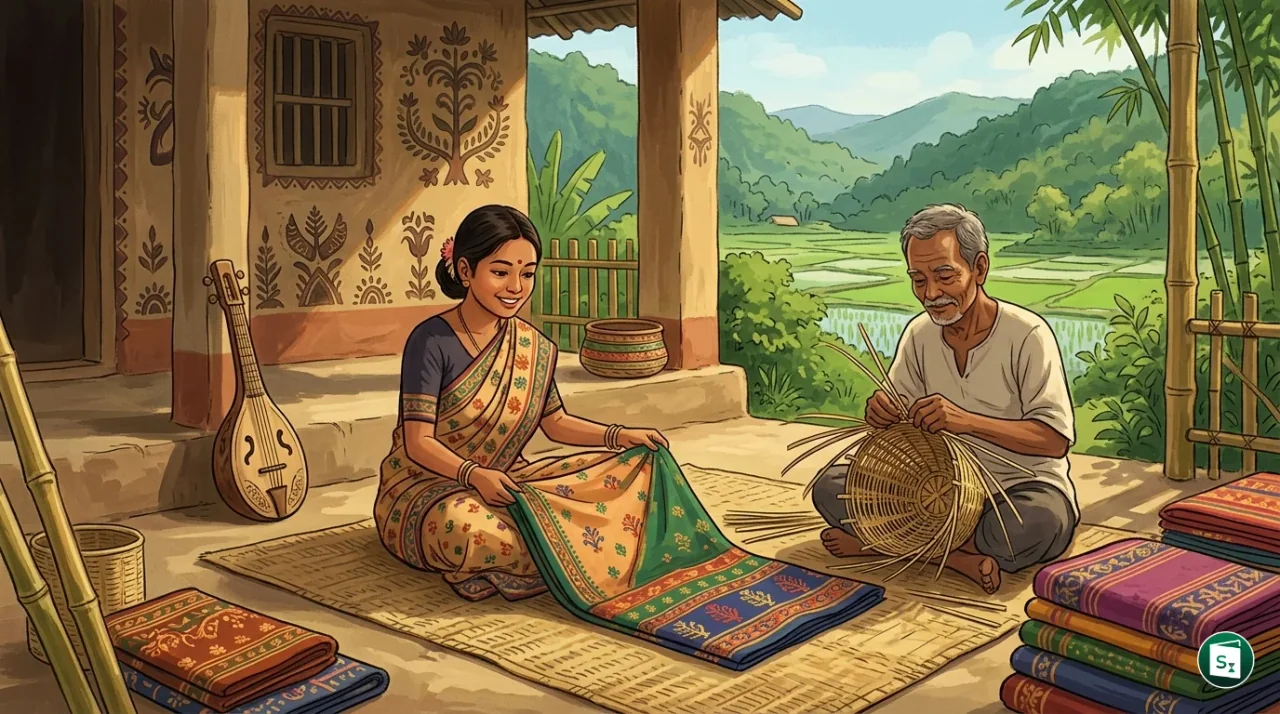
The Geographical Indications Registry (GIR) in Chennai has granted Geographical Indication (GI) tags to 16 traditional products across three states. Jharkhand received the highest number with 11 new GI tags, while Assam added 4 and Tripura secured 1. The recognition, supported in large part by the National Bank for Agriculture and Rural Development (NABARD), gives these products legal protection against imitation and opens up wider market opportunities for the artisans and communities behind them.
What Is a Geographical Indication (GI) Tag?
A Geographical Indication (GI) is a form of intellectual property right that identifies goods originating from a specific geographical location, possessing qualities, reputation, or characteristics unique to that region. In India, GI tags are governed by the Geographical Indications of Goods (Registration and Protection) Act, 1999, which came into force on 15 September 2003. The Act is administered by the Controller General of Patents, Designs and Trade Marks, who serves as the Registrar of Geographical Indications, with the GI Registry headquartered in Chennai under the Department for Promotion of Industry and Internal Trade (DPIIT), Ministry of Commerce and Industry.
A GI registration is valid for 10 years from the date of registration and can be renewed indefinitely for subsequent periods of 10 years each. Only authorised users registered under the GI have the exclusive right to use the tag. India’s first GI tag was awarded to Darjeeling Tea in 2004-05, and as of 2026, the country has over 650 registered GI products spanning agriculture, handicrafts, textiles, and food items. The GI framework is aligned with the TRIPS Agreement under the World Trade Organization.
Jharkhand: 11 Traditional Products Receive GI Tags
Jharkhand received its first GI tag in 2019 for Sohrai Khovar Painting, a traditional mural art practised by tribal women in the state. The latest round of GI recognitions has added 11 more products, taking the state’s total GI count to 12. With these additions, Jharkhand’s diverse cultural heritage spanning textiles, metalcraft, paintings, jewellery, and food has gained formal legal protection.
The 11 newly recognised products are:
| Product | Category | Key Features |
|---|---|---|
| Bhoya Saree and Fabric | Handloom Textile | Hand-spun wild Tussar silk woven by Santhal women from Godda district; natural golden sheen and high durability |
| Kuchai Silk Saree | Handloom Textile | Organic Tussar silk from Seraikela Kharsawan district; cultivated on host Asan and Arun trees |
| Kesaria Kalakand | Foodstuff | Premium slow-cooked milk sweet from Koderma district; grainy texture with rose water and saffron |
| Dokra Craft | Metal Handicraft | Non-ferrous metalware made using the ancient lost-wax casting technique |
| Tumka Chadar | Handloom Textile | Thick handwoven bedspreads and shawls from Dumka district used by tribal communities |
| Baroni Paintings | Folk Art | Stylised folk paintings and puppet craft reflecting local biodiversity and tribal mythology |
| Munda Jewellery | Tribal Jewellery | Hand-forged brass, silver, and bead ornaments with geometric motifs of the Munda community |
| Jharkhand Bamboo Craft | Handicraft | Eco-friendly utility and decorative items made from locally sourced bamboo |
| Tussar Silk and Sarees | Handloom Textile | Jharkhand is India’s largest producer of Tussar silk, known for its rich texture and natural colour |
| Jadopatia Painting | Folk Art | Vertical narrative scroll paintings on paper or cloth using natural mineral and plant pigments from Dumka |
| Pancho Saree and Fabric | Handloom Textile | Traditional two-piece tribal attire with distinctive borders conveying social and marital identity |
The Four NABARD-Supported Products
Of the 11 newly GI-tagged Jharkhand products, four were facilitated by NABARD. These are Bhoya Silk, Kuchai Silk, Munda Jewellery, and Jharkhand Bamboo Craft. NABARD played a key role in identifying these products, documenting their unique characteristics, organising producer groups and self-help groups, strengthening value chains, and guiding the entire GI registration process.
NABARD’s Chief General Manager in Jharkhand, Dipalala Ghosh, stated that the recognition honours the state’s traditional knowledge systems and craftsmanship while also creating commercial value and inspiring new generations to engage with traditional crafts. The GI tags are expected to boost branding, exports, and tourism while ensuring that economic benefits flow directly to the artisan communities.
Assam: Four New Additions
The GI Registry granted GI status to four traditional products from Assam, taking the state’s total tally to 45 GI-tagged products. Of these, 12 are supported by NABARD. Assam Chief Minister Himanta Biswa Sarma welcomed the development, calling it a proud moment for the state’s heritage conservation efforts.
The four newly recognised products are:
| Product | Category | Description |
|---|---|---|
| Karbi Anglong Handloom Products | Handloom Textile | Traditional weaving of the Karbi community, one of Assam’s oldest hill tribal communities |
| Assam Bihu Pepa | Musical Instrument | A wind instrument made from buffalo horn, integral to Bihu celebrations and Assamese folk music |
| Assam Bamboo Crafts (Bah Silpa) | Handicraft | Centuries-old bamboo craftsmanship producing household items and decorative pieces |
| Deuri Handloom Products | Handloom Textile | Distinctive textile heritage of the Deori tribe, reflecting their unique weaving traditions |
The Assam Bihu Pepa, a traditional wind instrument crafted from buffalo horn, holds special cultural significance as an inseparable part of the state’s Bihu festivities. The Karbi Anglong Handloom and Deuri Handloom products represent the weaving traditions of two of Assam’s major indigenous communities. Assam Bamboo Crafts, locally known as Bah Silpa, showcases the skill of artisans who transform locally available bamboo into functional and decorative items.
Loken Das, Chief General Manager of NABARD Assam, said that these certifications strengthen the identity and authenticity of these products while enhancing their market potential. NABARD’s post-GI strategy envisions building a holistic ecosystem around these products, moving from recognition to market-led livelihood enhancement through branding, capacity building, and market linkages.
Tripura: Sarinda Gets GI Recognition
Tripura’s traditional folk instrument, the Sarinda (also known as Sarinda Uakhrap), has been granted a GI tag, registered as “Tripura Sarinda (Musical Instrument)”. A handcrafted bowed string instrument, the Sarinda is made from a single block of wood with a hollow resonator. It is deeply associated with the folk music traditions of Tripura’s indigenous tribal communities and has been passed down through generations.
Tripura Chief Minister Manik Saha described the recognition as a proud moment for the state, stating that it will play a crucial role in preserving and promoting the state’s traditional musical heritage while creating new opportunities for artisans and musicians. Young tribal artist Athukuri Debbarma noted that the GI recognition acknowledges the Sarinda as part of India’s tribal heritage.
With this addition, Tripura now has four GI-tagged products, all of which are supported by NABARD. The state’s other GI-tagged items are Tripura Queen Pineapple (agricultural), Risha and Pachra (Rignai) (traditional handwoven attire of indigenous communities), and Matabari Peda (a traditional sweet).
Key Takeaways
- The Geographical Indications Registry granted GI tags to 16 traditional products across three states: 11 from Jharkhand, 4 from Assam, and 1 from Tripura.
- Jharkhand’s GI count rose from 1 in 2019 to 12; four of its new tags were facilitated by NABARD.
- Assam now has 45 GI-tagged products in total, with 12 supported by NABARD, including the newly tagged Bihu Pepa and Karbi Anglong Handloom.
- Tripura’s Sarinda, a handcrafted bowed string instrument, became the state’s 4th GI-tagged product; all four are NABARD-supported.
- GI tags in India are governed by the Geographical Indications of Goods (Registration and Protection) Act, 1999, administered by the GI Registry in Chennai under DPIIT.
- A GI registration is valid for 10 years and is renewable indefinitely; India’s first GI tag was Darjeeling Tea in 2004-05.