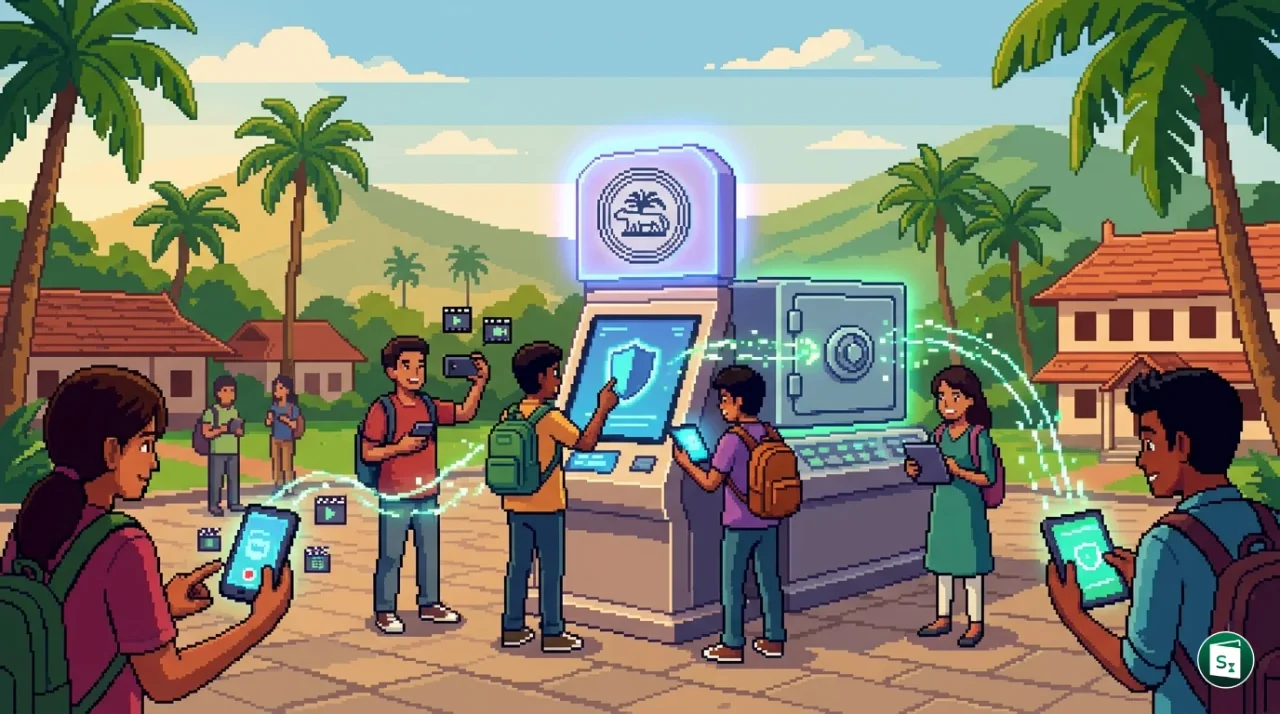
The Reserve Bank of India launched RBI Reelathon 2026 in Thiruvananthapuram, a statewide campaign that uses student creativity to fight rising cyber financial fraud across Kerala. Designed as a three-phase initiative, the campaign will reach 150 colleges with awareness sessions on safe digital banking and smart borrowing, followed by a reel-making competition where students create content on cyber threats such as illegitimate loan applications and mule accounts. The campaign reflects a broader shift by the central bank toward leveraging social media and peer-to-peer engagement to build financial awareness among young Indians.
Kerala’s Cyber Fraud Crisis: A Rs 814 Crore Challenge
The timing of the campaign is significant. Kerala has emerged as one of the most targeted states for cyber financial crimes in India. According to the National Crime Records Bureau, the state recorded the third-highest cybercrime rate in the country during 2022-2024, with 7,030 cases registered and a crime rate of 8.2 per lakh population.
The financial toll has been staggering. In 2025 alone, cyber criminals swindled Rs 814 crore from Kerala, which translates to roughly Rs 2 crore every day. The cumulative loss since 2022 has crossed Rs 1,800 crore. Among the hardest-hit districts are Ernakulam, which lost Rs 187 crore, and Thiruvananthapuram, which lost Rs 71 crore in 2025. Trading scams accounted for nearly 35% of all offences, followed by job scams at 33% and loan app scams at 6%.
The rise of mule accounts has been particularly alarming. In 2025, Kerala Police identified 44,088 mule bank accounts used to park and funnel stolen money, of which 34,781 were blocked. These accounts, often opened by unsuspecting individuals who rent them out for a small fee, form the backbone of cyber fraud networks that route illicit funds across multiple layers before converting them into cryptocurrency.
How RBI Reelathon 2026 Works
The Reserve Bank of India Thiruvananthapuram office, led by Regional Director Praveen Kumar Vasantha Ramachandran, designed RBI Reelathon 2026 as a three-phase statewide mass awareness initiative. The Kerala Police is the key implementation partner, with DGP Ravada Chandrasekhar officially launching the campaign at the RBI office in Thiruvananthapuram. The inaugural event was also attended by Banking Ombudsman for Kerala and Lakshadweep E B Chindan, senior RBI officials, and heads of major public sector banks.
Phase 1: Awareness Programmes in 150 Colleges
In the first phase, RBI teams will conduct awareness sessions across approximately 150 colleges across Kerala. These sessions focus on:
- Smart borrowing practices and responsible use of credit
- Safe digital banking habits and secure online transactions
- Awareness of common cyber financial fraud tactics
- Cyber hygiene and protecting personal financial information
The choice of colleges as the delivery channel is strategic. Social media platforms have become the primary medium through which young people consume information. By reaching students directly in their institutional settings, the campaign aims to build a foundation of financial literacy that participants can carry into their personal and professional lives.
Phase 2: The Reel-Making Competition
The second phase taps into student creativity through a reel-making competition. Students will create short videos on key cyber safety themes including:
- Illegitimate loan applications and predatory lending apps
- Mule account networks and the legal consequences of renting bank accounts
- Digital financial frauds such as phishing and vishing
- Digital arrest scams where fraudsters pose as law enforcement officials
- Cyber hygiene and everyday safety practices
After multiple rounds of evaluation, shortlisted entries will compete in a Gala Finale scheduled later this year. The top three winners will receive cash prizes of Rs 75,000, Rs 50,000, and Rs 25,000, respectively.
Phase 3: Amplification Through Social Media
In the third phase, the winning reels will be disseminated through RBI’s official social media platforms and amplified across the social media channels of Kerala Police, banks, colleges, and other partner institutions. This multi-channel distribution strategy ensures that the student-generated content reaches audiences far beyond what conventional financial literacy campaigns can achieve.
The Key Cyber Threats Targeting Kerala’s Youth
During the launch event, DGP Ravada Chandrasekhar identified several emerging cyber threats that the campaign aims to address. The most prevalent among these are fraudulent investment schemes, also known as trading scams, which lure victims with promises of extraordinary returns through fake trading platforms. These scams accounted for over a third of all cyber financial frauds in Kerala in 2025.
Digital arrest scams have emerged as a particularly vicious form of fraud. In this method, criminals pose as police or enforcement officials and inform victims that their bank accounts are linked to serious crimes. Victims are kept under psychological pressure through prolonged video calls and coerced into transferring large sums. Recent cases in Kerala include an elderly couple who lost Rs 1.5 crore and an industrialist who was defrauded of Rs 5.4 crore through such tactics.
Illegitimate loan applications, or loan app scams, prey on individuals seeking quick credit. Fraudsters offer instant loans through mobile apps and then use predatory recovery tactics, often accessing the victim’s contacts list to harass them. Mule account networks enable all these scams by providing a pipeline to move stolen money. The Reserve Bank Innovation Hub has developed MuleHunter.AI, an artificial intelligence tool now operational in over 26 banks, which detects nearly 20,000 mule accounts every month by analysing 19 distinct behavioural signatures including transaction velocity anomalies and device fingerprinting.
The Golden Hour: A Lifeline for Fraud Victims
A key message being driven through RBI Reelathon 2026 is the importance of the golden hour in cybercrime reporting. The golden hour refers to the critical window immediately after a fraud occurs when timely reporting through official channels significantly improves the chances of freezing fraudulent transactions and recovering lost funds.
Victims are urged to report incidents immediately through the National Cybercrime Helpline (1930) or the National Cybercrime Reporting Portal (cybercrime.gov.in). According to Kerala Police data, reporting within six hours offers the highest probability of freezing accounts before the money is withdrawn. In one case involving a former Kerala High Court judge who was cheated of Rs 90 lakh, Rs 80 lakh was recovered because the crime was reported promptly.
RBI’s Broader Financial Literacy Push
RBI Reelathon 2026 is part of a wider financial education framework led by the central bank. The Reserve Bank of India, established on April 1, 1935 under the RBI Act, 1934, with headquarters in Mumbai, has long recognised financial literacy as critical to its developmental role. Its flagship mass media campaign, RBI Kehta Hai, uses the slogan “Jaankar Baniye, Satark Rahiye” (Be Informed, Stay Alert) to spread awareness through television, radio, print, and social media.
Other notable initiatives include the annual Financial Literacy Week, first conducted in 2016, which in 2026 was observed from February 9 to 13 with the theme “KYC: Your First Step to Safe Banking”. The sixth edition of Digital Payments Awareness Week was held from March 9 to 13, 2026, with the launch of the “Thoda Dhyan Se” campaign focusing on safe digital transactions. The RBI has also established over 2,421 Centres for Financial Literacy across the country since 2017, each covering three blocks.
On the technology front, the Reserve Bank Innovation Hub developed MuleHunter.AI, an AI-powered platform that has identified over 85,000 mule accounts since its rollout in late 2024. In May 2026, the RBI Innovation Hub signed an MoU with the Indian Cyber Crime Coordination Centre (I4C) to scale the tool across the banking system. Additionally, the newly formed Indian Digital Payment Intelligence Corporation (IDPIC) is developing a real-time risk scoring platform for digital transactions to flag suspicious activity instantly.
Key Takeaways
- RBI Reelathon 2026 is a three-phase cyber fraud awareness campaign launched by the RBI Thiruvananthapuram office across 150 colleges in Kerala.
- The campaign features awareness sessions on smart borrowing and safe digital banking, followed by a reel-making competition with cash prizes of Rs 75,000, Rs 50,000, and Rs 25,000 for the top three winners.
- Kerala lost Rs 814 crore to cyber financial fraud in 2025 alone, with Rs 2 crore siphoned off daily, and the cumulative loss since 2022 has crossed Rs 1,800 crore.
- The golden hour in cybercrime reporting refers to the critical window soon after a fraud when timely reporting can help freeze transactions and recover funds. Victims should call 1930 or visit cybercrime.gov.in.
- The RBI, established on April 1, 1935 under the RBI Act, 1934 with headquarters in Mumbai, conducts annual financial literacy initiatives including Financial Literacy Week (since 2016) and Digital Payments Awareness Week.
- MuleHunter.AI, developed by the Reserve Bank Innovation Hub, detects nearly 20,000 mule accounts per month and is operational in over 26 banks.