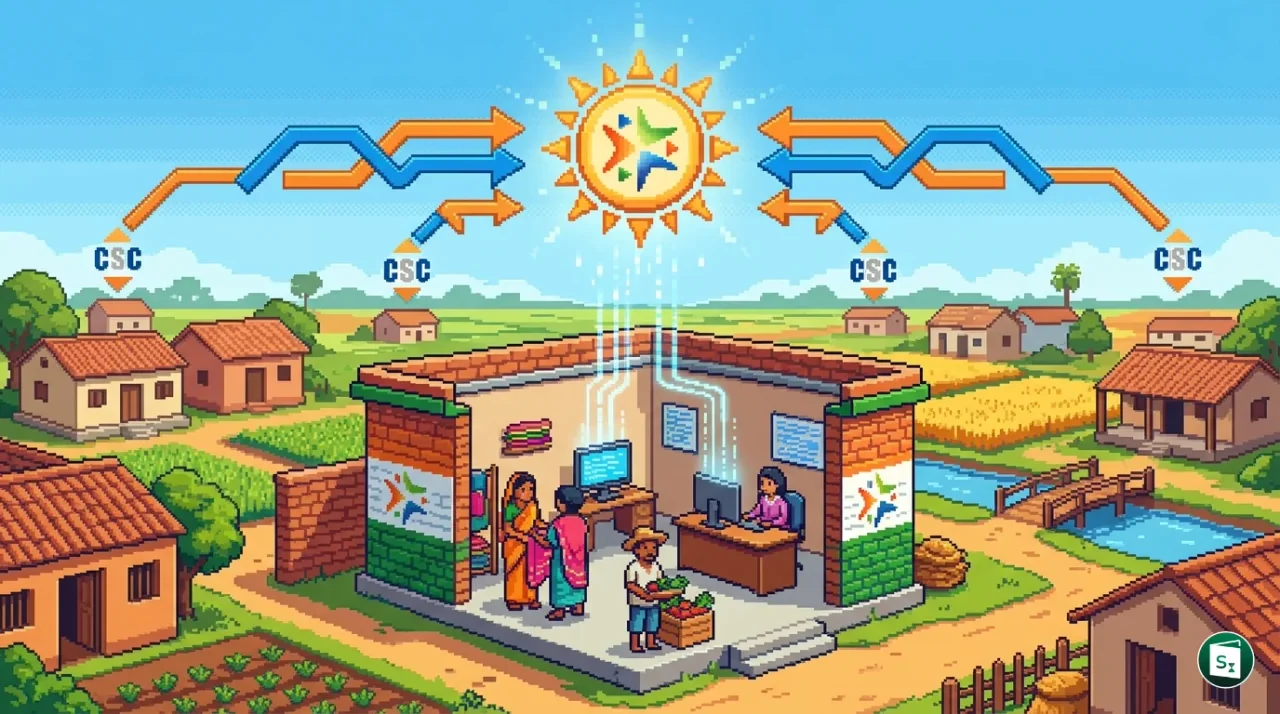
The Government e-Marketplace (GeM) has signed a renewed Memorandum of Understanding with the Common Service Centre e-Governance Services India Limited (CSC-SPV) to take government procurement opportunities to rural and underserved regions. The agreement, signed in New Delhi on 18 June 2026, expands an earlier partnership from 2022 and introduces a network of 50 dedicated facilitation centres called GeM Suvidha Kendras. These centres will provide end-to-end support to sellers, from registration to catalogue listing, across nine states and Union Territories.
The Government e-Marketplace and Common Service Centres
The Government e-Marketplace (GeM) is India’s national public procurement portal, launched on 9 August 2016 by the Ministry of Commerce and Industry. It was set up to transform the way government departments, public sector undertakings, and autonomous bodies buy goods and services. Before GeM, public procurement was largely manual, fragmented, and opaque. The platform replaced this with a fully digital, paperless, and cashless system that uses tools like e-bidding, reverse auctions, and demand aggregation to ensure transparency and competitive pricing.
Under Rule 149 of the General Financial Rules, 2017, all central government ministries and departments are required to procure goods and services available on GeM through the portal. As of 2026, GeM has achieved a cumulative Gross Merchandise Value (GMV) of over ₹18.4 lakh crore and serves more than 1.64 lakh buyer organisations with over 23 lakh registered sellers and service providers. The platform has been a major driver of the government’s Aatmanirbhar Bharat and Viksit Bharat vision by opening up public procurement to micro and small enterprises, startups, and women entrepreneurs.
Common Service Centres (CSCs) are a key pillar of the Digital India initiative, operating under the Ministry of Electronics and Information Technology (MeitY). The CSC scheme was approved in 2006 under the National e-Governance Plan and is implemented by CSC e-Governance Services India Limited (CSC-SPV), a Special Purpose Vehicle incorporated under the Companies Act. CSCs are ICT-enabled front-end delivery points that provide government, financial, educational, and healthcare services to citizens in rural and remote areas.
Today, India has over 6.5 lakh functional CSCs operated by Village Level Entrepreneurs (VLEs), making it one of the largest digital service delivery networks in the world. CSCs have been instrumental in delivering services like Aadhaar enrolment, banking, telemedicine, insurance, and digital literacy at the grassroots level.
The Renewed Partnership: A Broader Mandate
GeM and CSC first partnered in 2022, when CSC began helping businesses with seller registration and profile creation on the GeM platform. That collaboration proved highly successful. Through the CSC network, approximately 5.3 lakh sellers completed registration and profile creation, demonstrating the power of CSCs as a channel for last-mile outreach.
The renewed MoU, signed on 18 June 2026 at the GeM office in New Delhi by GeM Additional CEO Ajit B. Chavan and CSC-SPV Senior Vice President Subodh Mishra, takes this partnership much further. While the 2022 agreement focused only on registration, the new framework provides end-to-end support covering the entire seller journey.
Under the expanded scope, CSC will now assist sellers with:
- Vendor assessment, including documentation and compliance guidance
- Brand approval from original equipment manufacturers
- Product and service catalogue creation and publication on the GeM portal
- Awareness generation, training, and capacity-building programmes
- Grievance redressal support for platform users
This outcome-oriented approach is designed to improve the conversion rate from mere registration to active selling on the platform. Many sellers who register on GeM never complete the listing process because they lack the technical knowledge to create catalogues or obtain brand approvals. The new framework addresses this gap directly.
GeM Suvidha Kendras: Procurement Support at the Last Mile
The flagship element of the renewed partnership is the establishment of 50 GeM Suvidha Kendras (GSKs) on a pilot basis. These will be physical facilitation centres set up through the existing CSC network in nine states: Delhi-NCR, Maharashtra, Uttar Pradesh, Gujarat, Tamil Nadu, Kerala, Karnataka, Telangana, and West Bengal.
Each GSK will function as a dedicated support hub where sellers and service providers can access guidance, training, and hands-on assistance related to GeM processes. The centres will offer:
- Onboarding support for new sellers
- Training programmes on catalogue creation, bidding, and order fulfilment
- Awareness campaigns about government procurement opportunities
- Grievance redressal services
- Capacity-building initiatives for local entrepreneurs
The choice of states reflects a mix of industrially developed regions and states with significant rural hinterlands where the CSC network has a strong presence. The pilot will be closely monitored, and based on outcomes and stakeholder feedback, the government plans to expand GSKs to additional states and Union Territories.
The GeM Suvidha Kendras are particularly important because they address a fundamental challenge in public procurement. Many small businesses in rural areas are aware of GeM but lack the digital literacy, infrastructure, or confidence to navigate the platform independently. Having a local centre where a trained facilitator can walk them through the process removes these barriers and opens up the government market to a much wider pool of sellers.
Who Benefits from This Initiative
The partnership is designed to benefit a broad cross-section of enterprises, particularly those that have traditionally found it difficult to access government markets. The key beneficiary groups include:
Micro and Small Enterprises (MSEs) are the primary target. Under the Public Procurement Policy for MSEs Order, 2012 (amended in 2018), central government ministries and public sector undertakings must procure at least 25% of their annual purchases from MSEs. Within this, 4% is reserved for SC/ST-owned MSEs and 3% for women-owned MSEs. The GeM-CSC partnership directly supports this policy by helping MSEs get onboarded and listed on the platform.
Women entrepreneurs, SC/ST entrepreneurs, startups, artisans, weavers, Self-Help Groups (SHGs), Farmer Producer Organisations (FPOs), and local manufacturers are among the specific groups expected to gain from the initiative. These are exactly the kinds of small-scale producers and service providers who operate in rural and semi-urban areas and who lack the resources to navigate digital procurement platforms on their own.
For the government itself, the partnership serves a dual purpose. It helps meet the mandated MSE procurement targets while also increasing competition on the GeM platform. More sellers mean better price discovery, which leads to savings for the exchequer. Studies have shown that GeM generates minimum savings of about 10% on procurement value compared to traditional methods.
GeM’s Growing Role in Public Procurement
The expanded GeM-CSC partnership comes at a time when GeM is rapidly scaling up its reach and capabilities. In the financial year 2025-26, the portal crossed ₹5 lakh crore in annual GMV and achieved a cumulative GMV of over ₹18.4 lakh crore since its launch. More than 74 lakh orders have been processed through the platform.
GeM has also introduced several new features in 2026 to broaden its utility. The portal now supports multi-currency bidding and participation from foreign sellers, a move designed to align with India’s Free Trade Agreement (FTA) commitments. It has integrated with the Open Network for Digital Commerce (ONDC) through the MSME TEAM Initiative, allowing Udyam-registered MSE sellers to access private and commercial buyers beyond government departments.
The platform’s impact on inclusive procurement has been notable. As of 2026, MSEs account for 68% of total orders on GeM and 47% of total GMV, well above the mandated 25% target. Women-owned MSEs on the platform have grown from just 268 in 2016-17 to over 2.16 lakh, with procurement from them rising from ₹8 crore to more than ₹93,327 crore. Startup participation has grown from 88 entities to over 40,000, with procurement exceeding ₹61,400 crore.
By leveraging CSC’s extensive rural network, GeM is now positioned to extend these benefits to enterprises that have so far remained outside the formal procurement ecosystem. The 50 GSKs in the pilot phase represent a targeted investment in building the infrastructure for inclusive digital commerce at the grassroots level.
Key Takeaways
- The Government e-Marketplace (GeM) signed a renewed MoU with CSC-SPV on 18 June 2026 to expand government procurement access in rural areas.
- A total of 50 GeM Suvidha Kendras (GSKs) will be established on a pilot basis across nine states, including Delhi-NCR, Maharashtra, Uttar Pradesh, Gujarat, Tamil Nadu, Kerala, Karnataka, Telangana, and West Bengal.
- The earlier GeM-CSC partnership (2022) helped approximately 5.3 lakh sellers complete registration; the new agreement extends support to catalogue listing, vendor assessment, and brand approval.
- GeM was launched on 9 August 2016 under the Ministry of Commerce and Industry and has achieved a cumulative GMV of over ₹18.4 lakh crore as of 2026.
- CSCs were established in 2006 under the National e-Governance Plan and operate under MeitY, with over 6.5 lakh centres across India today.
- Central government ministries must procure at least 25% of annual purchases from MSEs, with sub-targets of 4% for SC/ST-owned and 3% for women-owned MSEs under the Public Procurement Policy for MSEs Order, 2012.