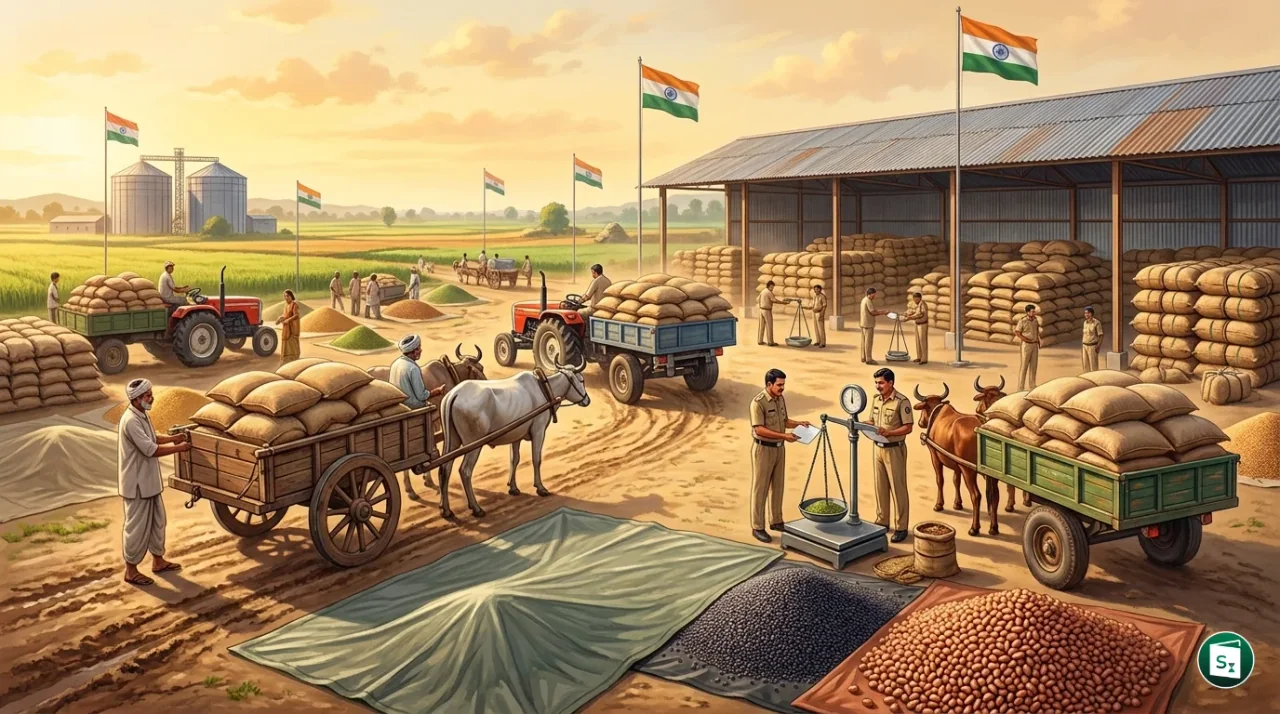
Union Agriculture Minister Shivraj Singh Chouhan has approved bulk procurement of moong, urad, and groundnut at Minimum Support Price under the Price Support Scheme (PSS) for the Summer 2026 season. Uttar Pradesh is the biggest beneficiary with approvals for over 1.87 lakh metric tonnes of pulses and oilseeds across three crops, while Gujarat, Haryana, and Tamil Nadu have also received procurement clearances. The move ensures farmers in these states get guaranteed prices for their produce at a time when market arrivals are at their peak.
What Is the Price Support Scheme?
The Price Support Scheme (PSS) is a central government mechanism to protect farmers of notified agricultural commodities from price crashes during the harvest season. When market prices fall below the Minimum Support Price (MSP) declared by the government, central nodal agencies step in to purchase the produce directly from farmers at the MSP.
Procurement under PSS is triggered only for stocks that meet Fair Average Quality (FAQ) norms. The central government bears all costs and losses incurred during procurement. Operations continue at a procurement centre for up to 90 days from the start of the harvesting period, or until market prices stabilise above MSP, whichever is earlier.
The scheme covers notified oilseeds, pulses, and copra. For the Summer 2026 season, moong and urad (pulses) and groundnut (oilseed) have been taken up for procurement. The implementing agencies make payments directly into farmers’ bank accounts through digital modes such as RTGS and NEFT, ensuring transparency and eliminating intermediaries.
PSS and the PM-AASHA Umbrella
The Price Support Scheme is one of the key components of PM-AASHA (Pradhan Mantri Annadata Aay Sanrakshan Abhiyan) , the government’s umbrella programme for assured price support to farmers. Launched in September 2018, PM-AASHA was designed to plug gaps in the MSP regime that historically benefited only cereal crops like wheat and paddy, leaving oilseed and pulse farmers exposed to market volatility.
PM-AASHA consists of four main components:
| Component | Mechanism | Coverage |
|---|---|---|
| Price Support Scheme (PSS) | Physical procurement at MSP by central nodal agencies | Pulses, oilseeds, copra |
| Price Deficiency Payment Scheme (PDPS) | Direct cash compensation for the gap between MSP and market price | Notified oilseeds |
| Market Intervention Scheme (MIS) | Procurement of perishable commodities outside MSP framework | Horticultural crops |
| Price Stabilisation Fund (PSF) | Buffer stocking to control price volatility | Essential commodities |
In September 2024, the Union Cabinet approved the continuation of PM-AASHA with a financial outlay of ₹35,000 crore up to the 2025-26 period. The government also enhanced the sovereign guarantee for MSP procurement to ₹45,000 crore to enable large-scale purchase of pulses, oilseeds, and copra.
The standard procurement ceiling under PSS is 25% of the state’s production of a notified crop. However, for critical pulses such as tur (arhar), urad, and masur (lentil) , this cap has been relaxed to 100% to encourage production and reduce import dependence. This relaxation was extended for four years up to 2028-29 under the Union Budget 2025-26.
State-Wise Procurement Approvals
The latest round of approvals covers four states across two marketing seasons. Uttar Pradesh received the largest allocation for the Summer 2026 season, followed by Gujarat and Haryana. Tamil Nadu’s approval pertains to the Rabi Marketing Season (RMS) 2025-26.
| State | Crop | Quantity (MT) | Season |
|---|---|---|---|
| Uttar Pradesh | Moong | 48,298 | Summer 2026 |
| Urad | 97,970 | Summer 2026 | |
| Groundnut | 41,718 | Summer 2026 | |
| Gujarat | Moong | 18,250 | Summer 2026 |
| Haryana | Moong | 2,115 | Summer 2026 |
| Tamil Nadu | Moong | 990 (revised up from 885) | RMS 2025-26 |
Uttar Pradesh alone accounts for approvals totalling over ₹1,490 crore in MSP value. The state’s allocation of nearly 98,000 MT of urad reflects the government’s focus on boosting production of this key pulse, for which 100% procurement at MSP has been permitted.
The procurement operations are carried out by NAFED (National Agricultural Cooperative Marketing Federation of India) and NCCF (National Cooperative Consumers’ Federation of India) . NAFED was established in 1958 and is registered under the Multi State Co-operative Societies Act. Both agencies operate through their cooperative networks at the state and district levels, with digital portals such as NAFED’s eSamridhi and NCCF’s eSamyukti used for farmer registration and payment tracking.
Significance for India’s Pulses and Oilseeds Economy
India remains a major importer of both pulses and edible oils, which puts pressure on the country’s foreign exchange and exposes domestic consumers to global price shocks. India meets roughly 55-60% of its edible oil demand through imports, while pulses imports have fluctuated between 8% and 21% of domestic consumption in recent years.
The government has set a target of achieving aatmanirbharta (self-reliance) in pulses by 2030-31. Under the Mission for Self-Reliance in Pulses (2025 to 2031), with an outlay of ₹11,440 crore, NAFED and NCCF have been directed to procure 100% of the tur, urad, and masur offered by pre-registered farmers. The Summer 2026 procurement approvals are a direct step in this direction.
Groundnut procurement is equally strategic. As India’s largest domestic source of edible oil after mustard, higher groundnut production and assured procurement help reduce the country’s dependence on imported palm oil, soybean oil, and sunflower oil.
The Summer (or Zaid) season occupies a unique position in India’s agricultural calendar. It runs from March to June, bridging the rabi harvest and the onset of kharif sowing. Summer crops are grown largely on irrigated land and have shorter growing cycles, making them an important source of early-season market arrivals and farmer income.
The Way Forward
The latest procurement approvals are part of a sustained policy push to strengthen India’s farm price support system for non-cereal crops. With the enhanced sovereign guarantee of ₹45,000 crore and the flexible 100% procurement cap for key pulses, the government has created a strong safety net for farmers.
However, challenges remain. The PSS relies on state governments making timely requests, and procurement infrastructure in some regions remains inadequate. Digital integration through farmer registration portals needs to be scaled up to cover all eligible growers. The NAFED and NCCF networks, while extensive, will require further strengthening in storage and logistics to handle growing procurement volumes.
Key Takeaways
- Union Agriculture Minister Shivraj Singh Chouhan approved MSP procurement of moong, urad, and groundnut under the Price Support Scheme for the Summer 2026 season.
- Uttar Pradesh is the biggest beneficiary with approvals of 48,298 MT of moong, 97,970 MT of urad, and 41,718 MT of groundnut.
- Gujarat received approval for 18,250 MT of moong, and Haryana for 2,115 MT of moong for Summer 2026.
- Tamil Nadu’s moong procurement limit for the Rabi Marketing Season 2025-26 was increased from 885 MT to 990 MT.
- The Price Support Scheme is a component of PM-AASHA, launched in September 2018, with a financial outlay of ₹35,000 crore extended up to 2025-26.
- NAFED (established 1958) and NCCF are the central nodal agencies implementing PSS procurement across states.