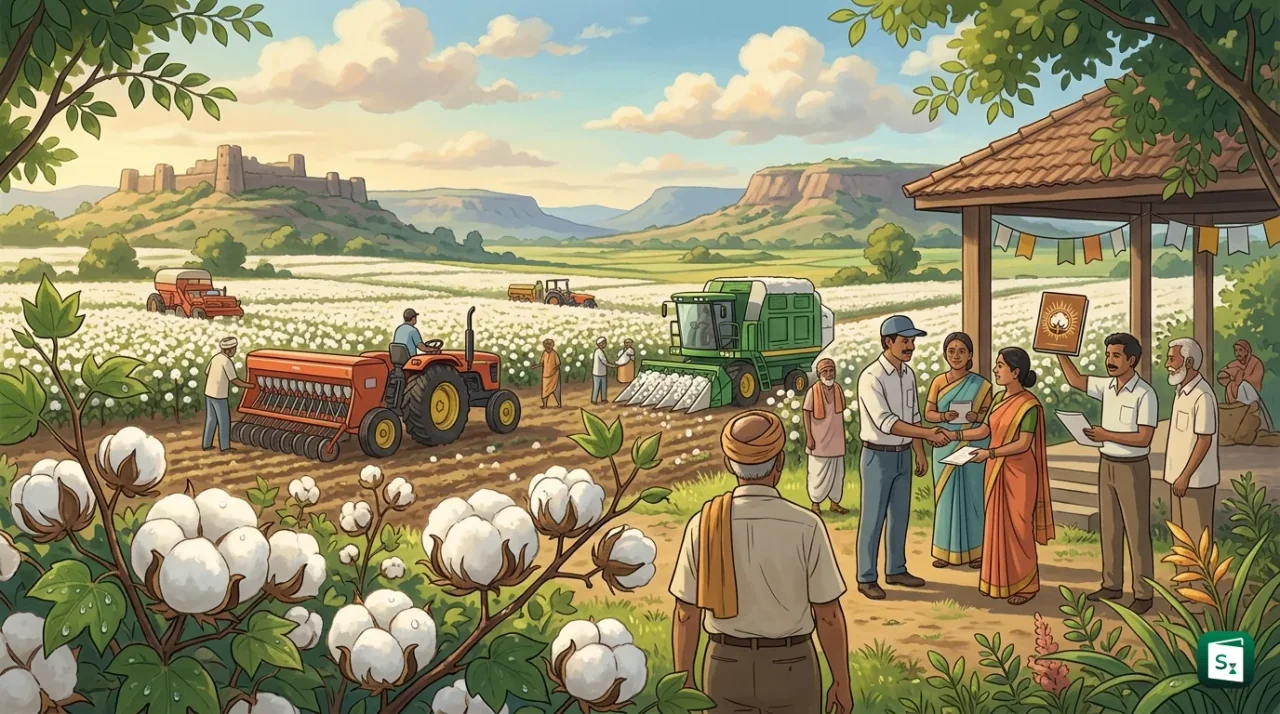
Union Minister of Textiles Giriraj Singh presided over the 56th Foundation Day celebrations of the Cotton Corporation of India (CCI) on 1 August 2026 in Chhatrapati Sambhajinagar, Maharashtra. The event doubled as a policy launchpad, with the minister unveiling the implementation roadmap for the ₹5,659-crore Cotton Productivity Mission (Kapas Kanti) and rolling out the Kapas Darshan Bulletin for cotton farmers. Four new Memorandums of Understanding (MoUs) were also signed to strengthen India’s cotton value chain, from farm-level productivity to global market traceability.
About the Cotton Corporation of India
The Cotton Corporation of India Ltd. (CCI) was established on 31 July 1970 as a government company under the Companies Act, 1956. It operates as a Public Sector Undertaking (PSU) under the administrative control of the Ministry of Textiles, Government of India. The corporation is headquartered in Navi Mumbai, Maharashtra, with a network of 19 branches spread across all major cotton-growing states.
CCI’s core mandate is to undertake price support operations whenever the market prices of seed cotton (kapas) fall below the Minimum Support Price (MSP) announced by the government, without any quantitative limit. Beyond MSP operations, CCI also carries out commercial purchase operations to fulfil the raw material requirements of the domestic textile industry, particularly during lean seasons. Over its 56-year journey, the corporation has evolved into the single largest institutional buyer of raw cotton in the country.
During the Cotton Season 2025-26, CCI carried out one of the largest MSP procurement operations in its history, procuring over 522 lakh quintals of seed cotton through nearly 24 lakh farmer transactions. It transferred ₹41,530 crore directly into the Aadhaar-linked bank accounts of farmers, eliminating middlemen and ensuring transparent, technology-driven procurement.
Cotton Productivity Mission (Kapas Kanti): The Big Push
The centerpiece of the Foundation Day event was the detailed announcement of the Mission for Cotton Productivity, branded as Kapas Kanti. Approved by the Union Cabinet with a total outlay of ₹5,659.22 crore, the mission covers the period from 2026-27 to 2030-31, making it a five-year transformational initiative for India’s cotton sector.
The mission aims to address the structural weaknesses that have plagued Indian cotton for years: low farm-level productivity, inconsistent fibre quality, volatile raw material supply, and a growing dependence on imports. Unlike earlier schemes that focused narrowly on cultivation, Kapas Kanti adopts a value-chain approach that connects farm-level reforms with textile manufacturing, exports, and global sourcing competitiveness.
Mission Budget and Components
The ₹5,659-crore outlay is distributed across four major components:
| Component | Allocation | Focus Area |
|---|---|---|
| Production and Technology | ₹3,804 crore | High-density planting, ELS cultivation, improved farming practices, farmer training |
| Research and Inputs | ₹555 crore | Climate-resilient seed varieties, pest-resistant seeds, soil health |
| Post-Harvest Management | ₹1,000 crore | Kasturi Cotton Bharat tagging, testing laboratories, skill development for ginning units |
| Sustainability and Alternative Fibres | ₹300 crore | Sustainable practices and natural fibre diversification |
The largest share of the budget, nearly 67 per cent, goes to production and technology, reflecting the government’s emphasis on raising on-farm output through scientific methods and better inputs.
Targets and Timeline
The mission sets ambitious targets for the cotton sector by 2030-31:
- Production target: Raise cotton output to 498 lakh bales (approximately 49.8 million bales) from an estimated 290 lakh bales in 2025-26.
- Productivity target: Nearly double yield to about 755 kg lint per hectare, approaching the global average of 833 kg per hectare. India’s current productivity stands at roughly 431 kg per hectare.
- Farmer coverage: Approximately 32 lakh cotton farmers across major producing states are expected to benefit from the mission.
- Fibre quality: Special emphasis on Extra Long Staple (ELS) cotton, which India currently imports in large volumes for high-value textile products.
The mission will be implemented through a coordinated framework involving the Ministry of Textiles, state governments, agricultural research institutions, Farmer Producer Organizations (FPOs), and the textile industry.
Kapas Darshan Bulletin and Farmer-Centric Initiatives
Alongside the mission announcement, the minister launched the Kapas Darshan Bulletin, a dedicated advisory publication designed to provide cotton farmers with timely and actionable information. The bulletin will cover weather updates, market price movements, scientific cultivation practices, quality management guidelines, and details of various government schemes relevant to cotton growers.
The bulletin is part of a broader push by CCI and the Ministry of Textiles to create digital and print-based farmer outreach channels. It complements the Kapas Kisan Mobile App, which was previously launched by CCI to streamline MSP procurement operations and provide farmers with self-service tools for registration, tracking, and payment status.
The Foundation Day celebrations also included the distribution of modern agricultural equipment to cotton farmers and Farmer Producer Organizations (FPOs). The equipment distributed included Kapas Plucker Machines, Cotton Stalk Shredder Machines, and Contamination Control Kits, all aimed at promoting scientific, sustainable, and contamination-free cotton cultivation. Additionally, audio-visual presentations on contamination control and the Kapas Kanti Mission were screened for farmers, along with a musical presentation on Pink Bollworm Management, one of the most damaging pests affecting cotton crops in India.
The Minimum Support Price (MSP) for seed cotton (kapas) was also highlighted at the event, with the minister noting that it has been increased by approximately 7 per cent for Cotton Season 2026-27. For reference, the MSP for the 2025-26 season stood at ₹7,710 per quintal for medium-staple cotton and ₹8,110 per quintal for long-staple cotton. The MSP increase is intended to ensure remunerative prices and strengthen the income security of cotton farmers across the country.
Four MoUs to Strengthen the Cotton Ecosystem
A major highlight of the programme was the signing of four Memorandums of Understanding (MoUs), each targeting a different dimension of India’s cotton ecosystem:
1. CCI and ICAR-CIRCOT: The Cotton Corporation of India signed an MoU with the ICAR-Central Institute for Research on Cotton Technology (CIRCOT), a premier institute under the Indian Council of Agricultural Research (ICAR) headquartered in Mumbai. The agreement focuses on capacity building and quality improvement in the ginning and pressing sector, which is the critical first link in cotton processing after harvest. ICAR-CIRCOT is known for its research on post-harvest processing technologies and value addition to cotton by-products.
2. CCI and GIZ: CCI entered into a partnership with GIZ (Deutsche Gesellschaft fur Internationale Zusammenarbeit), the German development agency, to enhance market access for cotton farmers through the Kasturi Cotton Bharat programme. The collaboration will promote sustainability, quality assurance, and traceability in the Indian cotton supply chain. GIZ has a long-standing presence in India working on sustainable development projects.
3. CITI, ICAC and MERAGO/GEOCLARA: The Confederation of Indian Textile Industry (CITI), the International Cotton Advisory Committee (ICAC), and MERAGO/GEOCLARA signed a joint MoU to promote carbon credit generation through climate-smart and sustainable cotton cultivation practices. The ICAC is an intergovernmental body formed in 1939 and comprising governments of cotton-producing, consuming, and trading countries. It is headquartered in Washington, D.C.
4. TEXPROCIL and Manjeet Cotton Pvt. Ltd.: The Cotton Textiles Export Promotion Council (TEXPROCIL), established in 1954 as India’s first export promotion council, signed an MoU with Manjeet Cotton Pvt. Ltd. to collaborate under the Kasturi Cotton Bharat programme for the production and certification of 30,000 cotton bales (comprising 20,000 Long Staple and 10,000 Extra Long Staple bales). The agreement ensures traceability, compliance with quality standards, and the development of a premium, traceable cotton supply chain.
India’s Cotton Sector: The Bigger Picture
The Kapas Kanti mission comes at a time when India’s cotton sector is facing serious headwinds. Production has been declining steadily, cultivation area is shrinking as farmers shift to more remunerative crops, and import dependence is growing at an alarming rate. Understanding these structural challenges is essential to grasp why the government has committed such a large outlay to the mission.
Declining Production and Shrinking Acreage
India’s cotton production has followed a consistent downward trajectory over the past six seasons. Production stood at 352.48 lakh bales in 2020-21 but fell to a provisional estimate of 290.91 lakh bales in 2025-26. The primary reason is not a decline in yield per hectare, which has remained relatively stable between 428 kg and 451 kg, but a significant reduction in the area under cotton cultivation. Cotton acreage has shrunk from 132.85 lakh hectares in 2020-21 to 114.82 lakh hectares in 2025-26, as farmers in states like Maharashtra, Gujarat, and Telangana have diversified toward crops offering better economic returns.
| Cotton Season | Area (Lakh Hectares) | Production (Lakh Bales) | Productivity (kg/ha) |
|---|---|---|---|
| 2020-21 | 132.85 | 352.48 | 451 |
| 2021-22 | 123.71 | 311.17 | 428 |
| 2022-23 | 129.27 | 336.60 | 443 |
| 2023-24 | 126.88 | 325.22 | 436 |
| 2024-25 | 114.84 | 297.24 | 440 |
| 2025-26 (Prov.) | 114.82 | 290.91 | 431 |
India ranks among the world’s largest cotton cultivators by area, but its yield per hectare of roughly 431 kg places it at the 40th position globally. The global average stands at 833 kg per hectare, and top producers like China and Brazil achieve significantly higher yields. Experts attribute India’s low productivity to dependence on rain-fed cultivation in many cotton-growing regions, persistent pest attacks (particularly the pink bollworm), poor seed quality, limited adoption of advanced varieties, and uneven mechanisation.
Rising Import Dependence
The production shortfall has forced India to increasingly rely on cotton imports. Raw cotton imports surged by 80.26 per cent during 2025-26, rising from 562,224 tonnes to 10,13,455 tonnes compared with the previous year. Cotton yarn imports also increased by nearly 20 per cent over the same period. In value terms, raw cotton imports jumped from $579 million in FY24 to $1.2 billion in FY25.
At the same time, India’s textile exports have been under pressure. Readymade garment exports declined to $15.77 billion in FY26 from $15.99 billion in FY25, and overall textile-related exports slipped to approximately $34 billion from $34.84 billion. India faces stiff competition from Bangladesh, Vietnam, and China in global textile markets, and rising raw material costs driven by import dependence only add to the challenge.
To address the immediate supply gap, the government has waived the 11 per cent import duty on cotton for the period 1 June to 31 October 2026. The duty-free import policy for Extra Long Staple (ELS) cotton, which has been in effect since 20 February 2024, has also been continued. These measures are designed to ensure that textile manufacturers have access to adequate raw material while the long-term Kapas Kanti mission takes effect.
The Way Forward
The Kasturi Cotton Bharat brand occupies a central place in the government’s long-term cotton strategy. The brand aims to position premium Indian cotton in the global market through internationally accepted standards of certification, traceability, and sustainability. It uses QR-based certification technology at every stage of processing, providing end-to-end traceability from farm to fashion. As of recent reports, over 1.20 lakh certified Kasturi Cotton Bharat bales have been produced, signalling early traction for the programme.
The Ministry of Textiles has articulated a vision of strengthening the entire cotton value chain, described as moving from Farm to Fibre, Fibre to Fabric, and Fabric to Fashion. The Kapas Kanti mission, with its integrated approach spanning seed development, farm mechanisation, post-harvest infrastructure, quality certification, and sustainability, represents the most comprehensive policy intervention in this direction in recent years.
At the event, Padmini Singla, Joint Secretary (Fibre) in the Ministry of Textiles, noted that India’s cotton sector is entering a transformative phase driven by innovation, sustainability, and productivity enhancement. She emphasised that the Kapas Kanti mission would accelerate productivity, strengthen global competitiveness through Kasturi Cotton Bharat, and promote sustainable natural fibres across the cotton value chain.
Lalit Kumar Gupta, Chairman-cum-Managing Director of CCI, highlighted the corporation’s journey over 56 years in safeguarding cotton farmer interests through transparent, technology-driven, and farmer-centric initiatives. He reaffirmed CCI’s commitment to contributing towards the vision of Viksit Bharat @2047.
The success of the mission will ultimately depend on on-ground implementation, particularly the adoption of improved farming practices by cotton growers, the pace of mechanisation, and the ability to build a credible and globally competitive cotton brand under Kasturi Cotton Bharat.
Key Takeaways
- The Cotton Corporation of India (CCI) was established on 31 July 1970 and operates as a PSU under the Ministry of Textiles, with headquarters in Navi Mumbai and 19 branches across cotton-growing states.
- The Cotton Productivity Mission (Kapas Kanti) has an outlay of ₹5,659.22 crore over five years (2026-27 to 2030-31), targeting production of 498 lakh bales and productivity of 755 kg per hectare by 2030-31.
- During Cotton Season 2025-26, CCI procured over 522 lakh quintals of seed cotton through nearly 24 lakh farmer transactions, transferring ₹41,530 crore directly into Aadhaar-linked bank accounts.
- India’s cotton productivity stands at approximately 431 kg per hectare, roughly half the global average of 833 kg per hectare, placing India at the 40th position globally.
- Raw cotton imports surged by 80.26 per cent in 2025-26, reaching over 10.13 lakh tonnes, while the government has waived the 11 per cent import duty from 1 June to 31 October 2026.
- The Kasturi Cotton Bharat brand uses QR-based blockchain certification for end-to-end traceability, with over 1.20 lakh certified bales produced to date.