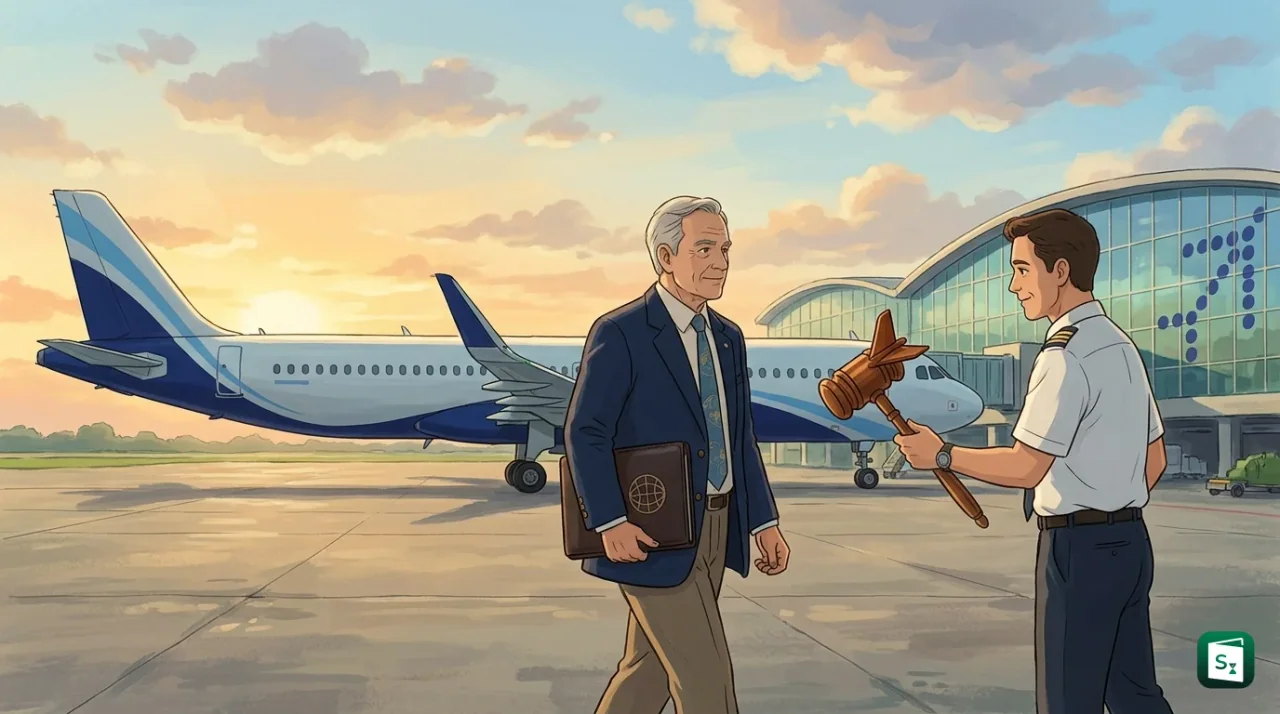
Willie Walsh, the former Director General of the International Air Transport Association (IATA), officially assumed charge as the Chief Executive Officer of IndiGo on 3 August 2026. He succeeds Pieter Elbers, who resigned in March 2026 following a severe scheduling crisis that disrupted thousands of flights. The appointment of one of aviation’s most seasoned leaders marks a new chapter for India’s largest airline as it navigates recovery and global expansion.
Who Is Willie Walsh?
William Matthew Walsh, commonly known as Willie Walsh, is an Irish aviation executive born on 25 October 1961 in Dublin, Ireland. He holds a Master of Science and Business Administration from Trinity College, Dublin. Walsh’s career in aviation spans over four decades, beginning at age 17 when he joined Aer Lingus as a cadet pilot in 1979. He rose through the ranks to become a Boeing 737 captain before transitioning into management.
Walsh’s leadership journey began at Aer Lingus, where he served as Chief Operating Officer from 2000 and was elevated to CEO in 2001. At the time, the airline was in financial difficulty. Walsh restructured it into a low-cost carrier, eliminating 2,000 staff positions and withdrawing short-haul Business Class services. While these moves restored operating profits, they also led to labour disputes, including a three-day lockout in 2002.
In 2005, Walsh moved to British Airways as CEO, steering the airline through the global financial crisis and the 2010 Icelandic volcanic ash eruption that grounded European airspace. He then oversaw the merger of British Airways and Iberia to form International Airlines Group (IAG) in 2011, serving as its CEO until 2020. Under his leadership, IAG grew into one of the world’s largest airline holding companies, owning Aer Lingus, British Airways, Iberia, Level, and Vueling.
Walsh was appointed the 8th Director General of IATA in November 2020, taking charge in April 2021. During his tenure, he guided the global airline industry through the recovery phase of the COVID-19 pandemic and criticised governments for their handling of the crisis. He concluded his IATA term on 31 July 2026 before joining IndiGo.
IndiGo: India’s Largest Airline
IndiGo, officially operated by InterGlobe Aviation Limited, is India’s largest airline by passengers carried and domestic market share. The airline was co-founded by Rahul Bhatia and Rakesh Gangwal in 2005 and commenced operations on 4 August 2006 with a flight from New Delhi to Imphal via Guwahati. It is headquartered in Gurgaon, Haryana, and is publicly listed on the National Stock Exchange (NSE) and Bombay Stock Exchange (BSE) under the ticker INDIGO.
IndiGo has grown from a small domestic carrier into one of the world’s largest airlines. As of early 2026, the airline operates a fleet of over 440 aircraft, running more than 2,200 daily flights across 95 domestic and over 40 international destinations. In calendar year 2025, IndiGo carried 124 million passengers and held approximately 64% of India’s domestic aviation market. The airline was named the Best Airline in India and South Asia at the Skytrax World Airline Awards 2025 and was ranked the sixth Most Punctual Airline in Asia-Pacific by Cirium.
IndiGo’s business model is built on a low-cost, single-aircraft-type strategy, operating predominantly Airbus A320 family aircraft. This simplifies crew training, maintenance, and procurement. In June 2023, the airline placed the largest aircraft order in commercial aviation history, booking 500 Airbus A320neo family planes. In April 2024, it ordered 30 Airbus A350-900 wide-body aircraft (with an option for 70 more) in a deal valued at $5 billion, signalling its ambitions for long-haul international operations. IndiGo also introduced IndiGoStretch, a business class product, on select routes in November 2024.
Why Did Pieter Elbers Leave?
Pieter Elbers, a Dutch aviation veteran and former CEO of KLM (the Dutch flag carrier), was appointed as IndiGo’s CEO in 2022. His mandate was to transform the airline from a domestic powerhouse into a global player. Under his leadership, IndiGo expanded its international network, placed major aircraft orders, and launched premium products.
However, Elbers’ tenure was undone by the December 2025 scheduling crisis, the most severe operational breakdown in IndiGo’s 20-year history. The crisis began on 2 December 2025 when the airline failed to adjust its schedule to new Flight Duty Time Limitation (FDTL) rules mandated by the Directorate General of Civil Aviation (DGCA). These rules, announced in June 2024, increased pilot rest periods and reduced the number of night landings allowed per week from six to two.
IndiGo cancelled approximately 4,500 flights over ten days, disrupting travel for over 10 lakh passengers during India’s peak wedding season. The on-time performance plummeted from 84.1% in October to as low as 8.5% on 5 December. The DGCA imposed a record fine of ₹22.2 crore, ordered a ₹50 crore bank guarantee, and directed IndiGo to cut 10% of its flight schedule. Several senior executives, including Elbers, received warnings, and some contracted flight operations inspectors were terminated.
Elbers resigned on 10 March 2026, citing personal reasons. The airline’s co-founder Rahul Bhatia assumed charge as interim CEO until Walsh’s appointment was announced on 31 March 2026.
What Walsh Brings to the Table
Walsh’s appointment is widely seen as a strategic coup for IndiGo. As the former head of IATA, which represents 367 airlines from over 120 countries and covers approximately 82% of global air traffic, Walsh brings unmatched industry connections and regulatory expertise. His career has been defined by three key strengths that IndiGo needs at this juncture.
Operational restructuring. Walsh successfully restructured Aer Lingus from a struggling flag carrier into a profitable low-cost airline. At British Airways, he managed operations through crises ranging from the 2008 financial meltdown to the 2010 volcanic ash disruption. These experiences are directly relevant to IndiGo’s need for operational discipline after the December 2025 meltdown.
Mergers and acquisitions. Walsh orchestrated the British Airways-Iberia merger to create IAG, one of the world’s largest airline groups. This expertise in managing complex, multi-airline structures could prove valuable as IndiGo explores further expansion, including its wide-body international strategy with the incoming Airbus A350-900 fleet.
Global network building. IndiGo is in the process of building an international identity, with long-distance routes using A321XLR and A350 aircraft. Walsh’s experience negotiating access to overseas markets, managing codeshare partnerships, and navigating international regulatory frameworks makes him uniquely suited to lead this expansion. As Kapil Kaul, CEO of aviation advisory firm CAPA India, noted, “For IndiGo to bring in Willie Walsh as its next CEO is a big move. It’s a reflection of the airline’s stature in global aviation as well as India’s rising importance.”
Challenges Ahead for IndiGo
Walsh takes over at a critical time for IndiGo. The airline faces several immediate and long-term challenges that will test his leadership.
Operational recovery. The December 2025 crisis exposed deep flaws in IndiGo’s manpower planning and rostering systems. The DGCA inquiry found “over-optimization of operations, inadequate regulatory preparedness, and deficiencies in management structure” as root causes. Walsh must rebuild operational resilience while maintaining the airline’s cost efficiency, which has been central to its success.
Regulatory compliance. IndiGo is operating under strict DGCA oversight, with a ₹50 crore bank guarantee requirement and a 15-month reform roadmap covering leadership, governance, manpower planning, fatigue risk management, and digital systems. The airline must demonstrate sustained compliance while restoring public trust.
International expansion. IndiGo has ambitious plans to establish itself as a leading global airline by 2030. The delivery of 60 Airbus A350-900 aircraft, expected to begin in 2027, will enable long-haul routes. Walsh’s challenge will be to build the international infrastructure, codeshare networks, and operational capabilities needed to compete with established global carriers.
Market competition. While IndiGo holds a dominant 64% domestic market share, competitors like Air India (backed by the Tata Group) are aggressively expanding. Air India has been adding aircraft, launching new routes, and improving its product offering. Walsh will need to defend IndiGo’s market position while pursuing profitable growth.
Financial pressures. IndiGo’s shares have been volatile, declining approximately 22% in early 2026. Higher fuel costs due to geopolitical tensions, including the conflict in the Middle East and Pakistani airspace restrictions, have increased operational expenses. Walsh must balance growth investments with financial discipline to maintain investor confidence.
Key Takeaways
- Willie Walsh assumed charge as CEO of IndiGo on 3 August 2026, succeeding Pieter Elbers who resigned on 10 March 2026.
- Walsh served as the Director General of IATA from April 2021 to July 2026, and was previously CEO of British Airways (2005-2011) and IAG (2011-2020).
- IndiGo (operated by InterGlobe Aviation) is India’s largest airline with a 64% domestic market share, a fleet of over 440 aircraft, and 124 million passengers carried in calendar year 2025.
- The appointment follows IndiGo’s December 2025 scheduling crisis, which saw the cancellation of approximately 4,500 flights and a record DGCA fine of ₹22.2 crore.
- IATA was founded in 1945 in Havana, Cuba, and is headquartered in Montreal, Canada. It represents 367 airlines from over 120 countries.
- IndiGo has ordered 60 Airbus A350-900 wide-body aircraft (deliveries from 2027) as part of its strategy to become a leading global airline by 2030.