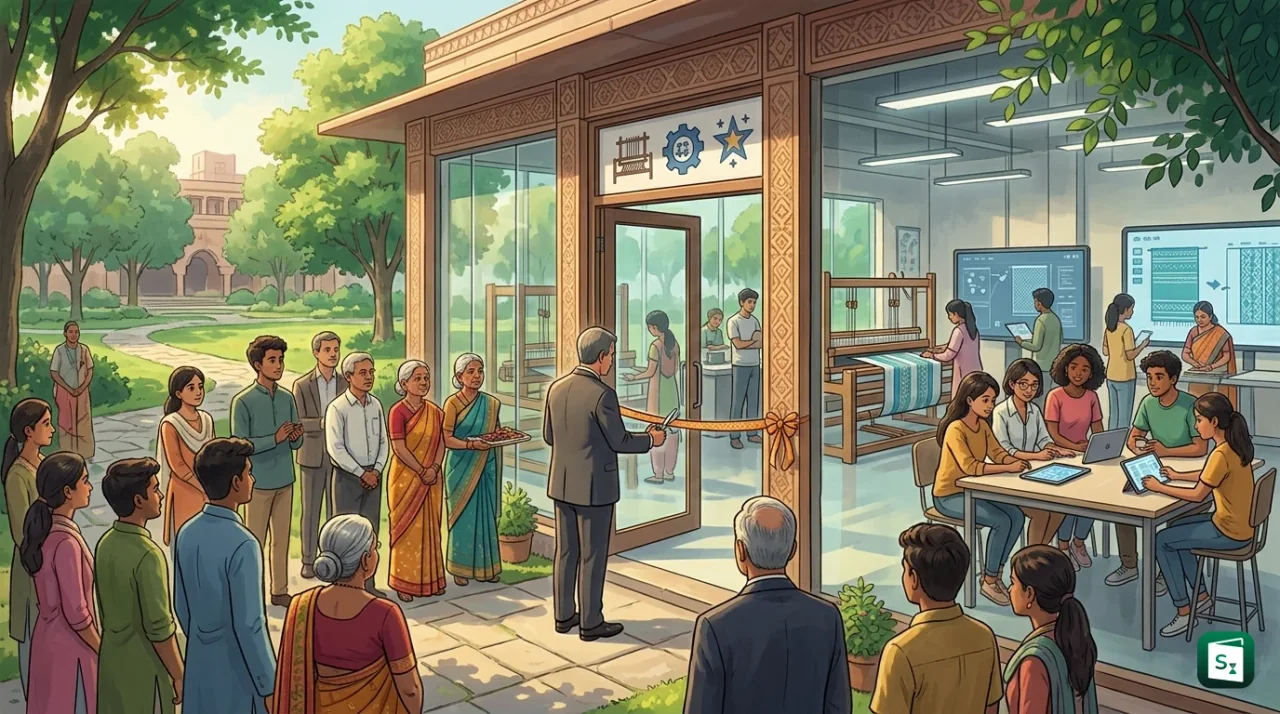
Union Minister of Textiles Giriraj Singh inaugurated the Centre of Excellence for Handloom Technology (CoE-HT) at the Indian Institute of Technology (IIT) Delhi on 3 August 2026, marking a significant push to blend India’s centuries-old weaving traditions with modern technology. Alongside the inauguration, five flagship digital and sustainability initiatives were launched to accelerate innovation across the handloom value chain. The centre, housed at one of India’s premier engineering institutions, aims to train at least 1,000 weavers, faculty members and handloom professionals over the next five years.
What Is the Centre of Excellence for Handloom Technology?
The Centre of Excellence for Handloom Technology (CoE-HT) is a national hub for research, innovation and technology transfer in the handloom sector, established at IIT Delhi under the Ministry of Textiles. IIT Delhi, founded in 1961 and declared an Institution of National Importance under the Institutes of Technology Act, was chosen for its strength in engineering research and its capacity to develop practical technological solutions for traditional industries.
The inaugural ceremony on 3 August 2026 was attended by Smt. Neelam Shami Rao, Secretary, Ministry of Textiles; Dr. M. Beena, Development Commissioner (Handlooms); Smt. Amrit Raj, Development Commissioner (Handicrafts); and Prof. Arvind K. Nema, Director-in-charge of IIT Delhi, along with faculty members, researchers, startup founders and weavers from across the country.
The Centre will undertake research in loom modernisation, ergonomics, artificial intelligence, sustainability, functional innovation and digital technologies. It aims to develop a national repository of handloom knowledge, create AI-enabled tools and facilitate technology transfer between academia and the handloom industry. The initiative brings together academia, industry, startups and handloom institutions under one umbrella to strengthen the entire handloom ecosystem and make Indian handloom products globally competitive.
Five Flagship Initiatives Launched
Alongside the inauguration of the CoE-HT, five flagship initiatives were launched to accelerate digital transformation, sustainability and innovation in the handloom sector.
Handloom 4.0 Mobile App
The Handloom 4.0 Mobile App enables digital monitoring of loom productivity, quality, maintenance and sustainability. It is designed to bring real-time data analytics to weavers, allowing them to track performance metrics, identify maintenance needs and adopt sustainable practices. By digitising loom operations, the app aims to improve efficiency and reduce waste across the handloom value chain.
Handloom e-Vidya
Handloom e-Vidya is a comprehensive digital learning and knowledge platform for capacity building across the handloom ecosystem. The platform will provide online training modules, technical resources and skill development content for weavers, designers, entrepreneurs and handloom professionals. It aims to bridge the knowledge gap between traditional weaving communities and modern market demands.
HandloomX
HandloomX is an accelerator and incubation platform supporting startups and innovators working across the Ministry of Textiles’ 5F value chain (Farm to Fibre to Factory to Fashion to Foreign Markets). The platform will provide mentorship, funding support and industry linkages to startups developing innovative solutions for the handloom sector, from raw material sourcing to international market access.
Kalagriha Handloom Studio (GenZ Design Studio)
The Kalagriha Handloom Studio, also called the GenZ Design Studio, leverages digital technologies to connect contemporary consumers with authentic handloom products through customisation and visualisation. The studio aims to make handloom products more appealing to younger consumers by offering personalised design options and virtual try-on features, bridging the gap between traditional craftsmanship and modern consumer expectations.
Threads of Valour
Threads of Valour is a sustainability initiative that transforms recycled defence textiles into premium handloom fabrics through scientific recycling and skilled craftsmanship. The programme repurposes decommissioned military uniforms and defence fabrics, giving them new life as high-quality handloom products. It combines environmental sustainability with social impact, creating new income opportunities for weavers while reducing textile waste.
Research Focus and Targets
The CoE-HT has been mandated to work across six core research areas: loom modernisation, ergonomics, artificial intelligence, sustainability, functional innovation and digital technologies. The centre will develop a national repository of handloom knowledge, cataloguing traditional weaving techniques, patterns and textile heritage from across India for preservation and future innovation.
A key target is the creation of AI-enabled tools for the handloom sector. These tools will assist in areas such as demand forecasting, quality control, design optimisation and supply chain management. The centre will also facilitate technology transfer, helping weavers adopt modern tools and techniques without losing the artisanal character of their products.
Over the next five years, the centre aims to train at least 1,000 weavers, faculty members and handloom professionals. This training will cover digital literacy, sustainable practices, design innovation and business skills, equipping participants to compete in both domestic and international markets. The initiative also plans to support startups through the HandloomX platform, encouraging entrepreneurship across the handloom value chain.
India’s Handloom Sector: Scale and Significance
India’s handloom sector is the country’s largest cottage industry, with an estimated 2.8 million looms spread across rural areas. According to the Fourth All India Handloom Census (2019-20), approximately 35.22 lakh handloom workers are employed across the country, of whom 25.46 lakh are women, accounting for over 72% of the workforce. The sector provides livelihoods to millions of families and is the second-largest employment provider in rural India after agriculture.
The textile and apparel industry as a whole contributes 2.3% to India’s GDP, 13% to industrial production and 12% to exports. India is the 6th largest exporter of textiles and apparel globally, with a 3.91% share of global trade in the sector. During April 2025 to February 2026, India’s total handloom exports stood at $142.23 million, with the United Arab Emirates ($44.80 million) and the United States ($40.02 million) as the top two destinations.
The government has set an ambitious target to achieve $10 billion in handloom exports by 2031. The Ministry of Textiles has implemented several schemes to support this goal, including the National Handloom Development Programme (NHDP), which provides financial assistance to handloom clusters, and the Raw Material Supply Scheme (RMSS), which supplies quality yarn at subsidised rates to eligible weavers. The Market Access Initiative (MAI) supports international marketing and participation in trade fairs.
The inauguration of the CoE-HT comes just days before National Handloom Day on 7 August, which commemorates the launch of the Swadeshi Movement on 7 August 1905 in Calcutta. The day was first observed in 2015 to honour the contributions of handloom weavers to India’s cultural and economic heritage.
Key Takeaways
- Giriraj Singh, Union Minister of Textiles, inaugurated the Centre of Excellence for Handloom Technology (CoE-HT) at IIT Delhi on 3 August 2026.
- Five flagship initiatives were launched: Handloom 4.0 Mobile App, Handloom e-Vidya, HandloomX, Kalagriha Handloom Studio and Threads of Valour.
- The centre will research loom modernisation, AI, sustainability and digital technologies, and aims to train 1,000 weavers and professionals over five years.
- India’s handloom sector employs 35.22 lakh workers (72% women) and operates 2.8 million looms across the country.
- The government targets $10 billion in handloom exports by 2031, up from $142.23 million in April 2025 to February 2026.
- National Handloom Day is observed on 7 August to mark the anniversary of the Swadeshi Movement of 1905.