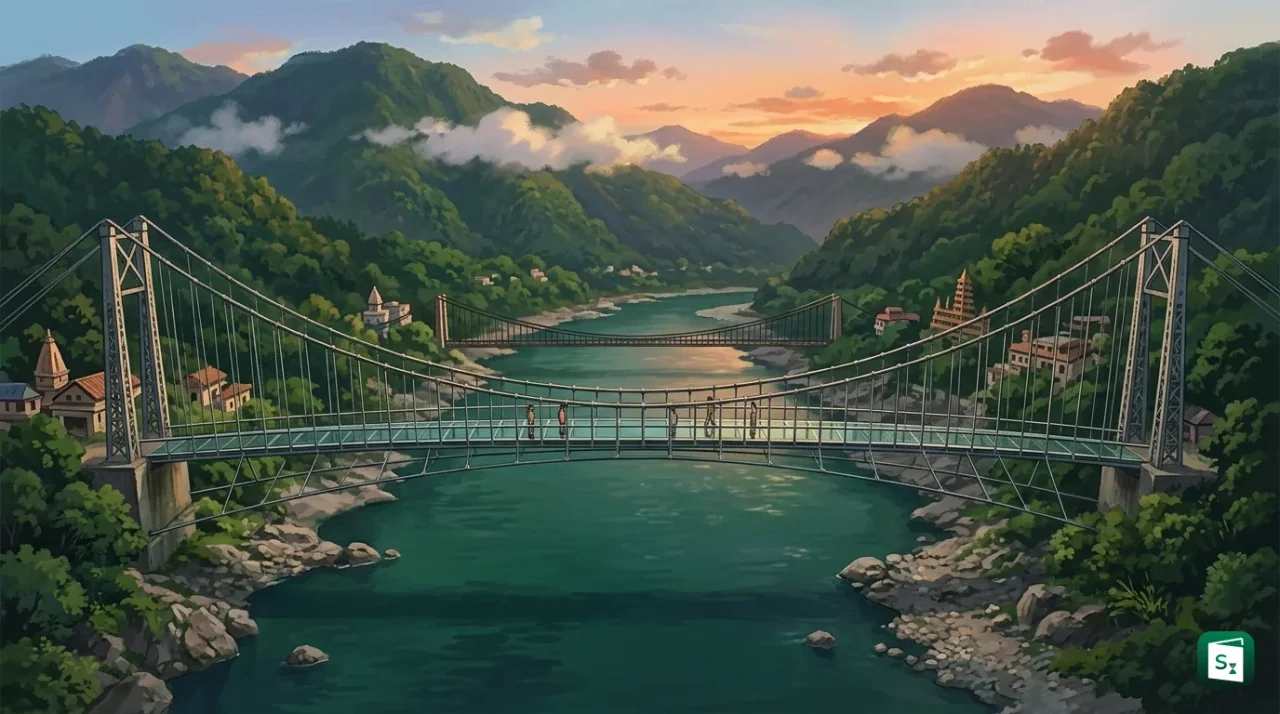
Bajrang Setu, North India’s first glass-floor cable suspension bridge, has been constructed over the Ganga River in Rishikesh, Uttarakhand. The 132-metre-long structure replaces the iconic Lakshman Jhula, which was closed in 2019 after being declared structurally unsafe. Built at an estimated cost of approximately ₹68 to 70 crore, the bridge connects Tapovan in Tehri Garhwal district with Jonk in Pauri Garhwal district, blending modern engineering with the spiritual heritage of the Himalayan town.
What Is Bajrang Setu?
Bajrang Setu is a cable suspension bridge with transparent glass-floor walkways on both sides of a central steel roadway. It stands approximately 57 to 70 feet above the Ganga and spans 132 metres in length with a total width of 8 metres. The bridge is India’s first glass-floor cable suspension structure over a river, and only the second of its kind in Asia.
The pedestrian walkways, each 1.5 metres wide, are constructed from five stacked layers of 12 mm toughened glass, giving a total panel thickness of 60 mm. Walking across them offers a direct, unobstructed view of the Ganga flowing beneath. The central lane is reserved for two-wheelers and light four-wheel vehicles, providing round-the-clock connectivity between the two districts. The glass walkway sections are open from 6:00 AM to 10:00 PM daily, while the central roadway operates 24 hours without any charge.
The bridge’s entry fee is set at approximately ₹100 for adults and ₹50 for children for access to the glass-floor sections. The Public Works Department (PWD), Narendra Nagar Division, of the Uttarakhand government executed the project, with construction beginning in 2022.
| Feature | Details |
|---|---|
| Length | 132 metres |
| Width | 8 metres |
| Glass walkway width | 1.5 metres (each side) |
| Glass thickness | 60 mm (5 layers of 12 mm toughened glass) |
| Height above Ganga | 57 to 70 feet |
| Project cost | ₹68 to 70 crore |
| Construction started | 2022 |
| Nodal agency | Uttarakhand PWD, Narendra Nagar Division |
| Entry fee (glass walkway) | ₹100 (adults), ₹50 (children) |
| Glass walkway timings | 6:00 AM to 10:00 PM |
| Central roadway | 24 hours, free |
The Legacy of Lakshman Jhula: Why a Replacement Was Needed
To understand why Bajrang Setu matters, one must first understand what it replaced. Lakshman Jhula was an iron suspension bridge across the Ganga, completed in 1929 during the British colonial era. It was opened to traffic on 11 April 1930 by Sir Malcolm Hailey, then Governor of the United Provinces. The bridge had a span of 450 feet and stood 59 feet above the mean summer water level.
According to Hindu mythology, Lord Lakshman, brother of Lord Ram, once crossed the Ganga at this very spot using a rope of jute. The bridge was named in his honour and became one of the most recognised landmarks in Rishikesh, drawing pilgrims, sadhus, and backpackers for nearly a century. It connected the villages of Tapovan on the west bank (Tehri Garhwal district) with Jonk on the east bank (Pauri Garhwal district), the same two points that Bajrang Setu now links.
Over the decades, the bridge deteriorated. Structural assessments in recent years found it unsafe for both pedestrian and vehicular traffic. In November 2020, authorities permanently restricted access, closing it to all traffic. The closure created a significant connectivity gap and dealt a heavy blow to local businesses in the Tapovan and Swargashram areas, which depended on the footfall the bridge brought. For nearly five years, shopkeepers and traders in the area faced severe economic hardship.
The closure left Rishikesh without a direct crossing at its most famous riverfront location. While Ram Jhula, built in 1986 about 2 kilometres downstream, continued to serve as a major crossing, the absence of Lakshman Jhula was felt deeply by both locals and visitors. Bajrang Setu was conceived as the direct replacement, built at precisely the same historic site to restore connectivity and revive the area’s economic life.
Design and Engineering: What Makes It India’s First
The designation of “India’s first” applies specifically to the combination of cable suspension architecture with glass flooring over a river. While India has several suspension bridges and some glass skywalks in hill stations, no previous structure combined both features over a flowing river. Bajrang Setu is reported to be only the second such bridge in all of Asia.
The engineering centrepiece is the glass walkway system. Each pedestrian pathway uses five layers of 12 mm toughened glass bonded together to create a 60 mm thick transparent panel. This layered construction is designed to handle heavy pedestrian loads while maintaining clarity. Even during pre-inauguration testing, when a top glass layer was damaged by a falling hammer, the four load-bearing layers underneath remained completely intact, demonstrating the structural redundancy built into the system.
The twin towers flanking the bridge are not standard steel pylons. They are architecturally modelled on the sanctum of Kedarnath Temple, one of the holiest Hindu shrines in Uttarakhand. One tower features a depiction of Lord Kedarnath while the other bears Lord Badrinath, integrating the region’s spiritual identity into the structural form itself. After dark, LED lighting illuminates the entire bridge, transforming it into a glowing landmark visible across the river.
A Hanuman statue is installed at the bridge, reflecting its name. “Bajrang” refers to Lord Hanuman (also known as Bajrang Bali), and the structure serves as a tribute not only to Lakshman but also to the broader mythological tradition of the area. The design philosophy blends cutting-edge engineering with sacred symbolism, making the bridge a piece of functional infrastructure that carries genuine spiritual weight for pilgrims and visitors alike.
Spiritual and Cultural Significance
Rishikesh has long been known as the “Yoga Capital of the World” and one of India’s most sacred Hindu pilgrimage cities. The Ganga, which flows through the town from the Himalayas, is revered as a living goddess. Any infrastructure built over the river in this region carries deep religious meaning, and Bajrang Setu is no exception.
The bridge’s name itself is a devotional statement. “Bajrang” is a reference to Lord Hanuman, the monkey god celebrated for his unwavering devotion to Lord Ram. Hanuman is also known as Bajrang Bali, meaning “one with a thunderbolt body.” By naming the bridge after Hanuman, the authorities have anchored it firmly within the local devotional landscape. The installation of a Hanuman statue at the bridge further reinforces this connection.
The mythological link to Lord Lakshman adds another layer of significance. According to tradition, Lakshman crossed the Ganga at this exact location using a jute rope, an act of faith that the original bridge commemorated. Bajrang Setu, while modern in construction, continues this narrative thread. The Kedarnath-inspired towers, the depictions of Lord Kedarnath and Lord Badrinath, and the overall design language position the bridge as both a transportation link and a spiritual landmark.
For the thousands of pilgrims who visit Rishikesh each year as part of the Char Dham Yatra (the pilgrimage to Badrinath, Kedarnath, Gangotri, and Yamunotri), the bridge offers a new point of connection with the sacred geography of the Garhwal Himalayas. Rishikesh sits at the gateway to these shrines, and the bridge’s visual and symbolic integration with the region’s temple architecture makes it a natural extension of the pilgrim experience.
Boost to Rishikesh’s Tourism Economy
The economic impact of Bajrang Setu extends well beyond its role as a river crossing. When Lakshman Jhula closed in 2019, the ripple effects were devastating for the local economy. Shopkeepers, hotel owners, cafe operators, and guides in the Tapovan and Swargashram areas saw footfall drop sharply. The bridge had been the primary pedestrian magnet drawing tourists into the area, and its absence left a vacuum that Ram Jhula alone could not fill.
Local traders have expressed strong optimism about the revival. As one shopkeeper in the area noted, the closure of Lakshman Jhula had meant five years of difficult times, and the opening of Bajrang Setu offers hope for a significant recovery. Hotels, restaurants, and craft sellers in the Tapovan zone are preparing for a surge in visitor numbers.
The bridge’s design itself is a tourism draw. The glass-floor walkway, offering panoramic views of the Ganga from 57 to 70 feet above the water, is expected to become one of the most photographed spots in Uttarakhand. Social media interest has been high even before the official inauguration, with early visitors sharing images and videos of the glass skywalk experience. The LED night lighting adds another dimension, creating a visually striking landmark after dark.
For the Uttarakhand government, the bridge fits into a broader strategy of developing tourism infrastructure that blends adventure, spirituality, and modern amenities. Rishikesh already attracts visitors for white-water rafting, bungee jumping, yoga retreats, and the famous Ganga Aarti at Parmarth Niketan. Bajrang Setu adds a new category, that of architectural tourism, to the town’s offerings. The government expects the bridge to attract tourists from across India and abroad, generating employment and boosting revenue for the surrounding communities.
Key Takeaways
- Bajrang Setu is North India’s first glass-floor cable suspension bridge, spanning 132 metres over the Ganga River in Rishikesh, Uttarakhand.
- The bridge replaces the iconic Lakshman Jhula, an iron suspension bridge built in 1929 that was closed in 2019 after being declared structurally unsafe.
- Constructed at an estimated cost of ₹68 to 70 crore by the Uttarakhand PWD, Narendra Nagar Division, construction began in 2022.
- The glass walkways use five layers of 12 mm toughened glass (60 mm total thickness) and stand approximately 57 to 70 feet above the river.
- The twin towers are modelled on the sanctum of Kedarnath Temple, with depictions of Lord Kedarnath and Lord Badrinath on either side.
- The bridge connects Tapovan in Tehri Garhwal with Jonk in Pauri Garhwal, restoring a vital link that had been severed for nearly five years.