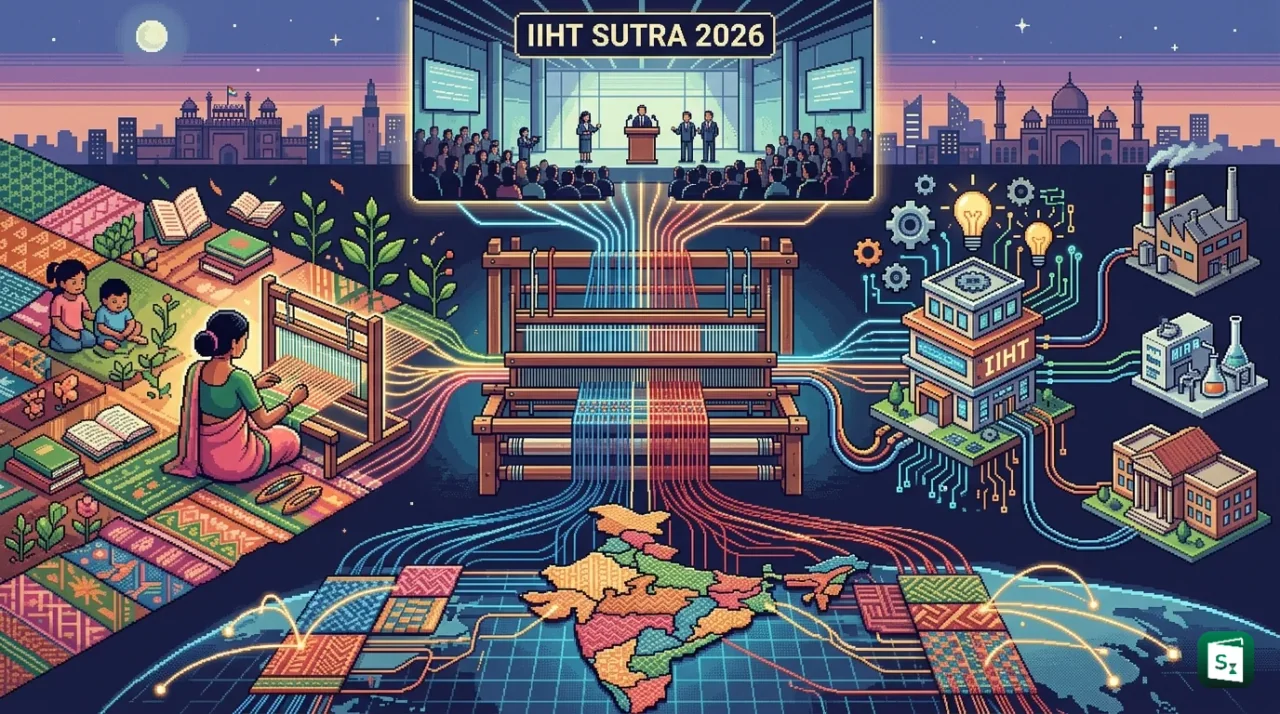
Union Textiles Minister Giriraj Singh on 12 August 2026 inaugurated IIHT SUTRA 2026, the first national conclave of the Indian Institutes of Handloom Technology (IIHTs), at the Dr. Ambedkar International Centre in New Delhi. The Ministry of Textiles used the event to sign three strategic partnerships and release publications aimed at reshaping handloom education. The conclave marks the first time the country’s handloom technology institutes have come together on a single national platform.
What Is IIHT SUTRA 2026?
IIHT SUTRA 2026 is the inaugural National Conclave of the Indian Institutes of Handloom Technology, conceived as a long-term institutional initiative of the Ministry of Textiles. It was organised by the Office of the Development Commissioner (Handlooms) under the Ministry of Textiles (MoT). The conclave carried the theme “IIHTs: Weaving the Future of the Indian Handloom Sector, Educate. Innovate”.
The event brought together policymakers, academics, industry representatives, research institutions, alumni and students to discuss how technical education can prepare the handloom sector for the future. It was inaugurated by Giriraj Singh, Union Minister of Textiles, in the presence of Neelam Shami Rao, Secretary, Textiles, and Dr. Beena M., Development Commissioner (Handlooms), along with other dignitaries from government, industry and academia.
The name SUTRA is positioned as a framework for the future of handloom education, with the stated aim of repositioning the IIHTs as centres of excellence for technical education, research, entrepreneurship and technological innovation. The conclave also hosted a panel discussion on industry-academia collaboration covering curriculum reform, emerging technologies, skills, entrepreneurship and applied research.
Indian Institutes of Handloom Technology: A Seven-Decade Legacy
The Indian Institutes of Handloom Technology (IIHTs) are premier government institutions that train technically skilled manpower for India’s handloom and textile sector. The first institute came into existence in 1956 at Varanasi, when the Government of India took over the Central Weaving Institute. It initially ran a diploma programme in handloom technology, later upgraded to a Diploma in Handloom and Textile Technology. Since 1976, the institutes have functioned under the aegis of the Office of the Development Commissioner (Handlooms), Ministry of Textiles. All programmes offered by the IIHTs are approved by the All India Council for Technical Education (AICTE).
There are six central IIHTs funded by the Government of India and five state IIHTs funded by respective state governments, taking the total to eleven institutes spread across the country. Over the past seven decades, these institutes have produced generations of skilled professionals who work across industry, entrepreneurship, exports, research and public institutions. In recent years, the network has expanded its B.Tech programmes, modernised laboratories and infrastructure, introduced student support measures and undertaken international training initiatives.
| Institute | Year Established | Sector | Location (State) |
|---|---|---|---|
| Varanasi | 1956 | Central | Varanasi (Uttar Pradesh) |
| Salem | 1960 | Central | Salem (Tamil Nadu) |
| Guwahati | 1982 | Central | Guwahati (Assam) |
| Jodhpur | 1993 | Central | Jodhpur (Rajasthan) |
| Bargarh | 2008 | Central | Bargarh (Odisha) |
| Fulia | 2015 | Central | Fulia, Nadia (West Bengal) |
| Kannur | 1987 | State | Kannur (Kerala) |
| Venkatagiri | 1992 | State | Venkatagiri (Andhra Pradesh) |
| Gadag | 1994 | State | Gadag (Karnataka) |
| Champa | 2006 | State | Champa (Chhattisgarh) |
| Hyderabad | later added | State | Hyderabad (Telangana) |
The newest central campus, IIHT Fulia, received its permanent campus at Nadia in West Bengal on 4 January 2025, built at a cost of ₹75.95 crore on 5.38 acres of land with smart classrooms, a digital library and modern handloom and textile laboratories.
The Three Strategic MoUs
A major highlight of the conclave was the signing of three strategic Memoranda of Understanding (MoUs) involving the IIHTs and partners from industry, research and management education. These pacts are meant to give a structured framework for closer engagement between the institutes and leading national institutions, raising the quality and relevance of technical education in the handloom sector.
| Partner | Domain | Focus of Collaboration |
|---|---|---|
| Grasim Industries Ltd | Industry (viscose staple fibre, Aditya Birla Group) | Curriculum enrichment, internships, industry exposure and skill development |
| Northern India Textile Research Association (NITRA) | Textile research | Collaborative research, testing, innovation, technical support and capacity building |
| IIM Sambalpur | Management education | Leadership development, entrepreneurship, innovation, faculty development and institutional capacity building |
Grasim Industries Ltd is part of the Aditya Birla Group and a leading producer of viscose staple fibre, a key raw material for the textile industry. Its partnership is expected to bring market-aligned design thinking and industry exposure to students. NITRA, the Northern India Textile Research Association, is a premier textile research and testing organisation that will support applied research and technical upgrading. IIM Sambalpur, established in 2015 in Odisha, will add management and entrepreneurship depth, encouraging students to become job creators rather than job seekers.
Celebrating Women Weavers and the IIHT Story
Alongside the conclave, the Office of the Development Commissioner (Handlooms) organised a special gathering titled ‘Srijan: Voices from the Loom’ to celebrate women in the handloom sector. The handloom workforce is overwhelmingly female, with more than 72 per cent of handloom workers being women as per the latest census, so the event underlined the sector’s role in women’s empowerment and rural livelihoods.
The Ministry also released a publication named “Handloom Change Makers”, which highlights the achievements of prominent IIHT alumni who have contributed to industry, exports, entrepreneurship, research and public service. The Minister launched a film titled “Weaving India’s Handloom Future”, presenting the history, contribution and future direction of the IIHT network. Together, these outputs were meant to project the institutes as a living pipeline of talent for a traditional yet evolving industry.
The Textiles Secretary, Neelam Shami Rao, stressed the need to continuously modernise handloom education by aligning curricula with emerging technologies, strengthening industry partnerships, promoting applied research and encouraging innovation-led learning. The Development Commissioner (Handlooms), Dr. Beena M., described IIHT SUTRA as a long-term platform for collaboration among government, industry, academia, research institutions and alumni.
Why Handloom Education Matters
The handloom sector is India’s largest cottage industry and a vital source of rural, women-led employment. According to the 4th All India Handloom Census (2019-20), there are 35.22 lakh handloom workers in the country, of whom 26.73 lakh are weavers and more than 72 per cent are women. The sector runs on roughly 2.8 million looms and is recognised as eco-friendly because it uses minimal power and adapts quickly to market demand.
The broader textile and apparel industry contributes about 2 per cent to India’s GDP, around 10 per cent to industrial production and roughly 8.2 per cent to total exports. It is the second largest employment generator in the country after agriculture, employing over 4.5 crore people, a large share of them women and rural workers. Handloom, therefore, sits at the intersection of heritage, livelihoods, exports and sustainable growth.
The nodal agency for the sector is the Office of the Development Commissioner (Handlooms), set up on 20 November 1975 under the Ministry of Commerce and now functioning under the Ministry of Textiles, with headquarters at Udyog Bhawan, New Delhi. It administers the National Handloom Development Programme (NHDP), the Raw Material Supply Scheme (RMSS) and the Handlooms (Reservation of Articles for Production) Act, 1985. Under it function 29 Weavers’ Service Centres, the six central IIHTs and an enforcement wing. The National Handloom Development Corporation (NHDC) Ltd, a public sector undertaking established in 1983, works under the Chairmanship of the Development Commissioner to ensure steady supply of yarn, dyes and chemicals and to support marketing.
The Minister noted that handloom was once a powerful tool of resistance during the freedom struggle and now needs to become a tool for economic empowerment. He urged students to design with the market in mind, develop handloom as a niche, Geographical Indication (GI)-tagged, high-value product, and adopt modern technology and stronger industry linkages to keep the sector competitive.
The Road Ahead
IIHT SUTRA 2026 is conceived not as a one-time event but as a continuing national platform for the handloom education ecosystem. The three MoUs will roll out over time through curriculum projects, internships, joint research, faculty development and entrepreneurship modules. The planned expansion of B.Tech programmes and modernisation of laboratories suggest a shift from traditional diploma training toward full-fledged technical and managerial education.
For the sector, the bet is clear. A future-ready handloom industry needs technocrats who can raise productivity, introduce contemporary design, upgrade technology and build brands that compete domestically and globally. If the industry-academia bridge works, the IIHT network could become the backbone of a more competitive, higher-income and sustainable handloom economy that protects both weaver livelihoods and cultural heritage.
Key Takeaways
- IIHT SUTRA 2026, the first national conclave of the Indian Institutes of Handloom Technology, was inaugurated by Union Textiles Minister Giriraj Singh on 12 August 2026 at the Dr. Ambedkar International Centre in New Delhi.
- The conclave was organised by the Office of the Development Commissioner (Handlooms) under the Ministry of Textiles under the theme “IIHTs: Weaving the Future of the Indian Handloom Sector, Educate. Innovate”.
- Three MoUs were signed with Grasim Industries Ltd, the Northern India Textile Research Association (NITRA) and IIM Sambalpur covering industry, research and management education partnerships.
- The first IIHT was established in 1956 at Varanasi, and there are now six central and five state IIHTs, all with programmes approved by AICTE.
- The Office of the Development Commissioner (Handlooms) was set up on 20 November 1975 and now functions under the Ministry of Textiles, headquartered at Udyog Bhawan, New Delhi.
- As per the 4th All India Handloom Census (2019-20), India has 35.22 lakh handloom workers, of whom more than 72 per cent are women.
- The Ministry released the publication “Handloom Change Makers” and launched the film “Weaving India’s Handloom Future” during the event.